Digital Gift Cards
Global Gift Cards
WINK

When a multinational decides to pay part of its Korean year-end performance bonus in gift cards rather than cash, the hard part isn't choosing the reward. It's the operation. You have to fund a batch in Korean won, send hundreds or thousands of codes on a deadline, and then prove to finance that every won is accounted for, all from a payout run that sits outside the payroll system. This guide covers how HR, total-rewards and finance leads can design that cycle before the December season begins.
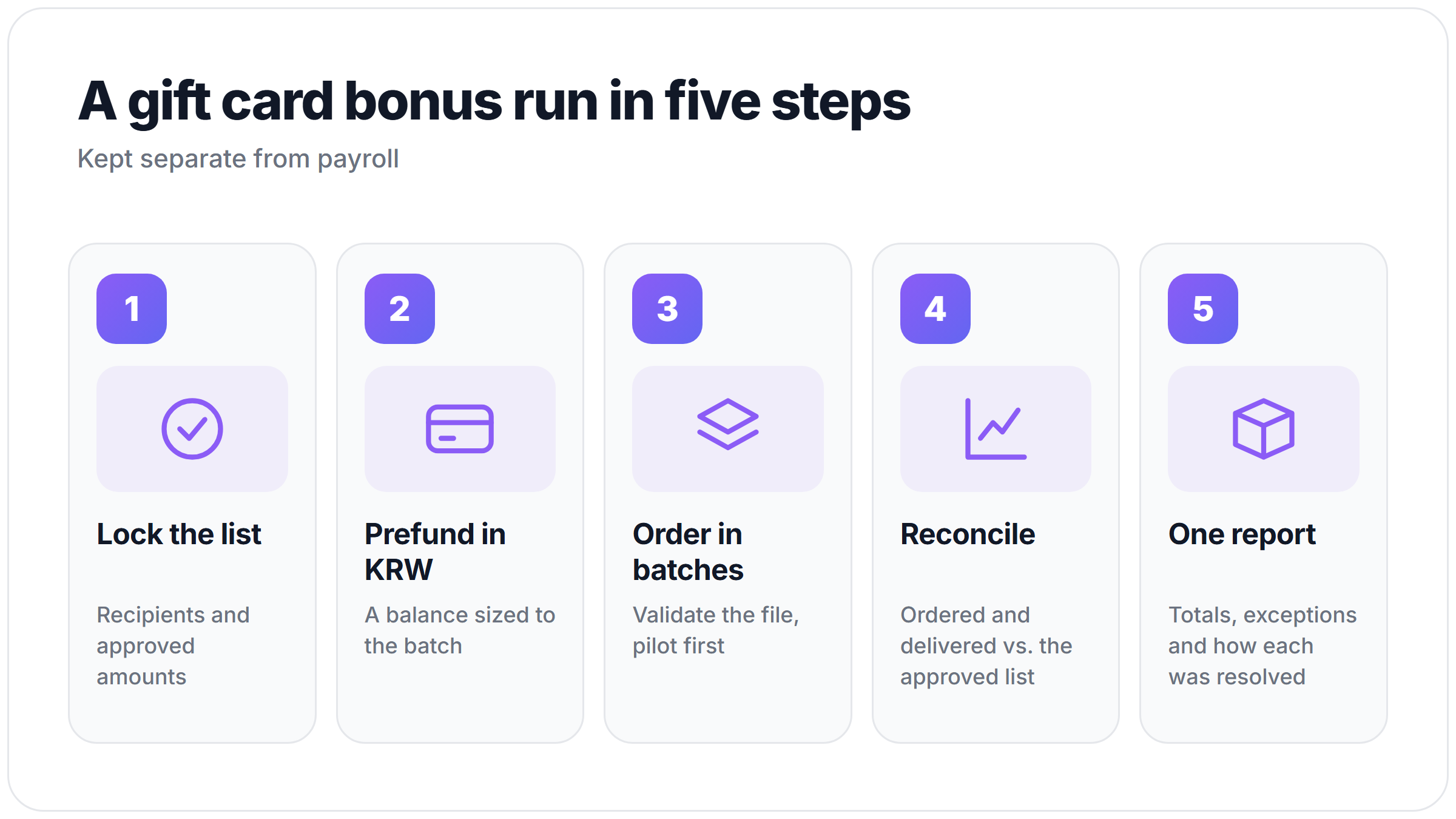
In short: Treat a gift card bonus run as its own controlled payout. Lock the recipient list and approved amounts first, prefund a KRW balance sized to the batch, order in validated batches and record each code against one recipient, and reconcile what was ordered and what reached employees against the approved list before you close the books. Keep the run separate from payroll. Confirm the tax and reporting treatment with local Korean counsel before launch, because gift card bonuses may still count as taxable compensation.
Non-cash rewards are an established budget line, not a side experiment. The Incentive Research Foundation's Industry Outlook for 2026, released in December 2025, found that gift cards are the most widely used reward in both North America and Europe, accounting for 30% and 34% of program allocations respectively, and that just over 70% of North American programs and 60% of European programs expect their non-cash reward budgets to increase (Incentive Research Foundation, Industry Outlook for 2026: Merchandise, Gift Cards, and Event Gifting, 2025). A Korean year-end bonus run is one regional application of a mechanism many global rewards teams already use.
The calendar also matters. A September 2026 press release from one digital rewards provider, analyzing its own platform's 2025 activity (so one company's figures, not a market-wide measure), reported that employee recognition reward value in December reached 7.4 times the January to October monthly average, and that reward value across all business use cases was up 94% in November and December compared with the January to October monthly average (BNN Bloomberg press release, New Data Reveals Two Distinct Waves of Holiday Gift Card Spending, 2026). If your Korean bonus run lands in December, it competes for issuance capacity, finance attention and approval cycles with everything else happening at year-end. That's a good reason to finish the design work in early November.
In practice, the companies that get value from these programs run them with the same discipline as any other payout.
A gift card bonus run for Korean teams sits between HR, which decides who gets what, and finance, which funds and records it. The design work is mostly about agreeing on handoffs before money moves.
In many organizations, the cash portion of a Korean performance bonus flows through the local payroll provider. The gift card portion often doesn't. Running it as a distinct payout gives you a clean audit trail, but it also means payroll systems won't catch errors for you. Decide early:
On that last point, the treatment of gift cards given to employees in Korea can differ from how cash bonuses or small gifts are handled, and it may depend on amount, purpose and how the reward is documented. Treat this as general guidance only, and confirm the withholding and reporting approach with your Korean tax advisor or local legal counsel before the first batch goes out.
For Korean recipients, a reward is useful only if it can be redeemed where they actually shop. Korean mobile gift cards and vouchers are commonly delivered by phone and redeemed at domestic convenience stores, cafés, department stores and online retailers. When you order Korean vouchers through an API or in bulk, the codes come to you, and you decide how employees receive them, for example in your HR portal or rewards app. A global card converted into KRW at checkout can feel like a downgrade. The reasoning behind localized catalogs is covered in The Future of Global Gift Cards Is Local. If you're building Korean products into an existing global rewards stack, How global reward platforms add Korean gift cards to their catalog walks through the catalog side.
Choose denominations that match your bonus tiers. If tiers fall in KRW amounts that no single product denomination covers, decide in advance whether to combine several cards or round to the nearest available value. Then document the rounding rule so finance can reconcile it.
Once the list is approved, issuance becomes an execution problem. A few practices keep it predictable.
Prefunding a KRW balance sized to the approved batch, plus a small buffer for corrections, separates the funding decision from the issuance decision. Finance approves one transfer. Operations then issues against that balance without going back for approval on each send. If your company holds funds in USD, the money is converted to KRW once, when it is credited to the balance, and each order then draws fixed KRW face values, so the won amount an employee receives does not move with the exchange rate. Agree internally which exchange rate you will use to compare the USD budget with the KRW balance, and confirm the conversion rate and timing with your provider before the first transfer.
Every code you order should be recorded in your own ledger against one employee and one approved line item, such as an employee ID plus the bonus cycle. This one design choice makes the rest of the process possible. Without it, reconciliation turns into matching names and contact details by hand.
For larger teams, an API-based flow can beat manual uploads. You can validate the file, order in chunks and match each response to your own record of the recipient. What Is a Bulk Gift Card API and Why Platforms Are Adopting One explains the mechanics, and the Korean Gift Card API for Rewards Platforms: 2026 Guide covers the Korea-specific details.
Run a pre-send check on the batch file:
Send a small pilot group first, often the HR and finance owners themselves, to confirm the message wording, sender name and redemption flow before the full run. Warn recipients that your company will never ask them to share codes or forward them to anyone else. That simple notice reduces the risk of reward-related phishing during a busy season.
Settlement is where gift card bonus programs either earn finance's trust or lose it.
A complete reconciliation compares the approved list against three separate states for each recipient:
Issued minus approved shows you errors. Delivered minus issued shows you contact-data problems that HR should fix before re-delivering the same code. Where redemption data is available, it is mainly an engagement signal, but it also tells you which employees may need a reminder before the card expires.
Decide in advance how you'll handle undelivered codes, lost messages and employees who leave between approval and ordering. Korean B2B vouchers are sold for promotional use and cannot be cancelled or refunded once ordered (see our guide to bulk Korean voucher orders), so re-check each employee's status just before you order, and when a message fails, re-deliver the original code rather than ordering a second one. Expiry terms may vary by product and issuer. Check the terms of the specific products you use, and confirm with local counsel how unused value should be treated in your accounts.
The end state should be one report per bonus cycle: approved total, funded total, issued total, delivered count, open exceptions and their resolution. That report is what your auditors and regional finance team will ask for. Building it into the process now saves a scramble in February. For a broader view of how cross-border reward delivery works end to end, see the related read How Employee Rewards Are Delivered Seamlessly Across Borders. This article focuses only on the Korean bonus cycle.
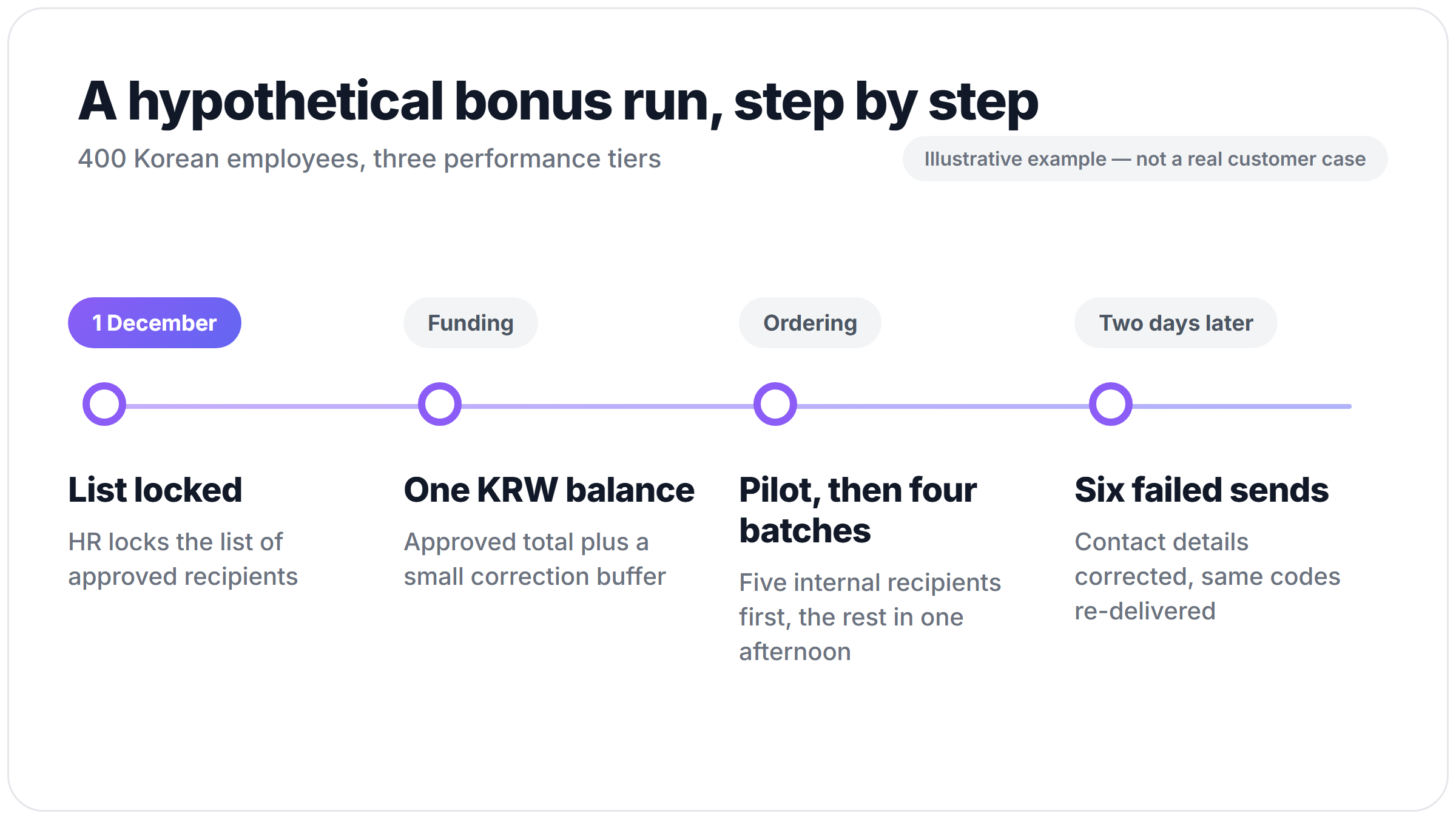
Imagine a hypothetical multinational with 400 Korean employees across three performance tiers. HR locks the list on 1 December. Finance prefunds one KRW balance for the approved total plus a small correction buffer. Operations pilots with five internal recipients and then orders the remaining codes in four batches over one afternoon, each code recorded against an employee ID and an "FY-bonus" cycle reference in the company's own ledger. Two days later, the distribution log shows six failed sends caused by outdated contact details. HR corrects them, and the same codes are re-delivered. The month-end report ties approved, funded and issued totals together with zero unexplained variance.
Wincube Global provides B2B gift card and rewards infrastructure for platforms and enterprises that need to reach recipients in Korea and beyond. It has processed over USD 220 million in gift card GMV in 2025, across a catalog of more than 30,000 gift cards spanning over 90 countries. For year-end bonus runs, that means access to KRW-native Korean gift cards through bulk fulfillment and real-time API integration, funded from a KRW balance that you can top up in any currency. Wincube delivers the voucher codes to you, and your team presents them to employees through its own channel.
Every company's bonus calendar, approval chain and tax treatment are different, so the right setup depends on how your HR and finance teams already work. If this is relevant to your team, Contact Us and we can walk through what it would look like.
Many companies do combine a cash bonus with a gift card component. Gift cards given as compensation may still be treated as taxable income, so reporting and withholding need to be planned in advance. Confirm the approach with a Korean tax advisor or local legal counsel before launching.
One approach is to prefund a KRW balance sized to the approved batch and then issue against it. Finance approves one funding transfer instead of many small ones. If the budget is held in another currency, it is converted to KRW once, when the balance is credited. Confirm the rate and timing with your provider before the first transfer.
Record every code you order against one employee and one approved line item. Then compare the approved list against what was issued and what was delivered, and add redeemed status where your provider can report it. Close each cycle with a single report covering totals, exceptions and how each exception was resolved.
Sources