Digital Gift Cards
Global Gift Cards
CROSS BORDER GIFTCARD
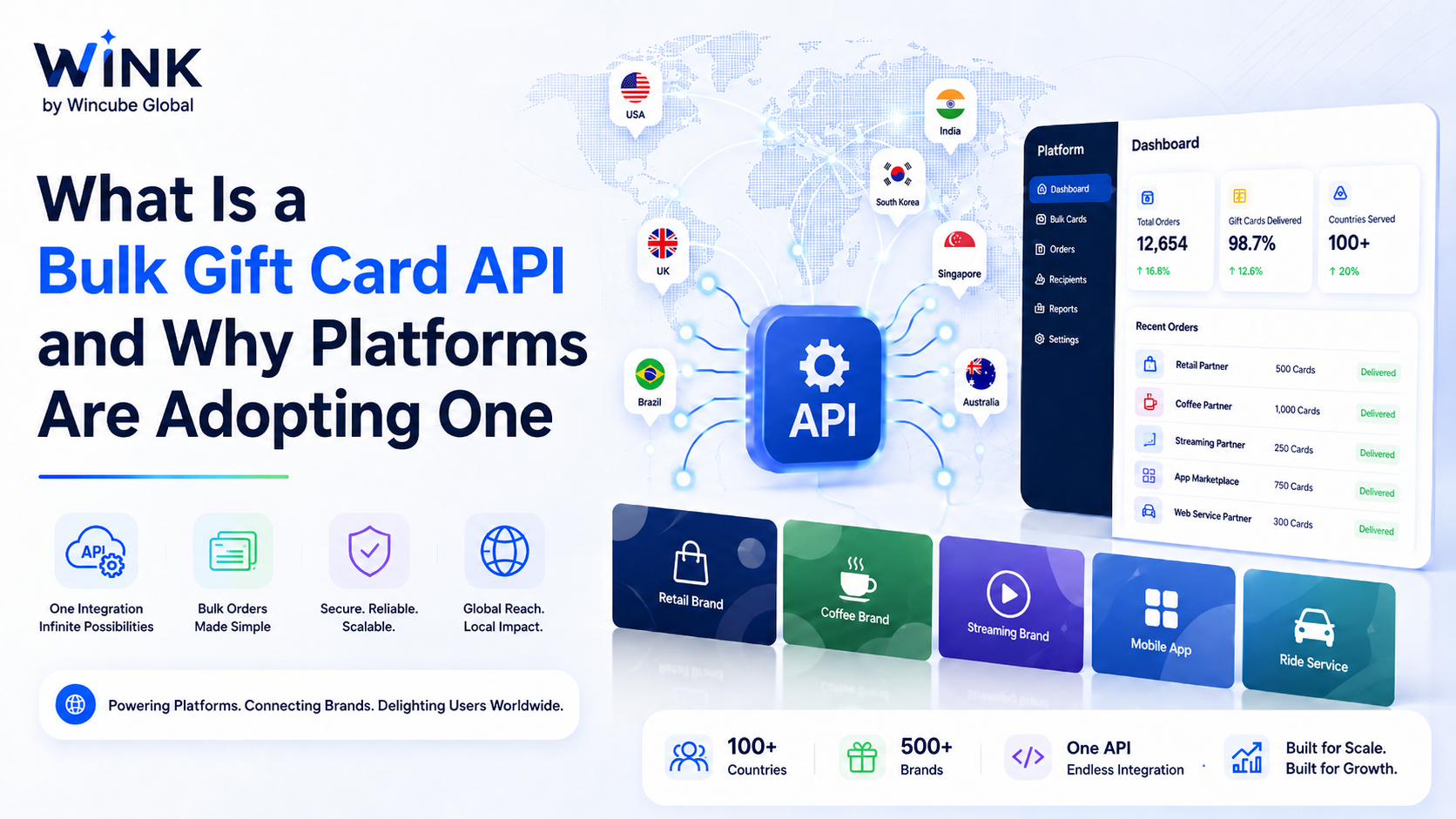

A bulk gift card API is a programmatic interface that lets a platform issue, manage, and deliver digital gift cards from many different brands through a single integration, instead of negotiating and connecting to each brand separately. One integration call can return a live catalog, reserve inventory, and issue a redeemable code in real time.
For a product team building a rewards feature, a loyalty program, or a payout system, this distinction matters more than it first appears. Building the same capability in-house means negotiating brand agreements one at a time, managing separate settlement processes for each, and maintaining that patchwork as brands rotate in and out of the catalog. None of that work disappears with an API — it moves to a provider whose core business is doing it at scale.
In short: a bulk gift card API centralizes catalog access, issuance, and settlement into one connection, so engineering teams ship reward features in weeks rather than negotiating brand-by-brand for months.
The demand for this kind of infrastructure is not slowing down. The global digital gift card market grew from an estimated $358.90 billion in 2025 to $398.85 billion in 2026, expanding at a compound annual growth rate of roughly 11.6% (The Business Research Company, Digital Gift Card Global Market Report, 2026). More platforms are entering this space every quarter, and most of them are choosing to integrate rather than build.
A rewards platform is a full front-end experience: a branded portal where end users log in, browse a catalog, and redeem points or cash for a reward. A bulk gift card API is the infrastructure layer underneath that experience — or underneath any other product surface a company wants to build.
That difference shapes who each option is for. A rewards platform suits a company that wants a ready-made redemption site with minimal engineering effort, accepting the platform's branding and catalog choices as given. An API suits a company that already has its own app, checkout flow, or payout system and wants gift card issuance to live inside that experience, under its own design.
This is also why the "build vs. buy" framing can be misleading. Most teams that evaluate a bulk gift card API are not deciding whether to build a rewards platform from scratch — they are deciding whether to maintain direct relationships with dozens of individual brands or consolidate that complexity behind one connection.
Three pressures show up consistently when platform teams evaluate this decision: catalog breadth, delivery speed, and maintenance overhead.
Catalog breadth is the most visible one. Users expect choice — a reward program limited to two or three brands feels dated compared to one offering hundreds. Sourcing and maintaining that many direct brand relationships individually is a full-time job that most product teams do not have the headcount to take on.
Delivery speed is the second pressure, and it is where the reward experience is won or lost. Employees don't want to wait days for a reward to hit their inbox. On the employee side, the case for speed is strong: 54% of employees say they would rather receive a gift card than a physical item (Capital One Shopping, Gift Card Statistics, 2026) — and that preference only holds up if delivery feels instant.
Maintenance overhead is the pressure that shows up later, after launch. Brand catalogs change: some titles rotate out, new ones get added, and regional availability shifts. A team that built direct integrations owns every one of those updates. A team on a shared API gets those updates as part of the platform, not as a new engineering ticket.
Currency and payment-rail differences compound this further for any program that spans more than one country. A team building direct brand relationships in five markets is effectively maintaining five separate sets of rules for currency conversion, tax treatment, and local payment preferences. A shared API absorbs that variation once, on behalf of every platform that uses it.
Underneath the product-facing decision is a fairly consistent technical flow. Here is the shape of it, at a conceptual level.
A platform authenticates once, using API credentials issued for its account. That single connection is what stands in for the dozens of individual brand relationships a direct-build approach would require.
Once authenticated, the platform queries the live catalog — the current list of available brands, denominations, and regional availability. Because gift cards are delivered from brands worldwide, catalog lookups typically return options spanning many countries and currencies rather than a single market's inventory.
When a user redeems a reward, the platform calls the issuance endpoint, which reserves the specific denomination and returns a redeemable code or link. This is the step end users actually experience, and it is why response time matters so much to the platforms building on top of it.
After issuance, the transaction is recorded and reconciled against the platform's account, with reporting data available for finance and operations teams. This is also where cross-border programs benefit most: value is delivered seamlessly across borders, so a single program can reward a distributed, multi-country workforce without the platform building separate settlement logic per country.
A few questions tend to separate a good fit from a poor one, and they're worth asking directly rather than assuming the answer.
Does the catalog match where your users actually are? A catalog that looks large in aggregate can still be thin in the specific countries your program serves. Ask for a breakdown by region, not just a total brand count.
How is redemption actually delivered? Instant digital delivery is table stakes for most reward use cases in 2026; anything slower should be a clear exception, not the default.
What does integration actually require from your engineering team? The honest answer is usually "less than building direct brand relationships, more than zero" — a real integration effort, just a smaller and more predictable one.
Is settlement and reporting built for how your finance team already works? A technically solid API that produces reconciliation data in an unusable format just moves the maintenance burden from engineering to finance.
None of these questions have a universally right answer — they depend on the program a team is building. But asking them before signing on to any provider, ours included, tends to save the most time later.
WINK is written by the team behind Wincube Global, which has processed over USD 220 million in gift card GMV in 2025 across a catalog of more than 30,000 gift cards spanning over 90 countries. That scale exists to answer exactly the questions above: broad regional catalog coverage, instant digital issuance, and settlement data built for finance teams to actually use.
If your team is somewhere in the process of evaluating a bulk gift card API — whether you're at the "is this even the right category" stage or already comparing specific providers — we're glad to talk through where Wincube Global might fit. No pressure, no sales script: reach out, and we'll walk through your catalog and delivery requirements together.
Sources
Related reading: Korean Gift Card API for Rewards Platforms: 2026 Guide · How Employee Rewards Are Delivered Seamlessly Across Borders
Learn more about Wincube Global