Digital Gift Cards
CROSS BORDER GIFTCARD
API
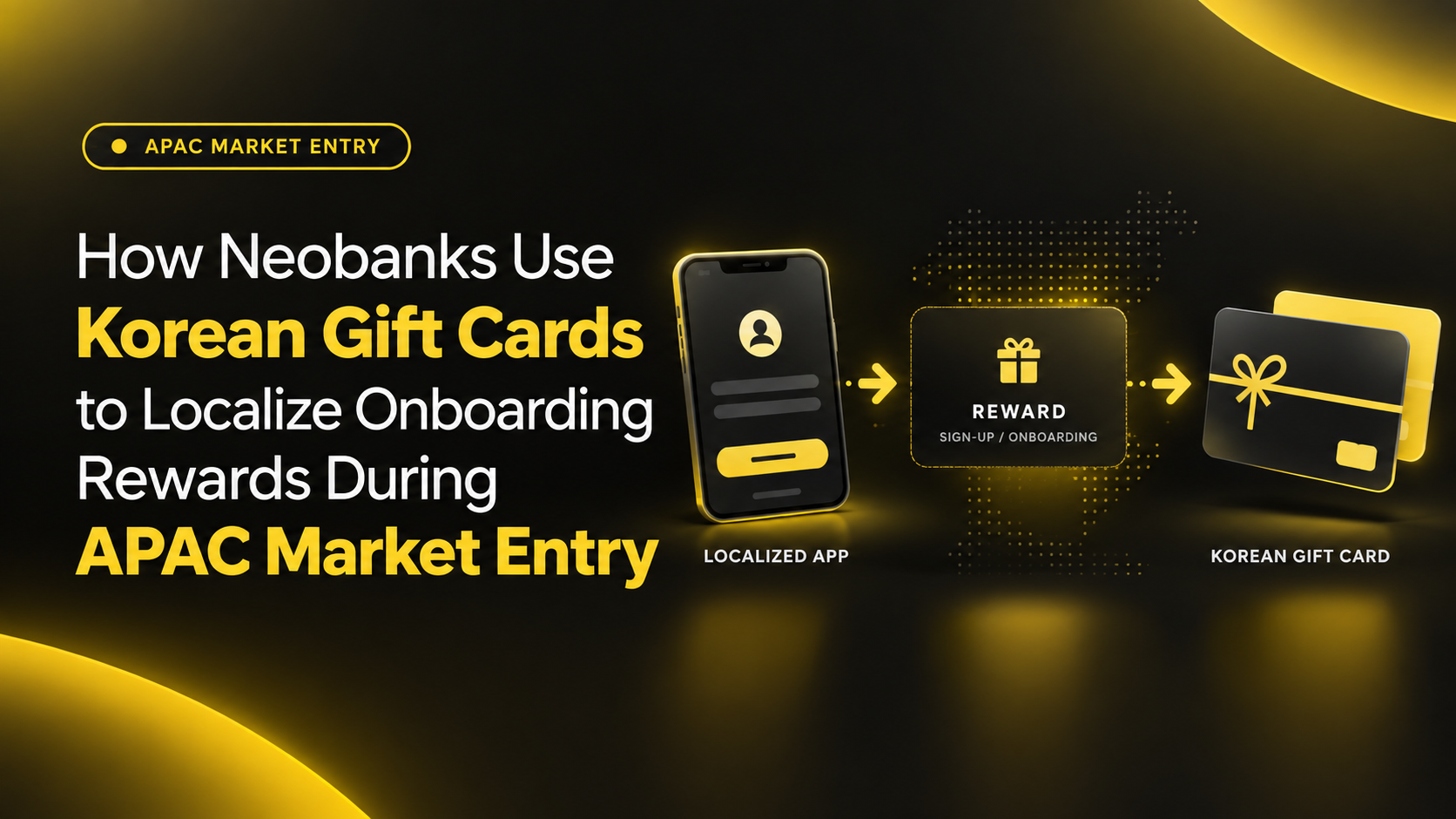

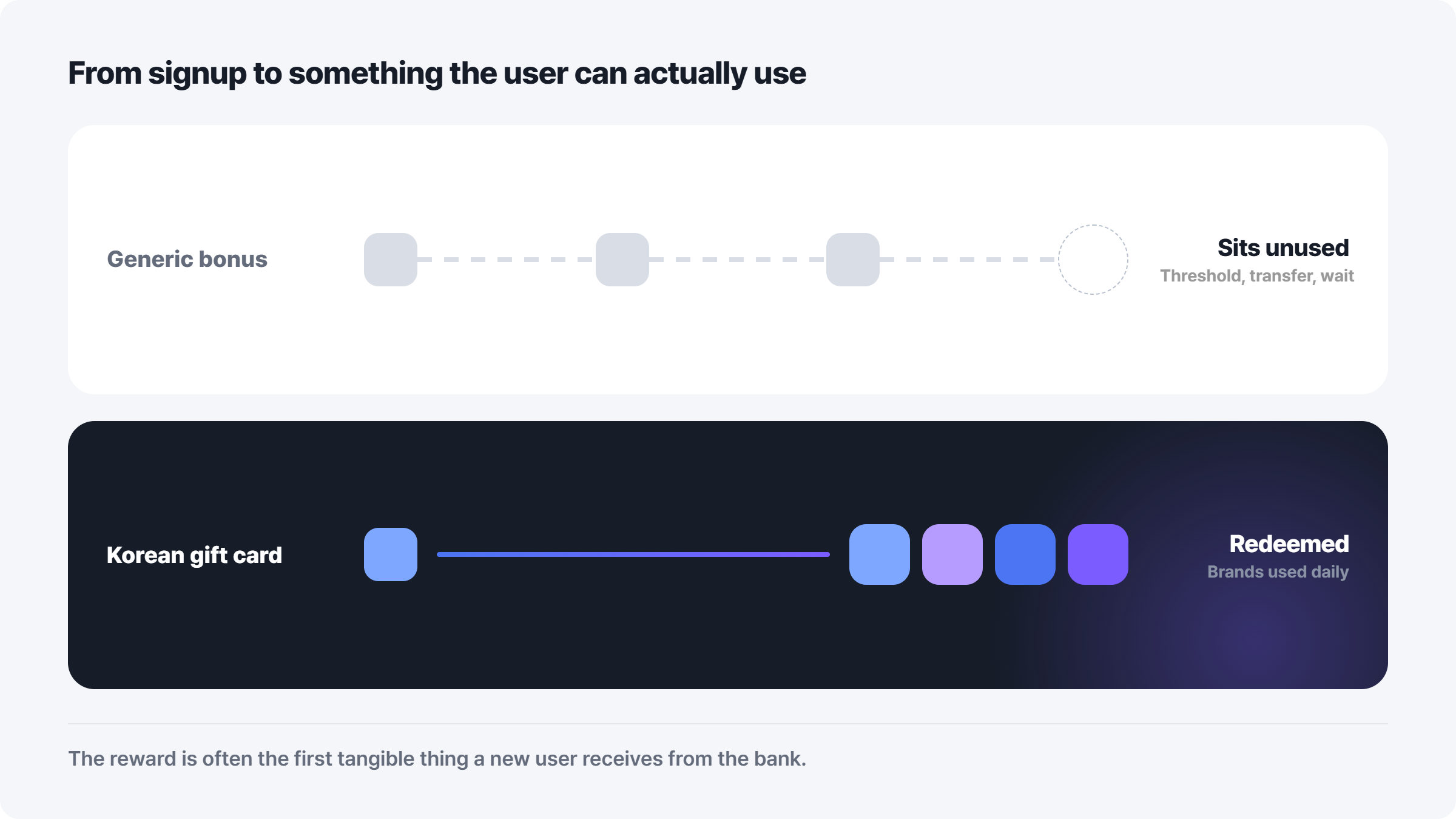
A neobank spends months building a compliant, localized app for a new APAC market, then hands every new signup the same generic reward it uses everywhere else: a flat cash bonus, a points balance, or a voucher for a brand the local user has never heard of. The onboarding flow feels native. The reward does not. So why do growth teams treat the reward itself as an afterthought when it is often the first tangible thing a new user receives from the bank?
In short: Neobanks entering Korea and neighboring APAC markets are increasingly swapping generic sign-up bonuses for Korean gift cards, redeemable at brands users already shop at daily, as the onboarding reward itself. This works because a reward denominated in a recognizable local brand signals "we understand this market" in a way a currency-agnostic points balance cannot, and it converts an abstract welcome bonus into something a new user can redeem immediately without friction. The approach borrows directly from how global rewards platforms already source and deliver Korean gift cards at scale.
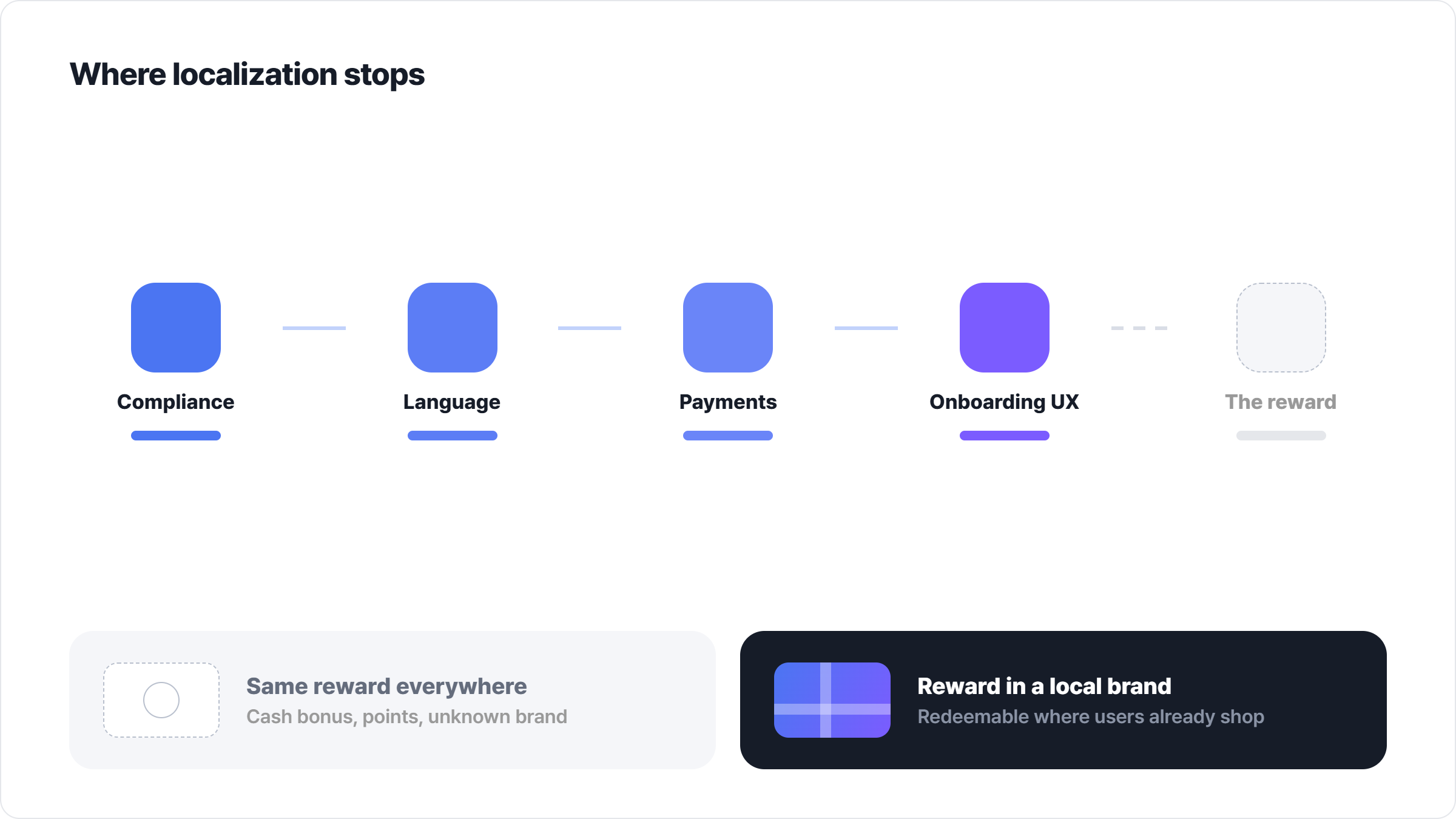
Localization efforts for market entry tend to concentrate on language, currency formatting, and KYC flow, since those are the pieces compliance and product teams are already staffed to handle. The reward mechanic in the onboarding sequence gets built later, often reused from whichever market launched first. That sequencing is backwards for one simple reason: the reward is the first proof point a new user receives that the bank understands where they live, and first impressions in financial services are unusually expensive to undo. Industry survey data backs this up directly. CSA Research found that 76% of online consumers prefer purchasing products when information is presented in their own language, and 40% say they will never buy from a website in another language at all (Slator, Third Global Survey by CSA Research Finds Language Preference of Consumers in 29 Countries, 2026). A reward denominated in an unfamiliar international voucher brand reintroduces exactly the kind of foreignness that careful app localization was supposed to eliminate.
The stakes for getting this right are also rising with the size of the opportunity. The global neobanking sector is projected to grow from USD 8.18 trillion in 2026 to USD 13.67 trillion by 2031, a compound annual growth rate of 10.82% (Yahoo Finance, Neobanking Market Report 2026: Forecasts Growth from $8.18 Trillion to $13.67 Trillion by 2031, 2026). APAC is one of the fastest-expanding regions inside that growth, which means more digital banks are competing for the same first-time users in the same markets, and the margin for a generic, forgettable onboarding experience keeps shrinking.
Raman Korneu, CEO and co-founder of neobank myTU, has argued that the industry underestimates how much deliberate, on-the-ground localization new entrants actually need, noting that banks "can't just crash land into a new market and start growing" because trust in a new financial brand has to be earned locally, not assumed (Retail Banker International, Neobanks must learn to localise while going global, 2026). A reward users recognize on day one is one of the fastest ways to start earning that trust before the relationship has had time to prove itself through actual banking usage.
Korea presents a particular version of this problem for neobanks because its retail and digital ecosystem is dense, brand-loyal, and largely self-contained. Consumers there already route a meaningful share of everyday spending through prepaid balances and stored-value instruments embedded in the apps they use constantly, so a gift card reward is not a novelty mechanic, it is a format users are already comfortable redeeming. The category is also sizable and growing: South Korea's gift card market is expected to reach roughly USD 8.03 billion in 2026 and grow to approximately USD 10.60 billion by 2030, a 7.2% compound annual growth rate over that period (Yahoo Finance, South Korea Gift Card Business Report 2026: $10.6 Billion Market Led by Kakao Pay and Naver Pay as Ecosystem-Embedded Digital Cards Drive Adoption, 2026).
For a neobank's growth team, that translates into a practical advantage over a generic cash bonus or points scheme. A Korean gift card reward:
None of this requires a neobank to build local merchant relationships from scratch. Rewards platforms already source Korean gift card inventory and make it available through integration paths built for exactly this kind of onboarding use case, which is the same infrastructure question covered in Korean Gift Card API for Rewards Platforms: 2026 Guide.
The most effective implementations treat the gift card reward as a sequence rather than a single welcome bonus. A small card denomination on account verification, a larger one on first funded deposit, and an optional third tier tied to a specific product action (linking a card, completing a transfer) gives the bank multiple localized touchpoints instead of one, and each touchpoint reinforces the same signal: this product was built with this market in mind.
Reward value in Korea needs to reflect local price expectations and everyday spend categories rather than a currency-converted version of whatever denomination the bank uses in its home market. A mix across a few recognizable categories, rather than a single brand, also reduces the risk that the reward feels irrelevant to any individual user's habits.
Gift card delivery needs to sit inside the same compliance and timing constraints as the rest of the onboarding flow, particularly around KYC completion, so the reward doesn't create a gap between "user is verified" and "user receives what was promised." Building that into the onboarding sequence from the start, rather than bolting it on after the core flow is finished, avoids the rework that comes from treating the reward as a marketing add-on. This is the same operational discipline behind how How global reward platforms add Korean gift cards to their catalog describes catalog integration more broadly.
WINK is published by Wincube Global, which has processed over USD 220 million in gift card GMV in 2025 across a catalog of more than 30,000 gift cards spanning over 90 countries.
For neobanks and digital banks planning APAC market entry, the onboarding reward is a small piece of a much larger localization effort, but it's one of the few pieces a new user experiences directly on day one. Getting the brand mix, denomination logic, and delivery timing right for a specific market like Korea is a narrower problem than it looks, and it doesn't require building local merchant relationships from the ground up before launch. If this is relevant to your team, Contact Us and we can walk through what it would look like.
A gift card reward denominated in brands a user already recognizes signals local relevance in a way a generic cash bonus or points balance does not. It also sidesteps some of the regulatory complexity that direct cash incentives can trigger in certain markets, while still giving the bank a flexible, milestone-based incentive structure.
No. Rewards platforms and neobanks typically source Korean gift card inventory through existing catalog and API integrations rather than negotiating individual local merchant relationships, which significantly shortens the time needed to include localized rewards in a market entry launch.
It's one component of a larger localization effort that also includes language, currency display, KYC flow, and customer support, but it's one of the few components a new user experiences directly and immediately. Treating it as part of the core onboarding design, rather than a reused global default, helps reinforce the trust signals the rest of the localization work is trying to build.
Sources