Digital Gift Cards
Global Gift Cards
CROSS BORDER GIFTCARD
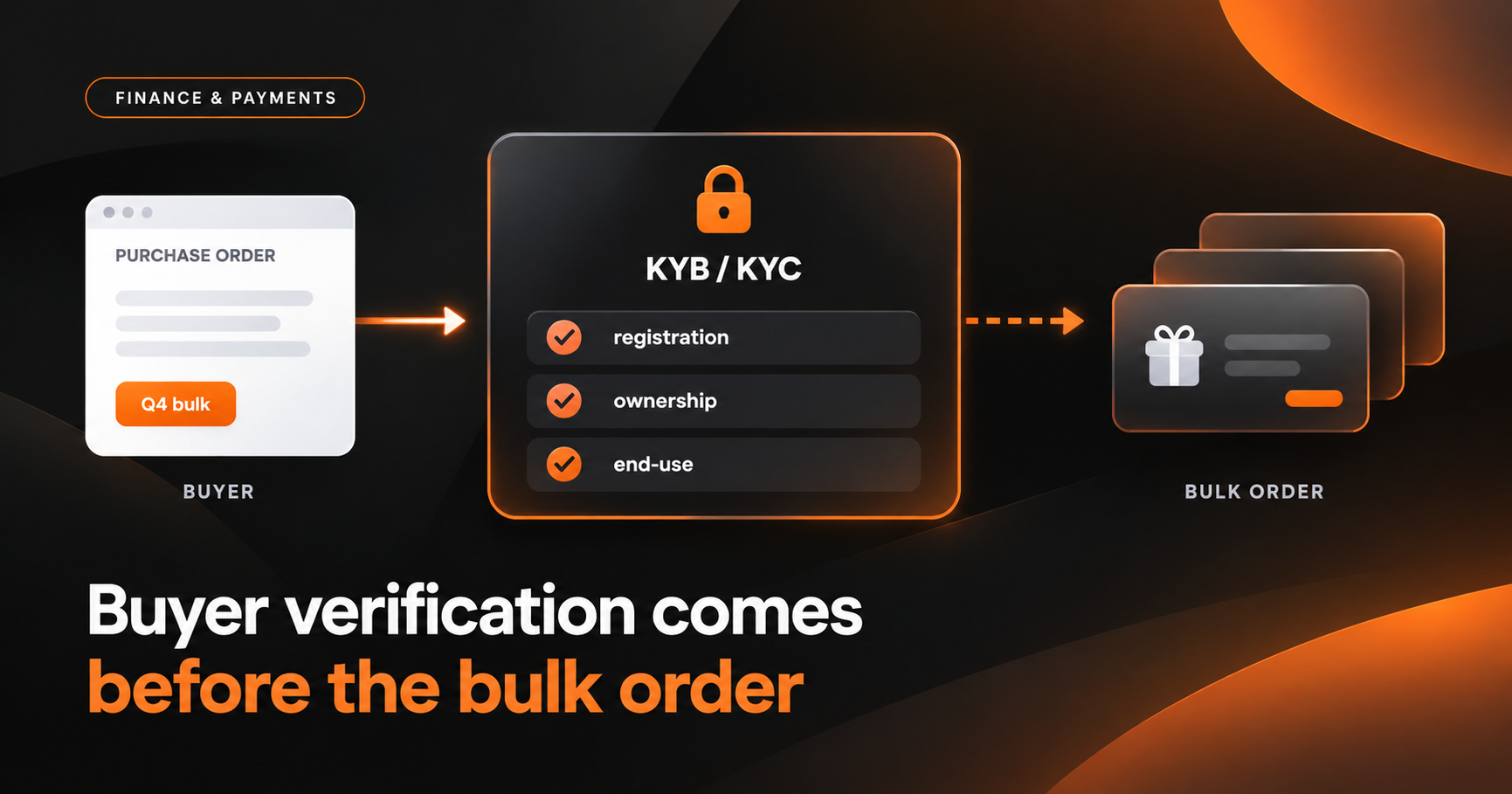

A procurement lead in Singapore or São Paulo finalizes a Q4 budget for thousands of Korean gift cards, expecting a straightforward purchase order. Then the supplier's compliance team asks for beneficial ownership documentation, a business registration certificate, and proof of end-use. The order stalls, the holiday deadline creeps closer, and nobody on the buying side understands why a gift card purchase suddenly looks like opening a bank account. This is the friction point almost no procurement guide addresses directly: buyer verification, not sourcing or pricing, is what most often delays or derails bulk Korean gift card orders in Q4.
In short: Corporate buyers ordering Korean gift cards in bulk for the holiday season should expect a Know Your Business (KYB) and Know Your Customer (KYC) review from any compliant supplier, covering company registration, beneficial ownership, and intended use of the cards. Starting this verification 3-4 weeks before the order deadline, and preparing documentation upfront, is the single most effective way to avoid a holiday-season bottleneck. Suppliers that skip this step are not doing buyers a favor; they are usually signaling weaker downstream compliance.
Holiday bulk orders concentrate exactly the conditions that make buyer verification both more necessary and more likely to cause delays: large transaction values, compressed timelines, and cross-border payment flows moving through regulated financial rails. Gift cards sit inside a broader market that keeps expanding fast. The global gift cards market is projected to grow from roughly USD 1,729 billion in 2026 to USD 3,037 billion by 2030, a compound annual growth rate near 15.1% (The Business Research Company, Gift Cards Global Market Report, 2026). That scale is precisely why regulators and payment processors have pushed harder on business verification standards across the sector, not just at the point of consumer sale but at the B2B procurement layer where a single purchase order can move six or seven figures.
The compliance infrastructure behind this is also growing fast, and growing for a reason. Global spend on Know Your Customer and Know Your Business systems by non-financial businesses is projected to rise 140% over five years, reaching USD 22 billion by 2029 (CFOtech, Global spend on KYC systems to hit USD $22bn by 2029, 2026). Procurement teams that have not yet budgeted time for this in their holiday timeline are underestimating a cost that is rising industry-wide, not shrinking.
Industry observers describe this shift as a structural change in how business relationships get established, not a temporary regulatory fad. Dr. Camillo Werdich, CEO and founder of KYB compliance platform Sinpex, said the industry is "seeing an enormous transformation ahead in how financial institutions handle increasing client expectations and regulatory demands around AML, KYC, and KYB" (FinTech Global, Sinpex secures €10m to expand AI KYB compliance platform, 2026). That transformation reaches beyond banks: any supplier moving cross-border gift card value at scale now sits inside the same expectations.
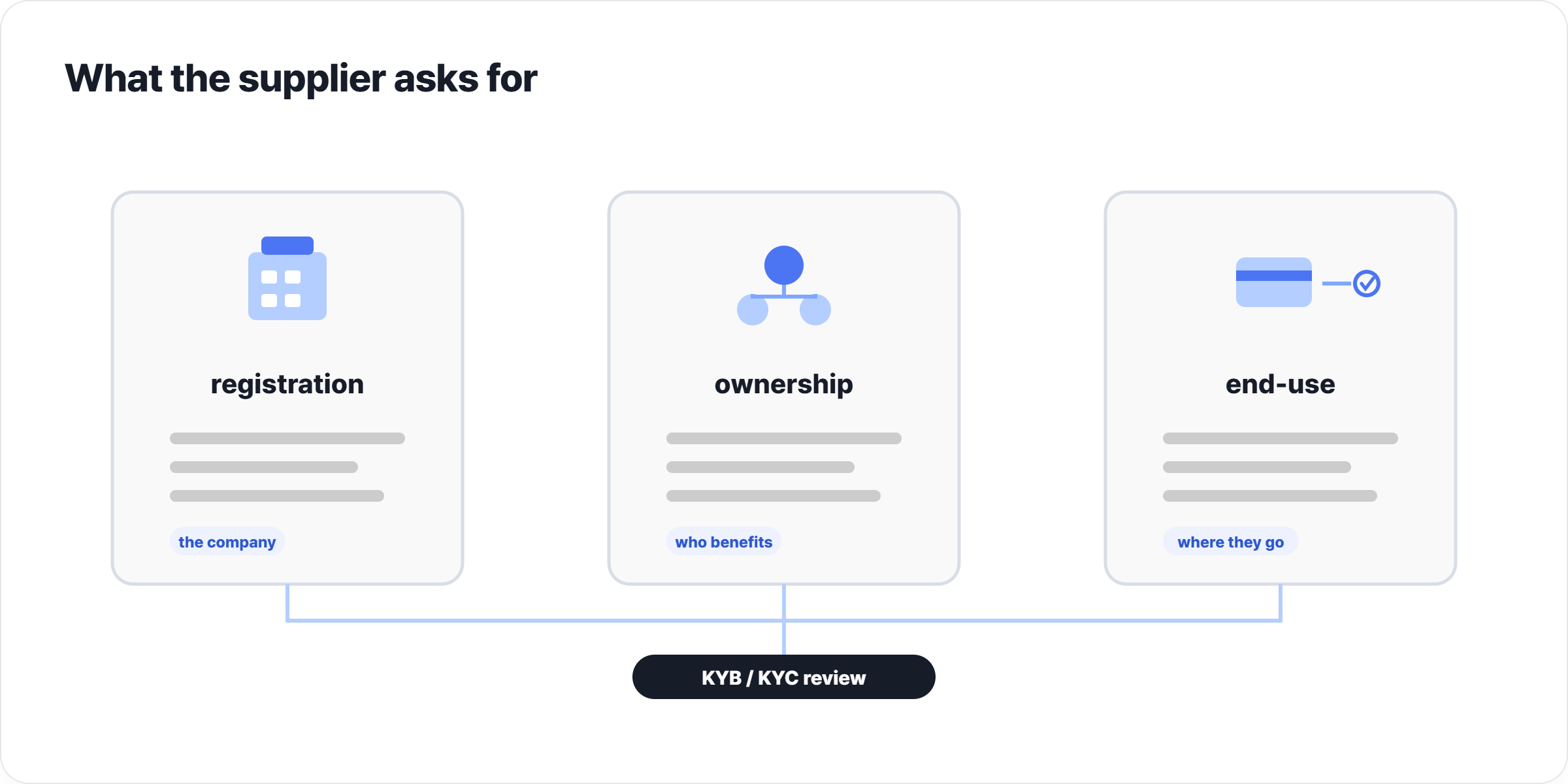
Buyer verification for bulk Korean gift card orders typically covers a narrower, more predictable set of checks than procurement teams often fear. Understanding the shape of the request in advance removes most of the surprise.
None of this is unique to Korean gift cards specifically. It reflects the same KYB discipline that any regulated payment intermediary applies to a large B2B buyer, and Korea's own financial and gift-card distribution regulations add a layer of local diligence on top of what a global buyer's home-market rules already require.
Korean gift card supply chains typically route through licensed local distributors and regulated payment processors, which means a foreign buyer's documentation sometimes needs a second pass, cross-border wire confirmations, an English-language registration extract if the local one is not in English, or clarification on how funds move once cards are issued. This is not unique friction created to slow down foreign buyers. It is the standard diligence a licensed Korean distributor applies to any large B2B order, domestic or cross-border. Buyers who have already gone through the process of adding Korean gift cards to a rewards catalog tend to move through this stage faster the second time, because the underlying entity documentation rarely changes between orders.
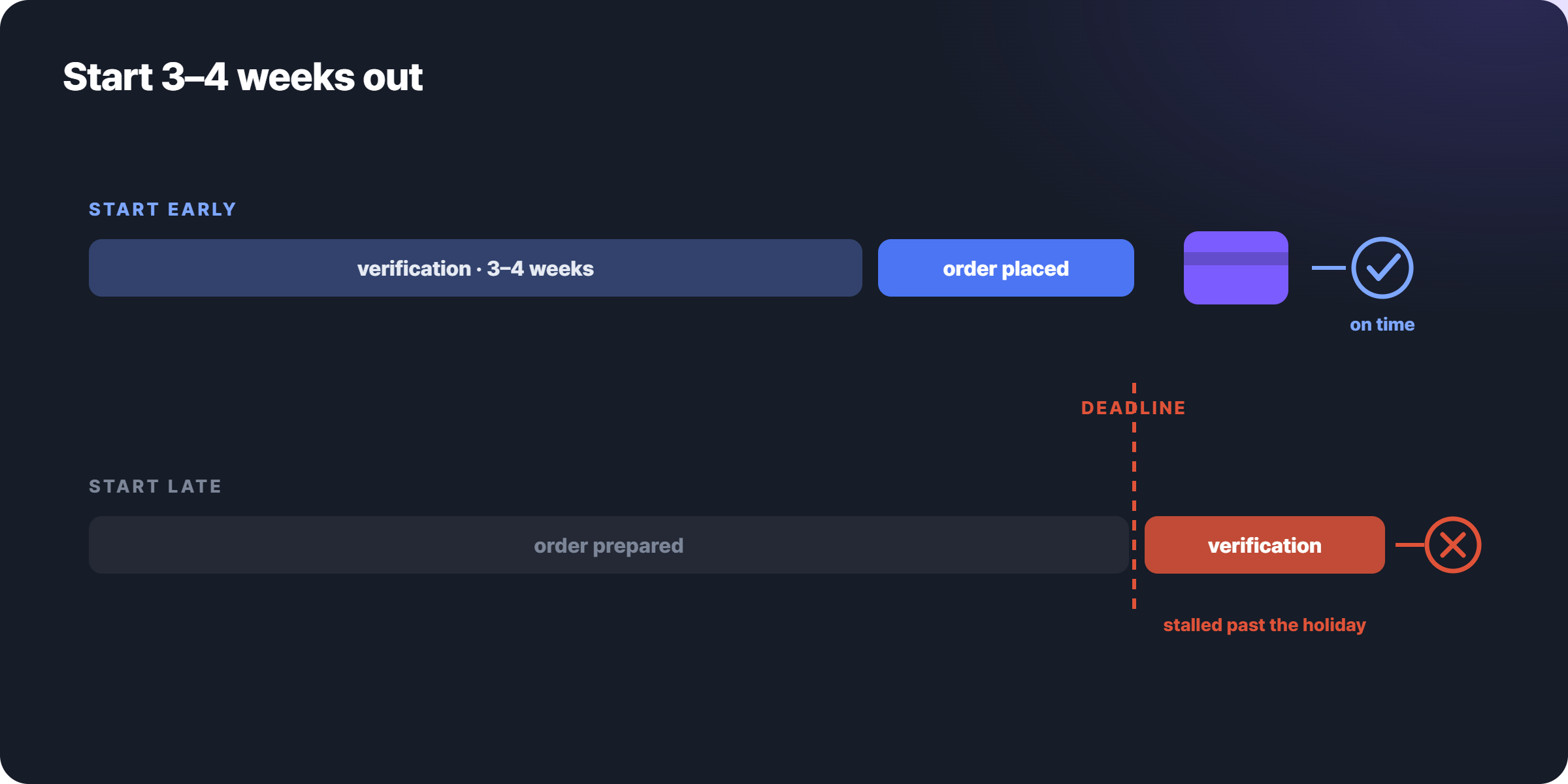
The practical fix is sequencing, not shortcuts. Procurement teams that treat verification as a parallel track rather than a final gate rarely feel the bottleneck at all.
Most suppliers request a certificate of incorporation or business registration extract, beneficial ownership information for individuals with significant control, and a brief description of intended use, such as employee rewards or customer incentive programs. Large first-time orders sometimes also require source-of-funds confirmation tied to the payment method.
Verification can often complete within a few business days when documentation is submitted upfront and the buying entity's structure is straightforward. It can stretch to several weeks if beneficial ownership is layered across multiple holding entities or if documents need translation, which is why starting the process 3-4 weeks ahead of a holiday deadline is the safer default.
Not usually. If the buying entity, its ownership, and its payment method remain unchanged, most compliant suppliers will not require a full re-verification for each new order within a set review period. Material changes, a new entity, new ownership, or a different payment source, generally do trigger a fresh check.
WINK is built by Wincube Global, which has processed over USD 220 million in gift card GMV in 2025 across a catalog of more than 30,000 gift cards spanning over 90 countries. That scale means buyer verification isn't a one-off hurdle bolted onto a single order; it's infrastructure built to move repeat, large-volume corporate orders through compliance once and reuse that clearance across future purchases. For teams planning to add Korean gift cards to a rewards catalog, understanding what verification will be asked for, and when, is what keeps a holiday-season order on schedule rather than stuck in a compliance queue in late November.
If this is relevant to your team, Contact Us and we can walk through what it would look like.
Sources