Digital Gift Cards
CROSS BORDER GIFTCARD
API
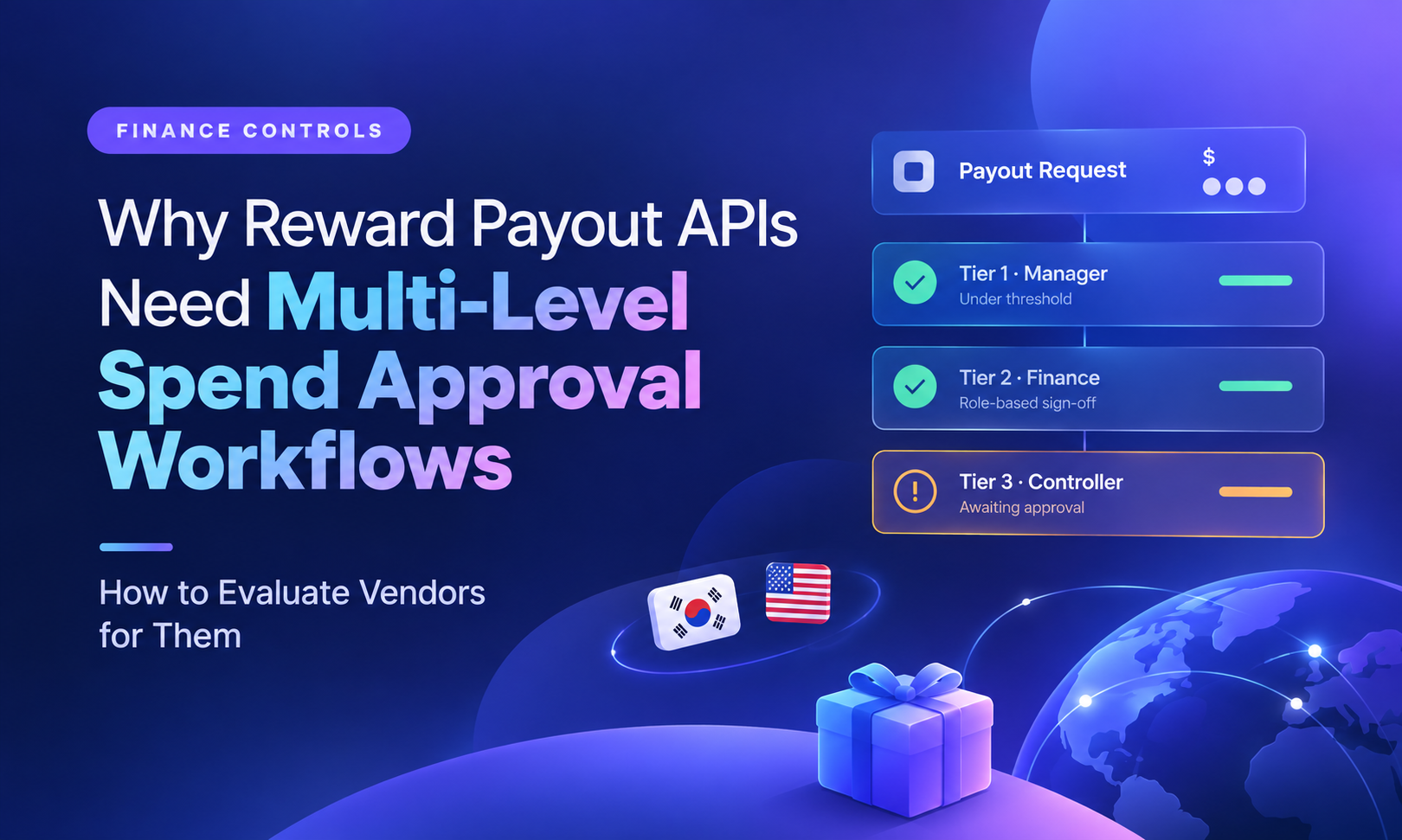

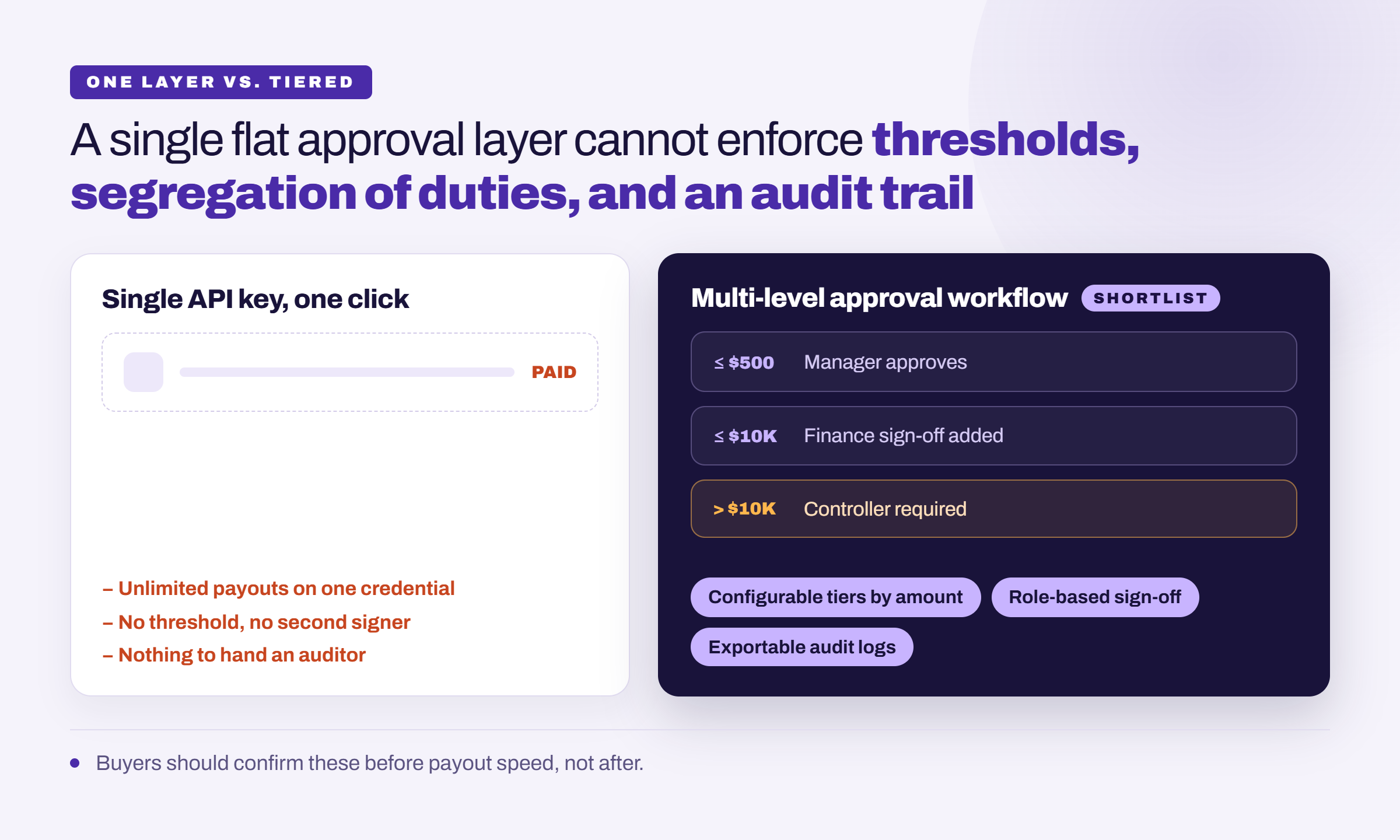
A single API key that can push unlimited payouts with one click is a liability, not a feature. Finance and procurement teams evaluating a reward payout API rarely ask about payout speed anymore; they ask who can approve what, at what dollar amount, and what happens when that person is on leave. That question, more than uptime or catalog size, decides whether a vendor makes the shortlist.
In short: Reward payout APIs need multi-level spend approval workflows because a single flat approval layer cannot enforce the thresholds, segregation of duties, and audit trail that finance and procurement teams require before releasing funds. When evaluating vendors, buyers should confirm the platform supports configurable approval tiers by amount, role-based sign-off, and exportable audit logs, not just fast disbursement.
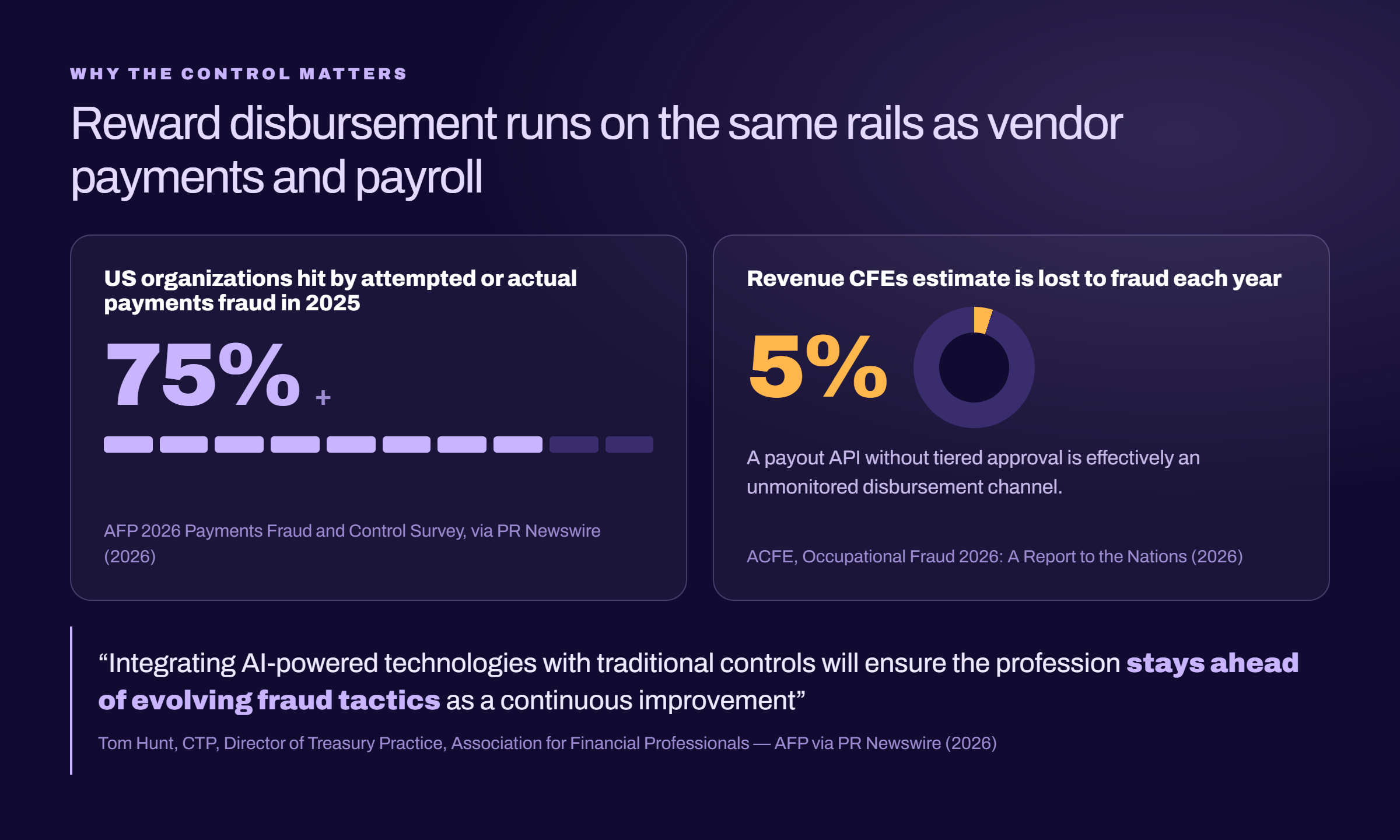
Payment fraud is not a hypothetical line item for teams that move money through APIs. More than three-quarters of US organizations experienced attempted or actual payments fraud in 2025, according to the Association for Financial Professionals' 2026 Payments Fraud and Control Survey (PR Newswire, Over 75% of US Firms Experienced Payments Fraud in 2025, 2026). Reward disbursement runs through the same rails as vendor payments and payroll, so the control gap the survey describes applies directly to gift card and incentive payouts, not just traditional AP.
The exposure compounds when approval controls are thin. CFEs estimate that 5% of revenue is lost to fraud each year, according to the ACFE's own release of Occupational Fraud 2026: A Report to the Nations (ACFE, Occupational Fraud 2026: A Report to the Nations, 2026). A payout API without tiered approval is effectively an unmonitored disbursement channel, and disbursement channels are exactly where that kind of loss tends to surface first.
Tom Hunt, CTP, Director of Treasury Practice at the Association for Financial Professionals, stated it directly: "AFP's survey demonstrates how the treasury function has solidified its role as a primary line of defense against fraud. Integrating AI-powered technologies with traditional controls will ensure the profession stays ahead of evolving fraud tactics as a continuous improvement" (AFP via PR Newswire, Over 75% of US Firms Experienced Payments Fraud in 2025, 2026). That framing applies to reward payouts as much as it does to supplier payments: the API is the rail, but the approval workflow sitting on top of it is the control.
A workflow worth the name does more than route a request to a second person. It typically enforces:
Without these five elements, "approval" is a checkbox rather than a control. A vendor that only offers a single admin toggle for who can trigger payouts is asking the buyer's finance team to trust the API itself instead of trusting a governance layer built around it.
Single-approver setups work fine for a pilot program moving a few thousand dollars a month. They break down the moment a reward program scales across regions, currencies, or business units, because the volume of requests outpaces what one person can meaningfully review. At that point, teams either rubber-stamp requests to keep the queue moving, which defeats the purpose of approval, or they bottleneck the program waiting on a single signer, which frustrates the business units the program is supposed to serve.
Multi-level workflows solve both failure modes at once. Low-risk, low-amount payouts clear automatically within pre-set limits, while higher-amount or higher-risk requests route to the right level of authority without waiting on someone who has no context on that specific request. This is also where audit and compliance functions benefit: a documented, tiered approval chain is what a SOC 2 or internal audit reviewer expects to see, and its absence is often the first finding in a vendor risk review.
For a finance or procurement buyer running vendor due diligence, a few concrete questions separate a real approval workflow from a marketing claim:
Our own How to Evaluate a Digital Rewards Platform for a Global Workforce covers the broader vendor scorecard; spend approval governance is one section of that scorecard, but it deserves its own line item rather than being folded into a general "security" checkbox, because approval logic is a business-process question as much as a technical one.
Spend approval governance deserves to be treated as a first-order requirement for a reward payout stack, not an afterthought bolted on after a vendor is already selected. WINK is built by Wincube Global, which has processed over USD 220 million in gift card GMV in 2025 across a catalog of more than 30,000 gift cards spanning over 90 countries, running disbursement infrastructure that platform, fintech, and institutional partners already rely on to move reward and incentive spend across borders without losing sight of who approved what. If this is relevant to your team, Contact Us and we can walk through what it would look like.
It is a configurable set of rules that route a disbursement request to one or more approvers based on the amount, recipient, or program, rather than allowing any authorized user to trigger a payout unilaterally. Higher-value or higher-risk requests typically require sign-off from more than one role, such as a program manager plus a finance controller.
A single approver becomes a bottleneck as request volume grows, which pressures teams to either slow the program down or approve requests without real scrutiny. Tiered, role-based routing keeps low-risk payouts moving automatically while still requiring genuine review on the requests that carry real financial exposure.
Ask whether approval thresholds are configurable by amount and role, whether the platform separates who can initiate a payout from who can approve it, whether delegation is supported and logged, and whether the audit trail can be exported independently for a compliance review.
Sources