
Digital Gift Cards
Global Gift Cards
API
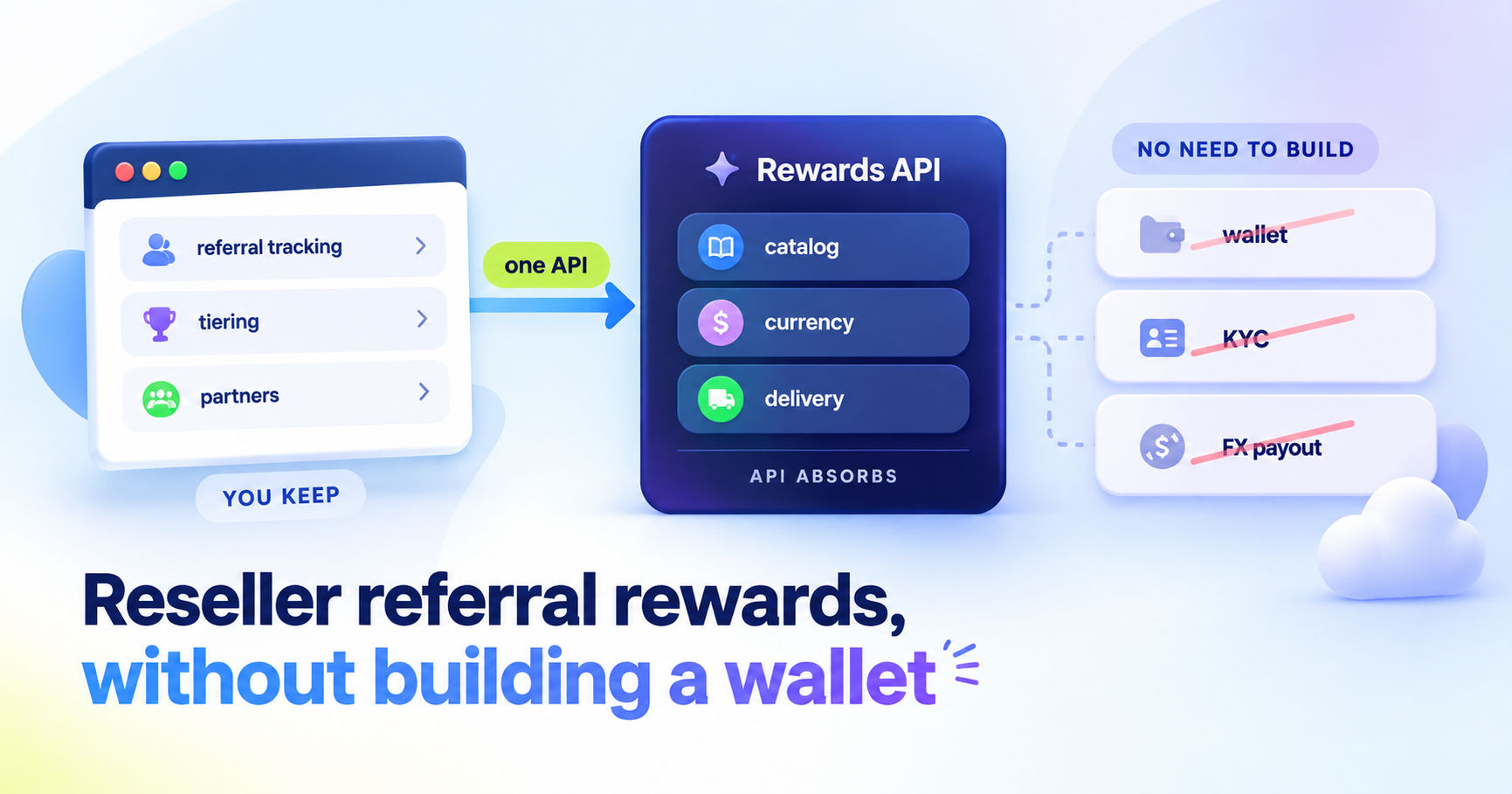

An ad-tech platform decides its agency and reseller network is worth rewarding for referrals, upsells, and volume growth, and the partnership team immediately runs into the same wall every channel program hits: paying out cash, gift cards, or credits across dozens of countries and currencies is a payments and compliance problem, not a marketing one. So the real question partnership and channel managers end up asking is not "should we build a referral reward program," but "do we actually need to build a wallet to run one."
In short: No. Ad-tech platforms can launch agency and reseller referral reward programs by connecting a gift card or digital rewards API to their existing partner portal or CRM, rather than building and licensing in-house payout, KYC, and multi-currency wallet infrastructure. The API handles catalog, currency conversion, and cross-border delivery, while the platform keeps ownership of referral tracking, tiering, and partner relationships.
Referral-driven growth channels are no longer a side experiment for B2B platforms. One industry estimate projects the global referral marketing space will reach USD 7.24 billion by 2031, reflecting how many platform businesses are formalizing partner and referral rewards into structured programs rather than running them as one-off manual bonuses (SHNO, Referral Program Statistics for 2026, 2026).
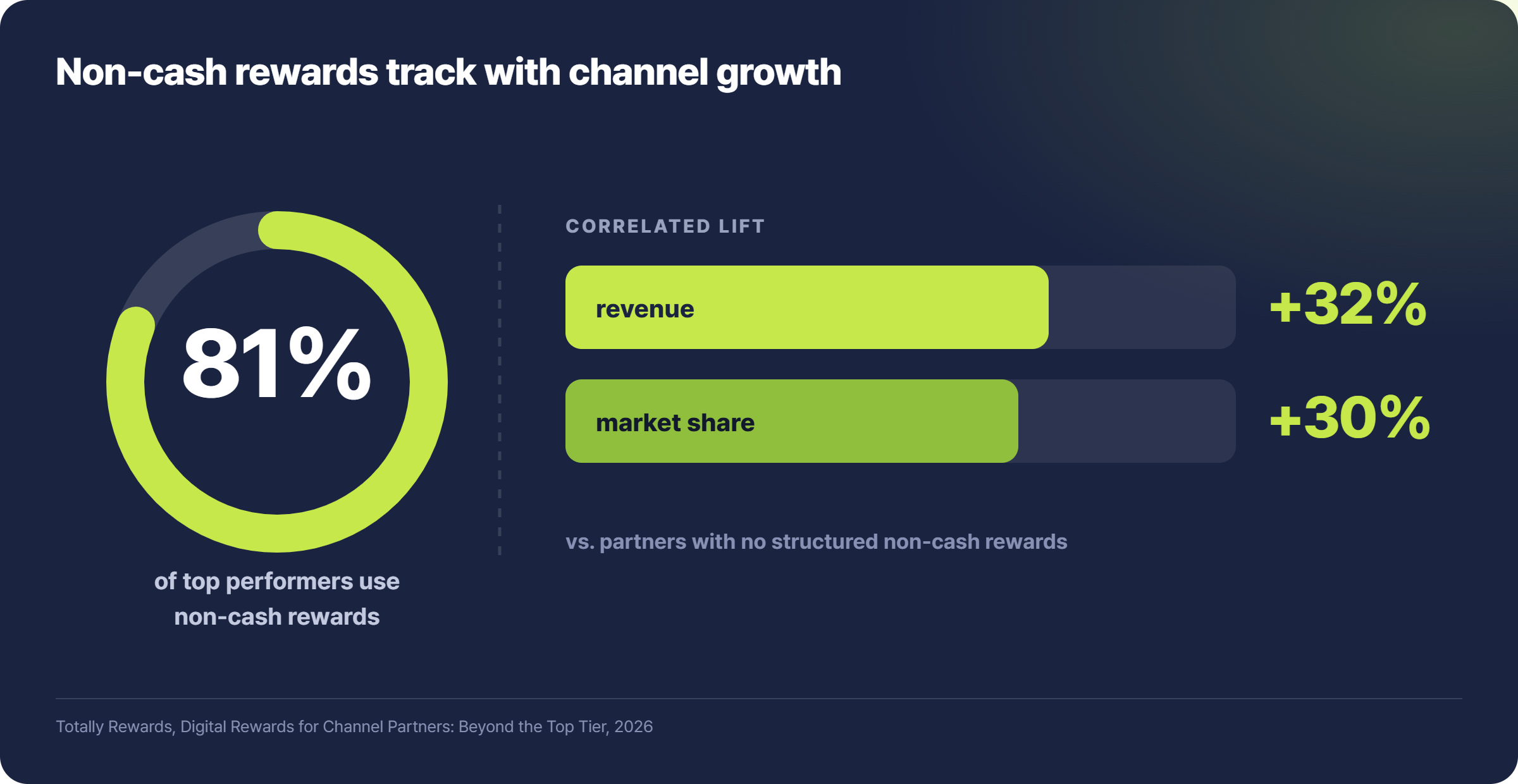
The reward format inside that program matters just as much as the program's structure. Research into channel partner incentives found that 81% of top-performing companies run non-cash incentive programs, such as digital gift cards and prepaid cards, and that these programs correlate with a 32% increase in total revenue and a 30% increase in market share compared with partners operating without structured non-cash rewards (Totally Rewards, Digital Rewards for Channel Partners: Beyond the Top Tier, 2026). For an ad-tech platform, that is a direct argument for building the reward layer deliberately, instead of bolting on manual PayPal transfers or invoice credits as an afterthought.
Most ad-tech platforms already have some reward or loyalty mechanism for advertisers or publishers. Agency and reseller referral programs are a different animal. The agency isn't the end user of the platform, and often isn't even the one who signs the contract, it's the party that introduced a client, negotiated a package, or drove renewal volume. That changes what the reward needs to do:
Gary Sabin, VP of Product at Impartner, has pointed out that reward mechanics affect partner behavior well past the initial onboarding step: implementing rewards management as part of a channel partner strategy "helps motivate partners past the onboarding process by enabling incentive programs that are simple to manage and easy to use" (Impartner, 2026). That framing matters for ad-tech specifically, because agency and reseller relationships are rarely one-time transactions, they compound over renewal cycles, upsells, and referred accounts, so the reward mechanism needs to keep working long after the first payout.
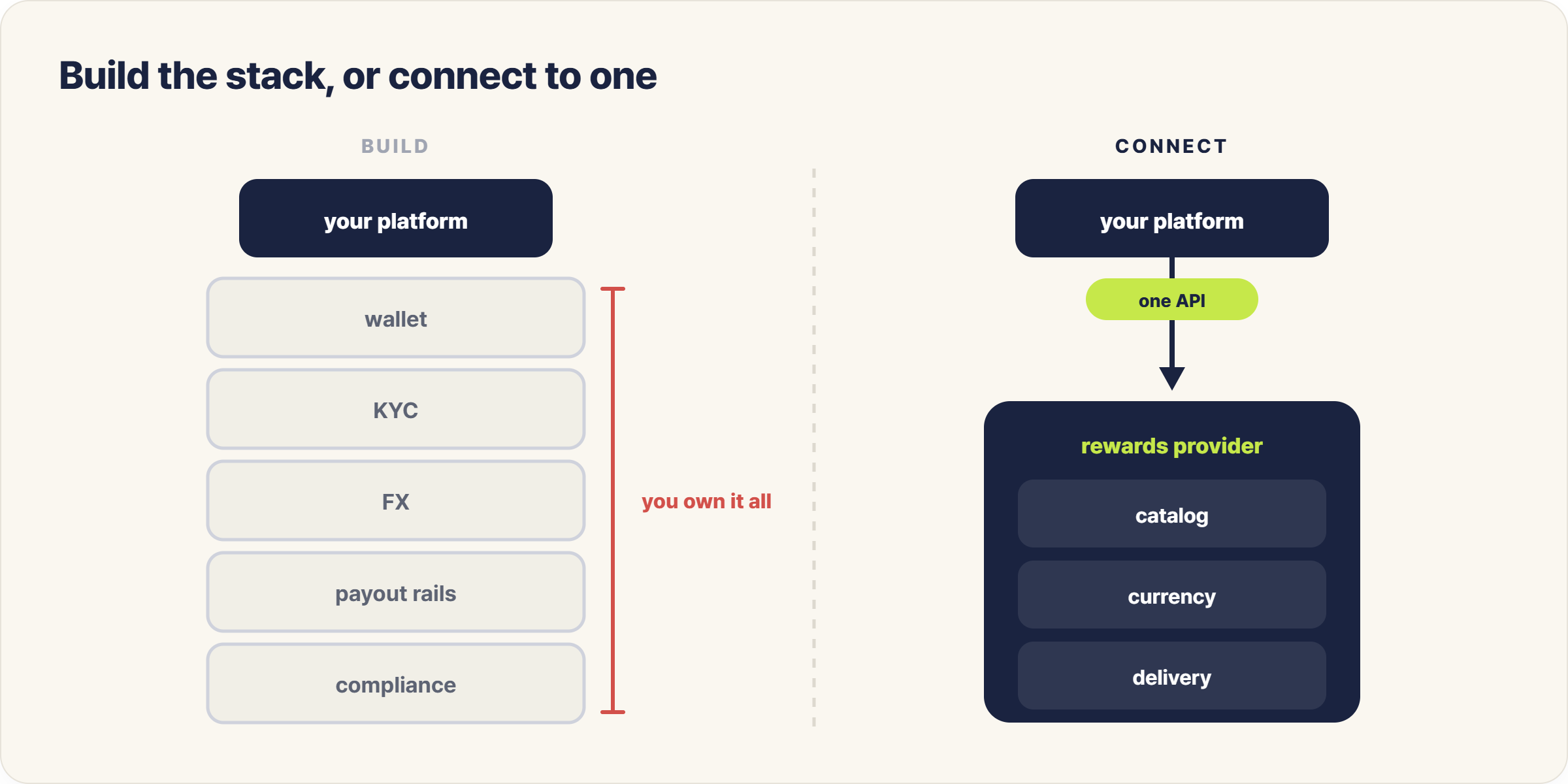
When a partnership team first scopes a referral reward program, "just build a payout feature" sounds like a reasonable ask of the platform's own engineering team. In practice, an in-house wallet for agency and reseller rewards means the platform is now responsible for holding balances, verifying recipient identity across jurisdictions, handling currency conversion and local payment rails, staying compliant with money-transmission and anti-money-laundering rules in every country a partner might be based in, and maintaining that infrastructure indefinitely as regulations shift.
This is the same trade-off ad-tech platforms already face when they consider in-house loyalty or rewards systems for other partner segments, and it's the reason more platforms are treating rewards delivery as infrastructure to plug in rather than a system to build. A closer look at this same build-versus-buy trade-off for bulk reward delivery is covered in What Is a Bulk Gift Card API and Why Platforms Are Adopting One; the same logic applies directly to an agency or reseller referral program, where the partnership team wants the referral tracking and tier logic to be theirs, but has no reason to also own multi-country payout compliance.
For an ad-tech platform specifically, this trade-off is sharper than in most other verticals, because the core product, the ad exchange, the DSP, the attribution tooling, is already engineering-intensive. Diverting a sprint or a quarter to build payout rails for a channel program that sits outside the core product is a hard sell internally, and it's the kind of project that quietly stalls once the initial referral volume doesn't justify the build cost.
Instead of building payout infrastructure, a partnership team can connect a gift card or digital rewards API directly into the systems it already uses to track referrals and reseller performance, typically a CRM, a partner relationship management (PRM) tool, or an internal admin panel.
The mechanics are straightforward once the reward layer is external:
This structure also solves the long-tail reseller problem that trips up in-house builds. A platform might have five strategic agency partners worth a white-glove payout process, and two hundred smaller resellers who occasionally refer a client. Manually processing payouts for the long tail doesn't scale, but an API-driven reward call is the same amount of engineering effort whether it's triggered five times a month or five thousand times a month.
A few decisions early on determine whether an agency or reseller referral program stays manageable as it grows:
None of this requires the partnership team to become payments experts. It requires picking a reward delivery layer that's built for exactly this problem, and keeping the referral and tiering logic inside the systems the team already controls.
Wincube Global, which has processed over USD 220 million in gift card GMV in 2025 across a catalog of more than 30,000 gift cards spanning over 90 countries, provides the kind of API-based reward layer that ad-tech platforms need for agency and reseller referral programs without building payout infrastructure themselves.
For a partnership or channel management team, that means the referral tracking, tiering rules, and agency relationships stay entirely in-house, while reward issuance, currency handling, and cross-border delivery to agencies and resellers wherever they're based become a connected capability rather than a multi-quarter engineering project. If this is relevant to your team, Contact Us and we can walk through what it would look like.
Not if the reward is issued through a third-party gift card or digital rewards API rather than a platform-run wallet or cash payout system. The API provider handles the regulated parts of value transfer, such as currency conversion and cross-border delivery, so the ad-tech platform's referral program itself doesn't require a money-transmission license.
An advertiser loyalty program typically rewards the end customer of the platform for spend or engagement, while an agency or reseller referral program rewards a third party for introducing or growing that customer relationship. The reward mechanics, tiering, and recipient verification needs are usually different enough that the two programs shouldn't share the same payout logic.
Start by connecting an existing referral or CRM event, such as a new client signed through a specific agency, to a gift card API call, rather than designing a full tiered incentive structure upfront. A single trigger-to-reward flow can validate whether agencies and resellers actually respond to the incentive before the program expands into multiple tiers and regions.
Sources