Digital Gift Cards
Global Gift Cards
CROSS BORDER GIFTCARD

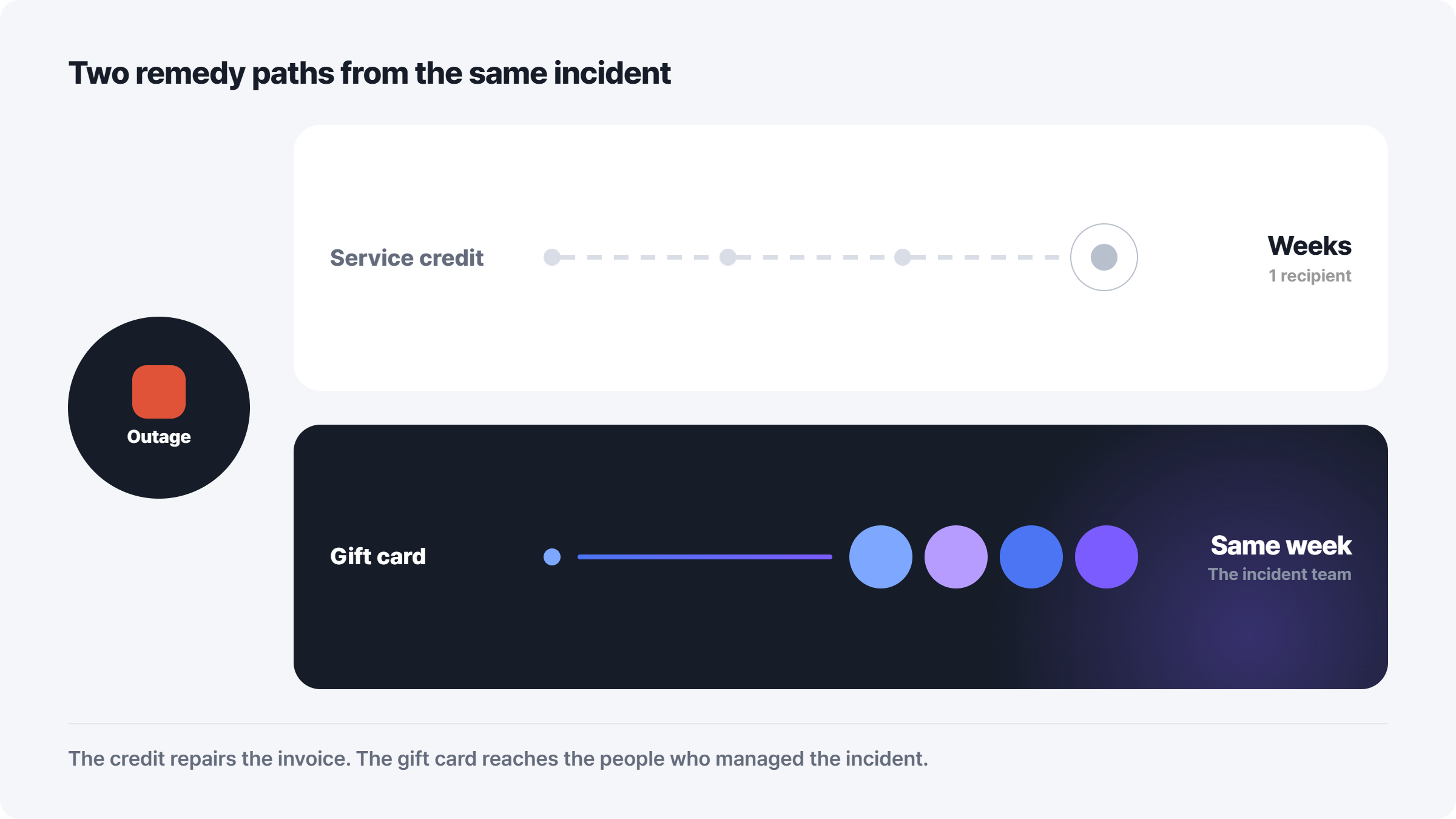
When a SaaS platform misses its uptime SLA, the standard remedy is a service credit: a percentage knocked off next month's invoice. For years this was treated as sufficient closure. But as customer success and contract management teams take a harder look at what those credits actually deliver, a different question is surfacing: if a service credit doesn't restore trust and rarely reaches the people who actually felt the outage, what should sit alongside it in the compensation stack?
In short: Enterprise SaaS platforms are increasingly pairing, and in some cases replacing, invoice-based service credits with gift card compensation because credits are pricing adjustments that only reach the billing contact, arrive on the next invoice cycle, and cap out at a small percentage of monthly fees. A gift card, by contrast, can be issued immediately and directed to the specific stakeholders who managed the incident. This shift doesn't eliminate the contractual service credit; it adds a faster, more personal remedy layer for the relationship damage that credits were never built to repair.
Most enterprise SLA structures were never designed to compensate for business impact. They were designed to cap vendor liability. Analyses of enterprise cloud contracts show service credits typically max out around a 30% cap on the monthly subscription fee, with vendor-favorable agreements limiting exposure closer to 10% (CloudNuro, SLAs for SaaS: Uptime, Support Response, Credits, and Enforcement, 2026). For a platform paying $50,000 a month, a 10% cap after a multi-hour outage works out to a few thousand dollars in credit against an incident that may have disrupted an entire go-to-market team for a full business day.
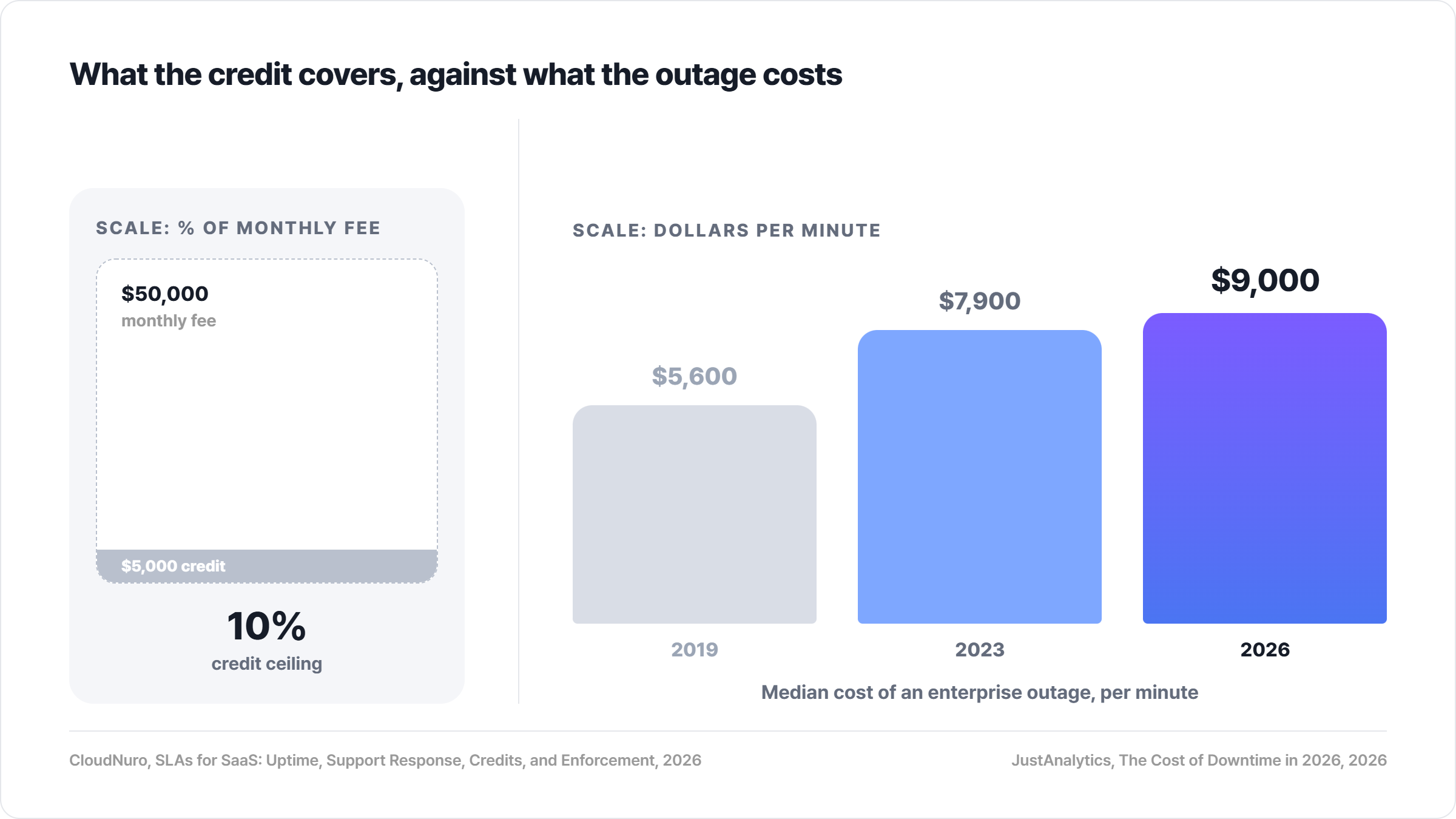
That gap looks even starker next to what downtime actually costs the affected business. The median cost of an enterprise outage has climbed to roughly $9,000 per minute in 2026, up from $7,900 in 2023 and $5,600 in 2019 (JustAnalytics, The Cost of Downtime in 2026: Statistics Every Engineering Leader Should Know, 2026). A service credit sized as a percentage of subscription fees was never built against a cost curve like that, which is exactly why CS and contract teams are looking for a remedy that can be issued the same week, to the people who actually managed the incident, rather than folded into next quarter's invoice.
The instinct to reach for a gift card instead of a formal credit line item isn't hypothetical. After the July 2024 global outage traced to a faulty CrowdStrike update, the company's chief business officer, Daniel Bernard, emailed the partners and teammates who had been working the incident with a $10 Uber Eats gift card, writing that "we send our heartfelt thanks and apologies for the inconvenience" and that "your next cup of coffee or late night snack is on us" (TechCrunch, 2024). The gesture drew criticism for being too small relative to the incident's scale, but the logic behind it, reaching the individual people affected with something immediate and personal instead of waiting for a contractual credit cycle, is exactly what enterprise SaaS platforms are now trying to formalize and size correctly in their own SLA compensation design.
A service credit is, structurally, a discount. It reduces what the customer owes on their next bill, which means the value only becomes real to whoever controls that budget line, usually procurement or finance, months after the incident that caused it. The engineering lead who spent a weekend firefighting an outage, or the customer success manager who fielded angry escalations from their own end users, never sees that credit. It shows up as a smaller number on an invoice they may never review.
Credits are also capped by design, not by the actual cost of the disruption. Vendors write SLAs to limit their own liability exposure, not to make the customer whole, so the credit tiers are set as a fraction of fees paid rather than a reflection of business impact. That structural mismatch is precisely why CS and contract teams describe the standard remedy as commercially symbolic rather than commercially meaningful, especially for outages that touch revenue-generating workflows.
Finally, credits require a renegotiation of sorts every time they're applied. Someone has to calculate the breach, apply it against the master agreement's terms, and route it through billing. That process alone can take weeks, which delays any sense of acknowledgment the affected team might have wanted in the moment.
Gift card compensation solves a different problem than the service credit does. It doesn't touch the master services agreement's pricing terms, so it can be issued without a contract amendment or finance sign-off cycle. It can be sent within days of an incident rather than folded into the next billing period. And because it's delivered per person rather than per account, it can reach the specific individuals who absorbed the operational cost of the outage: the platform admin who managed the incident channel, the integration engineer who rebuilt a broken pipeline, or the account's internal champion who had to explain the outage to their own leadership.
That per-person reach is the real behavioral shift. A service credit treats the customer as a single billing entity. Gift card compensation treats the customer as a group of people who each had a different, specific experience of the outage, and it lets a vendor acknowledge that difference directly instead of hoping a line-item discount trickles down to the people who mattered.
It also changes how the gesture is perceived. A credit reads as an accounting adjustment. A gift card reads as a deliberate act of goodwill, closer to how How Employee Rewards Are Delivered Seamlessly Across Borders describes recognition programs: the value isn't just the dollar amount, it's the fact that someone chose to send it to a specific person for a specific reason.
For CS and contract teams building this out, the practical questions are less about whether to do it and more about how to structure it so it doesn't become another line item nobody trusts.
Delivering this at enterprise scale usually means wiring the reward step into an existing incident-response or CS workflow rather than issuing cards manually after every breach, which is part of why platforms evaluating this shift also look at What Is a Bulk Gift Card API and Why Platforms Are Adopting One before committing to a compensation model they'd otherwise have to run by hand.
WINK is published by Wincube Global, which has processed over USD 220 million in gift card GMV in 2025 across a catalog of more than 30,000 gift cards spanning over 90 countries.
For a CS or contract management team designing an SLA compensation tier, the operational questions tend to come down to reach and speed: can the gift card catalog actually cover every country where the affected stakeholders sit, and can it be issued fast enough to matter within days of an incident rather than weeks. Those are infrastructure questions as much as policy ones, and they're worth working through before a compensation policy gets written into a customer-facing SLA. If this is relevant to your team, Contact Us and we can walk through what it would look like.
Not usually. Most platforms keep the formal service credit as the contractual remedy tied to the SLA's breach thresholds, since that's what the master agreement legally requires. Gift card compensation is layered on top as a faster, more personal gesture that reaches individual stakeholders rather than the billing entity.
It depends on who actually experienced the disruption. Many teams send it to the specific people who managed the incident on the customer's side, such as a technical admin or project sponsor, rather than routing it to the accounts-payable contact who would otherwise see the eventual invoice credit.
It can be handled either way. Some platforms formalize it as a defined compensation tier tied to existing breach thresholds, while others treat it as a discretionary CS gesture issued alongside the contractual credit. Formalizing the trigger tends to make the process faster and more consistent when an incident actually occurs.
Sources