Digital Gift Cards
CROSS BORDER GIFTCARD
API
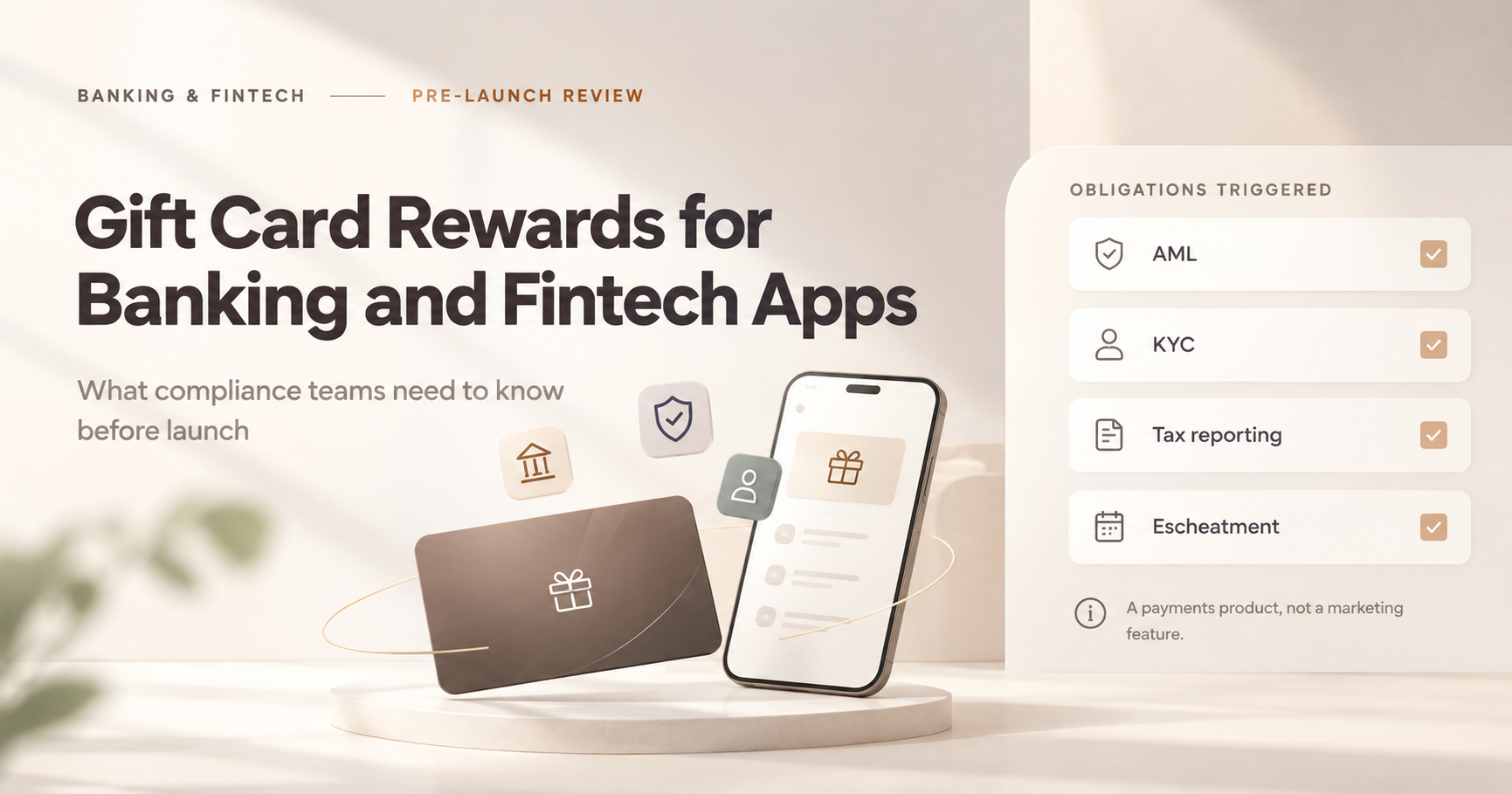

baA product team wants to launch a referral bonus paid out as a gift card inside a neobank app by next quarter. The pitch deck is done, the catalog is picked, and marketing is already drafting the push notification. Then compliance asks a question nobody prepared an answer for: is this a prepaid access instrument, and if so, who is registered to issue it? That single question can delay a launch by months, or it can be answered cleanly in week one if the compliance team is looped in before the vendor contract, not after.
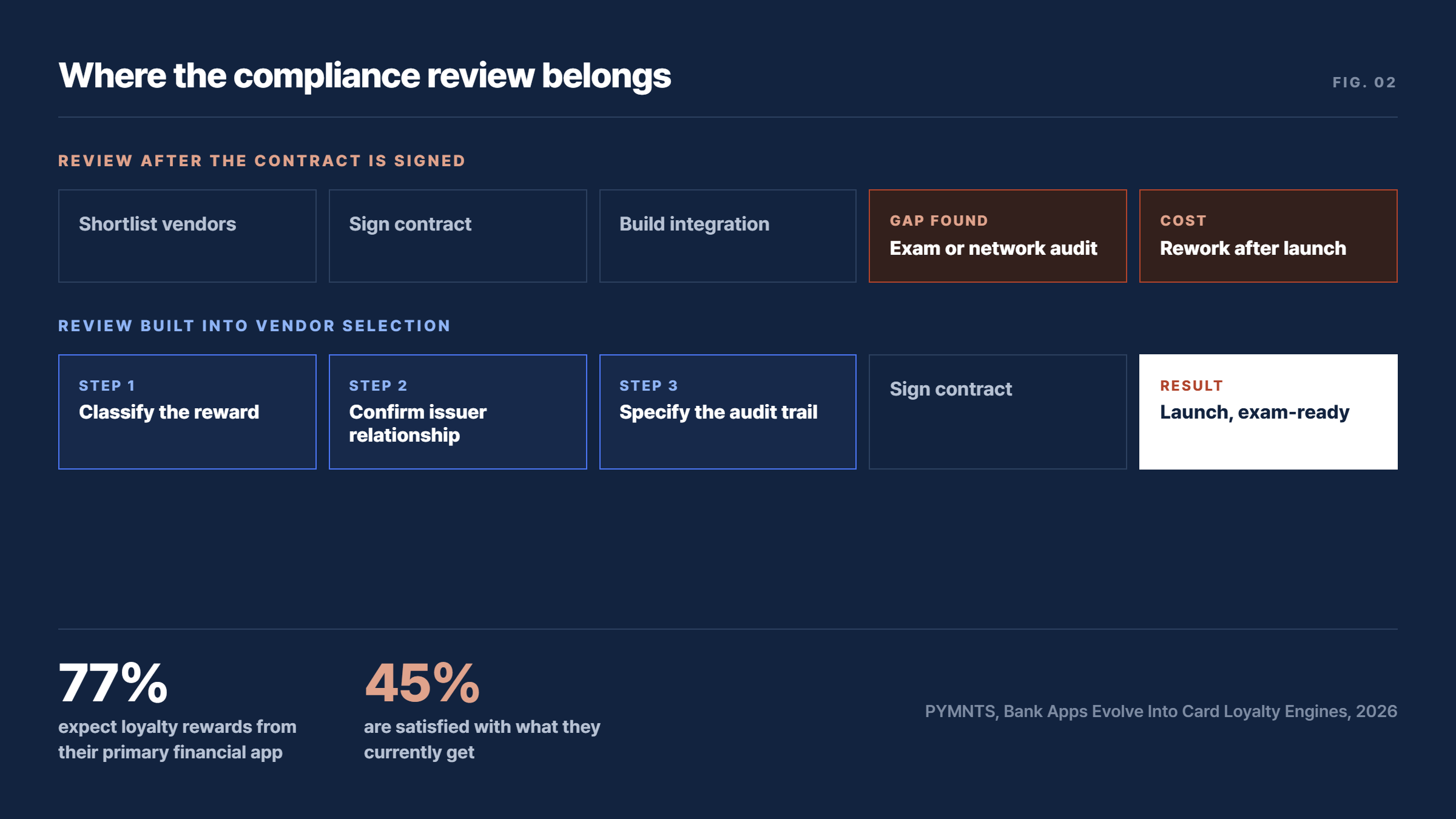
In short: Gift card rewards inside banking and fintech apps sit at the intersection of loyalty marketing and regulated payments, which means the same reward mechanic that works for a retail app can trigger AML, KYC, tax reporting, and escheatment obligations for a chartered bank or e-money institution. Compliance teams should treat a gift card reward program as a payments product, not a marketing feature, and build the review into the vendor selection process rather than after the contract is signed. Getting the classification, issuer relationship, and audit trail right before launch avoids the rework that comes from discovering a gap during a regulatory exam or a card network audit.
Reward mechanics inside banking apps are becoming a bigger part of how institutions compete for engagement: 77% of banking customers now expect loyalty rewards from their primary financial app, but only 45% say they're satisfied with what they currently get (PYMNTS, Bank Apps Evolve Into Card Loyalty Engines, 2026). That gap is exactly why more institutions are looking at gift cards as a fast way to close it, and exactly why compliance teams are being asked to weigh in earlier in the process than they're used to.
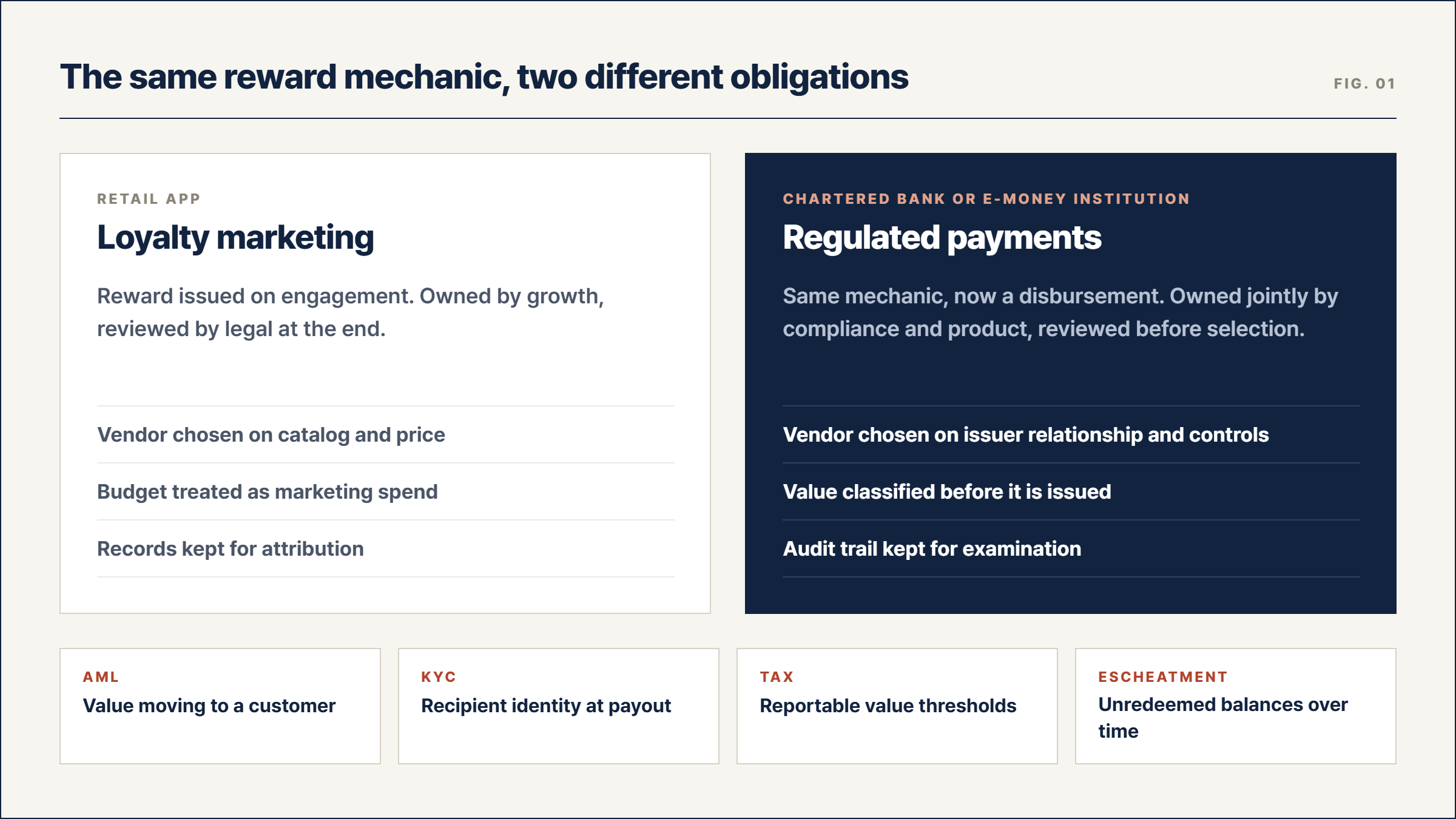
A retail brand giving away a gift card as a promotion is generally treated as a marketing expense. A bank or fintech doing the same thing inside a regulated app is often doing something closer to issuing or facilitating a prepaid instrument, and the distinction matters for three reasons.
Under U.S. rules, prepaid access products, including many gift cards, fall under FinCEN's prepaid access framework, which requires providers and sellers to maintain an anti-money-laundering program, file suspicious activity reports where thresholds are met, and satisfy recordkeeping obligations. Closed-loop cards used at a single or limited merchant network are generally treated as lower risk than open-loop, reloadable instruments, but "generally lower risk" is not the same as "exempt." Compliance teams need to confirm, in writing, which category the specific reward SKU falls into before it ships, because the answer changes what the bank has to build around it.
A bank or fintech already has a verified identity on file for the account holder receiving the reward, which is a real advantage over a standalone rewards platform starting from zero. But that existing KYC record doesn't automatically satisfy every downstream obligation tied to the reward itself, particularly around transaction monitoring, aggregate value thresholds across a reward program, and any secondary use restrictions tied to the card issuer's own terms. The program has to map its own reward flows onto the bank's existing controls rather than assuming they carry over silently.
Most gift card rewards inside a banking app are fulfilled through a third-party card issuer or program manager, not the bank itself. Compliance needs a clear answer to who is legally issuing the instrument, who holds the AML obligation for that specific product, and who is responsible for consumer protection disclosures if something goes wrong. This is the piece that gets missed most often when a rewards program is scoped by a product or marketing team without payments compliance in the room from day one.
Before a gift card reward program goes live inside a banking or fintech app, a compliance review should be able to check off each of the following:
None of these items are unusual for a payments-adjacent product. What's different about gift card rewards is that they often get scoped by a growth or product team that isn't thinking in payments-compliance terms, so the checklist has to be introduced deliberately rather than assumed to be part of the standard vendor review.
A compliance sign-off at launch isn't the finish line. Reward programs tend to scale quickly once they work, and a program that passed review at 500 users a month can look very different at 50,000. Two things make the difference between a program that stays audit-ready and one that quietly drifts out of scope.
The first is treating the vendor relationship as a live compliance dependency, not a one-time procurement decision. That means periodic reconfirmation that the issuer relationship, catalog composition, and jurisdictional coverage haven't changed in ways that shift the risk profile, especially if the program expands to new markets or the catalog adds new card types. For institutions running reward programs across multiple countries, this is closely related to how cross-border delivery is structured operationally, covered in more depth in How Employee Rewards Are Delivered Seamlessly Across Borders.
The second is keeping the audit trail queryable, not just stored. A program that can technically produce records but needs two weeks and a data engineer to assemble them for an examiner is going to create friction during a review even if nothing is actually wrong. The compliance team's leverage at launch is in requiring that reporting be a standard, self-serve feature of the platform, not a custom request fulfilled after the fact.
Wincube Global, which has processed over USD 220 million in gift card GMV in 2025 across a catalog of more than 30,000 gift cards spanning over 90 countries, works with platforms that need reward infrastructure built for scale rather than assembled ad hoc. For banking and fintech teams evaluating gift card rewards, the questions in this article, instrument classification, issuer clarity, audit-trail access, and jurisdictional coverage, are the kind of details worth raising early with any infrastructure partner under consideration. If your team is mapping out what a compliance review of a gift card reward program should look like, it's worth a conversation before the vendor shortlist is finalized rather than after.
If this is relevant to your team, Contact Us and we can walk through what it would look like.
Are gift cards considered a regulated financial instrument when used as rewards in a banking app? It depends on the specific card type. Closed-loop, non-reloadable gift cards are generally treated as lower-risk under frameworks like FinCEN's prepaid access rules, but they are not automatically exempt from anti-money-laundering or recordkeeping obligations, and the classification should be confirmed in writing for each product in the catalog rather than assumed.
Does a bank's existing KYC on an account holder cover gift card rewards issued through that account? Not automatically. Existing identity verification is a strong foundation, but reward-specific obligations, such as aggregate value monitoring or issuer-specific terms, need to be mapped onto that existing KYC framework rather than assumed to be covered by it.
Who is responsible for tax reporting on gift card rewards paid through a fintech app? Responsibility should be explicitly assigned in the vendor agreement rather than left implicit. Depending on the structure, it may fall to the bank, the fintech, or the card program manager, and reward values that cross reporting thresholds need a clearly designated owner for the filing obligation before the program launches.
Sources