Digital Gift Cards
Global Gift Cards
CROSS BORDER GIFTCARD
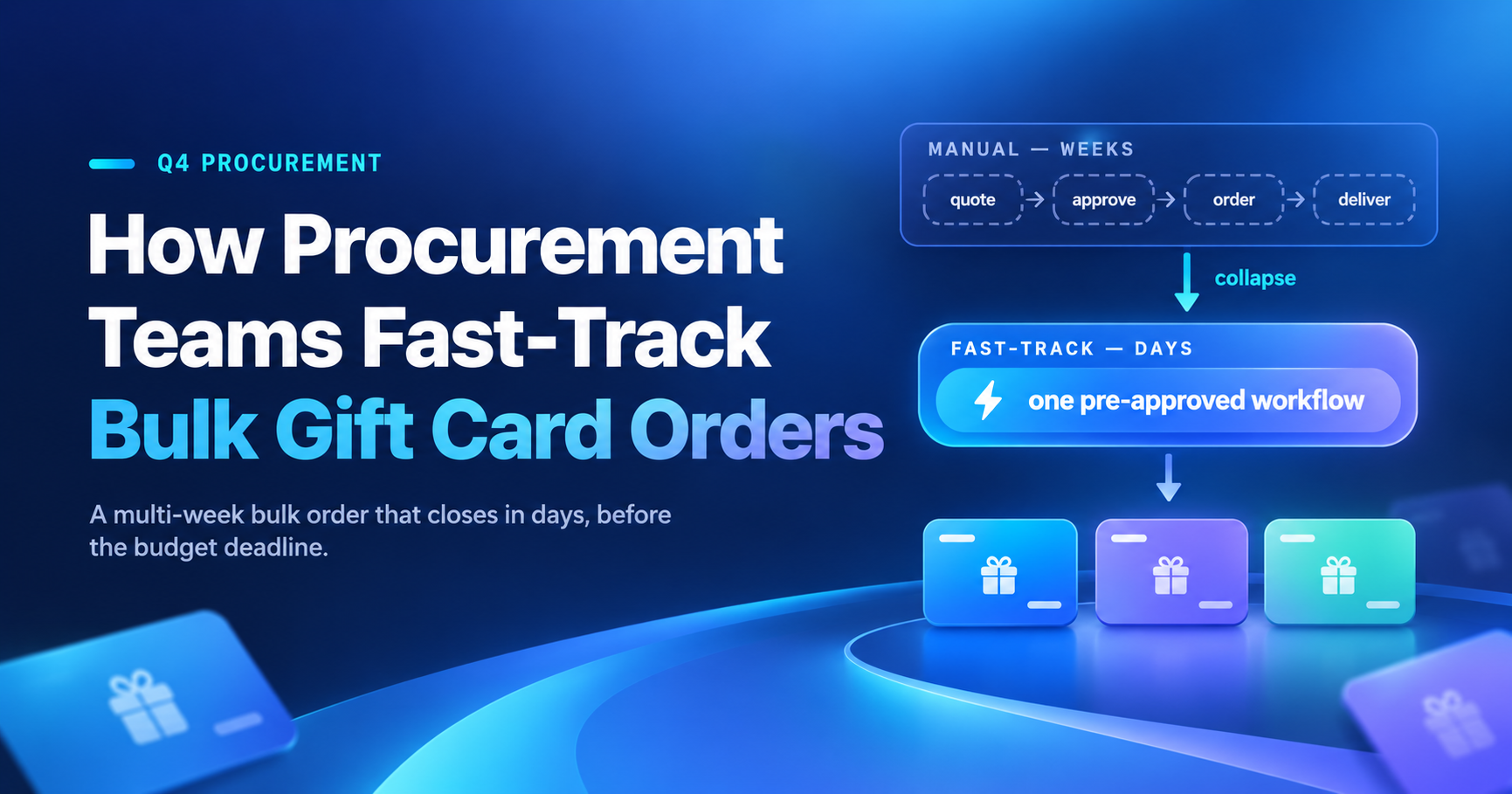

Every fourth quarter, procurement teams hit the same wall: a fixed pool of remaining budget, a fixed date it has to be committed by, and a purchase order process built for slower-moving categories than gift cards. The question isn't whether the budget gets spent, it's whether it gets spent through a process that survives an audit, delivers on time, and doesn't leave a buyer chasing a vendor's manual quote three days before the fiscal year closes.
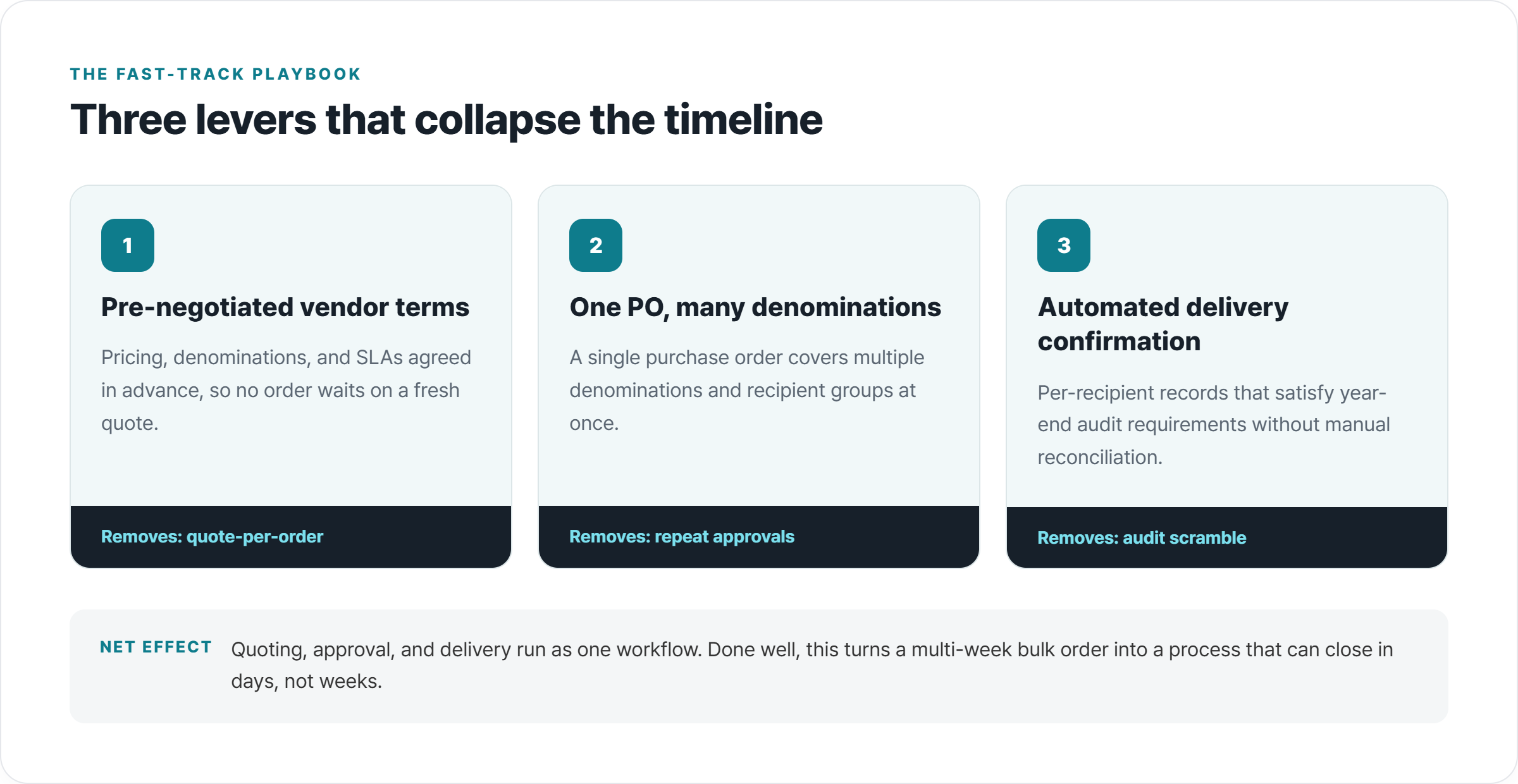
In short: Procurement teams fast-track bulk gift card orders before Q4 deadlines by moving from manual, quote-per-order purchasing to pre-approved catalogs and API-based ordering that collapse quoting, approval, and delivery into a single workflow. The core levers are pre-negotiated vendor terms, a single purchase order covering multiple denominations and recipient groups, and automated delivery confirmation that satisfies year-end audit requirements. Done well, this turns a multi-week bulk order into a process that can close in days, not weeks.
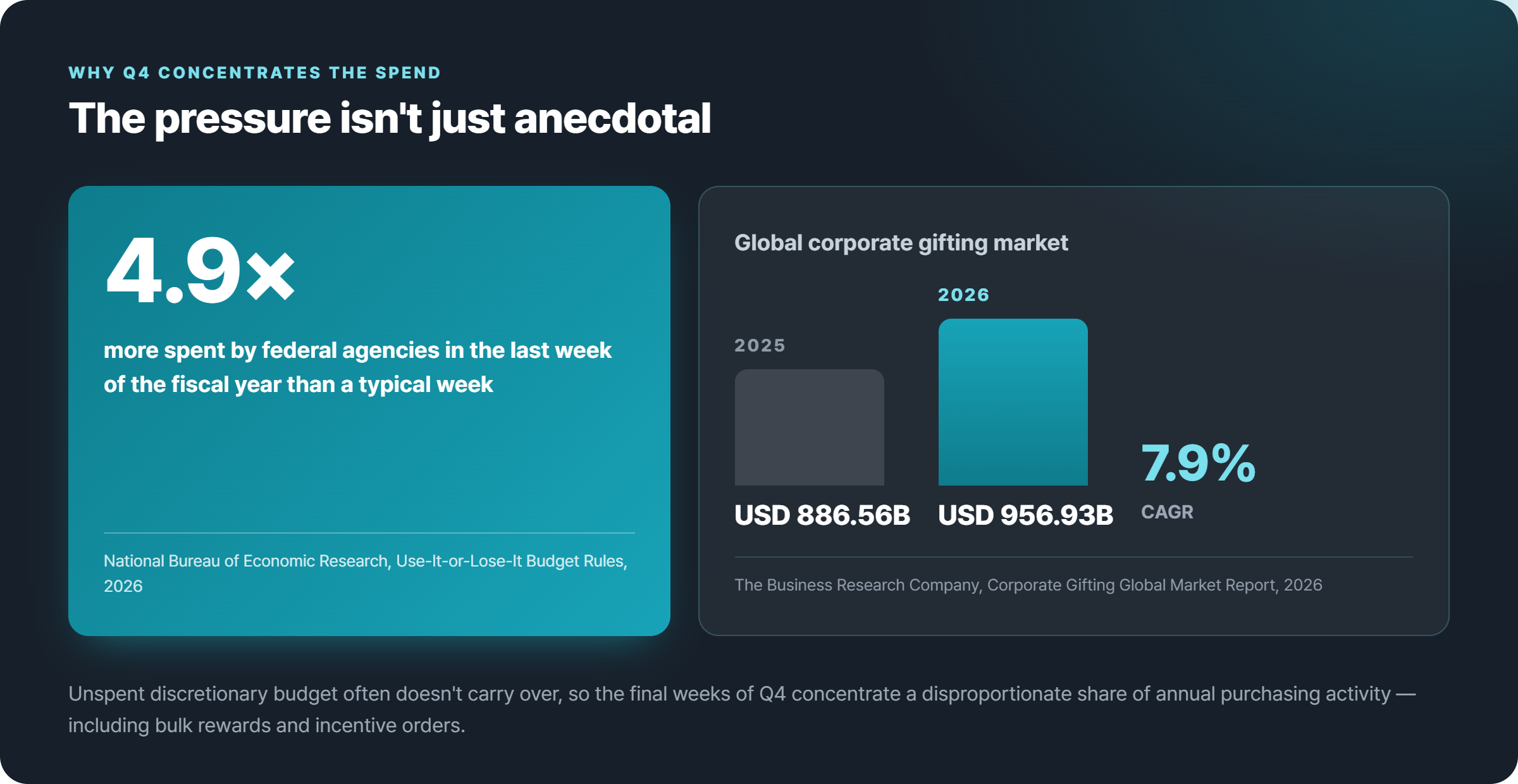
The pressure behind this isn't just anecdotal. Federal agencies spend an average of 4.9 times more in the last week of their fiscal year than in a typical week during the rest of the year, according to research summarized by the National Bureau of Economic Research, Use-It-or-Lose-It Budget Rules, 2026. Corporate procurement teams face a milder version of the same incentive: unspent discretionary budget often doesn't carry over, so the final weeks of Q4 concentrate a disproportionate share of annual purchasing activity, including bulk rewards and incentive orders.
The category itself is growing fast enough that manual processes are becoming the bottleneck rather than the safeguard. The global corporate gifting market is projected to grow from USD 886.56 billion in 2025 to USD 956.93 billion in 2026, a compound annual growth rate of 7.9%, according to The Business Research Company, Corporate Gifting Global Market Report, 2026. As more of that spend shifts into gift cards specifically, procurement teams that still rely on one-off quote requests per order are the ones most likely to miss the deadline.
Budget-side pressure is compounding with program-side caution. Stephanie Harris, President of the Incentive Research Foundation, noted that "incentive programs are important tools for businesses, particularly during challenging economic times," and that "incentive program owners are approaching 2026 with a strategic mindset, carefully managing costs while aligning rewards with organizational objectives and participant preferences" (Incentive Research Foundation, Industry Outlook for 2026: Merchandise, Gift Cards, and Event Gifting, 2026). That combination, more scrutiny on how the money is spent plus less time to spend it, is exactly why the fast-track playbook below matters more in Q4 than any other quarter.
A typical bulk gift card order, handled the way most procurement teams still handle it, involves several sequential steps: a request for quote sent to a vendor, a wait for that quote to come back, a review of denominations and recipient counts, an approval chain that may touch finance and legal, and then a separate delivery timeline once the order is placed. Each step is manageable on its own. Stacked together during a normal quarter, they take one to two weeks. Stacked together in the final two weeks of a fiscal year, when every other team is also trying to close out spend, they routinely blow past the deadline.
Three specific failure points show up repeatedly:
None of these are exotic problems. They're the predictable result of applying a manual, per-order process to a spend category that behaves more like recurring software procurement than like a one-time capital purchase.
The teams that consistently close Q4 gift card spend on time have usually done one thing differently well before the deadline arrived: they moved the vendor relationship and catalog approval out of the purchase-order cycle entirely. Instead of negotiating terms and reviewing a catalog at the moment of ordering, that work happens earlier in the year, so the Q4 order becomes a matter of specifying quantities and recipients against terms that are already agreed.
Once vendor terms and catalog access are pre-approved, the ordering step itself can move through an API rather than a quote request. A single purchase order can cover multiple denominations, multiple recipient groups, and multiple countries in one transaction, instead of requiring a separate PO for each variation. That single change, replacing several sequential manual quotes with one programmatic order, is often the difference between a bulk order that closes in a week and one that closes in a day. Our earlier piece on what a bulk gift card API is and why platforms are adopting one covers the mechanics of this shift in more detail for teams evaluating whether to move off manual ordering.
Delivery confirmation matters just as much as order speed. Year-end audits typically require proof that funds were actually disbursed and not just committed, so a process that returns delivery status and redemption tracking automatically removes a manual reconciliation step that otherwise falls on procurement or finance in January.
Fast-tracking a single order is useful. Building a process that doesn't require fast-tracking at all is better, and that mostly comes down to timing the groundwork outside of the deadline window. Vendor evaluation, catalog scoping across the countries and currencies a company actually operates in, and internal approval workflows are all decisions that are easier to make well in Q1 or Q2 than under a fiscal year-end deadline. Teams that treat bulk gift card procurement as a standing capability, with pre-approved vendors and a repeatable ordering mechanism, rather than a once-a-year scramble, consistently report shorter cycle times and fewer exceptions that need manual handling.
That shift also changes what "urgent" means. When the ordering mechanism is already in place, a Q4 budget deadline becomes a matter of specifying amounts and recipients rather than starting a vendor conversation from scratch. The deadline pressure doesn't disappear, but it stops being a process risk.
Wincube Global, which has processed over USD 220 million in gift card GMV in 2025 across a catalog of more than 30,000 gift cards spanning over 90 countries, works with platforms and enterprise buyers that need bulk gift card ordering to move on a fiscal calendar rather than a vendor's quoting calendar. For a procurement team trying to close out Q4 budget cleanly, the practical question is less about finding a new vendor relationship and more about whether the ordering mechanism already in place can handle multiple denominations, currencies, and recipient groups in a single transaction with a clear delivery record. If this is relevant to your team, Contact Us and we can walk through what it would look like.
Most delays come from vendor onboarding and catalog approval rather than the order itself, so those steps should be finished well before the final weeks of the fiscal year. If vendor terms and catalog access are already approved, the order itself, quantities, denominations, and recipient groups, can typically be finalized and submitted within days.
Yes, when the ordering process runs through an API rather than a series of manual quotes, a single purchase order can specify multiple denominations, currencies, and recipient groups in one transaction. This is one of the main ways teams compress a multi-week bulk order into a much shorter timeline.
Finance teams generally need proof that funds were disbursed, not just committed, along with delivery confirmation and redemption tracking tied to the original purchase order. Automated delivery and reporting removes a manual reconciliation step that would otherwise fall on procurement or finance after the fiscal year closes.
Sources