Digital Gift Cards
Global Gift Cards
CROSS BORDER GIFTCARD
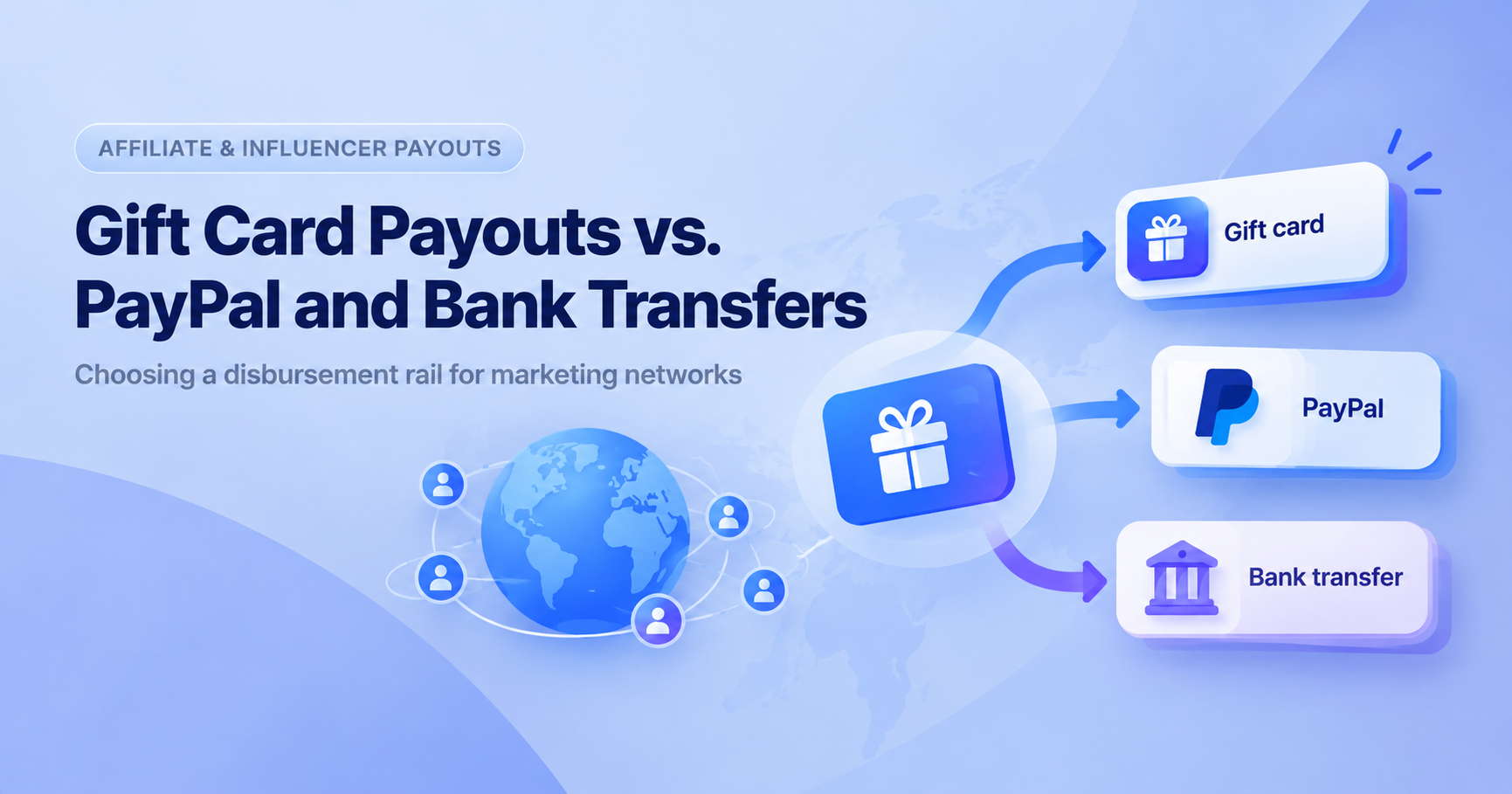

An affiliate network with 4,000 active publishers spread across dozens of countries and an influencer platform paying 200 creators a month are solving the same problem: how do you get money out the door reliably, without a support queue full of "where's my payout" tickets? The rail you pick, PayPal, bank transfer, or gift card, determines how much of every payout survives fees, how fast it lands, and how many of your partners you can actually reach in the first place.
In short: PayPal and bank transfers remain the default for affiliate and influencer payouts, but both carry real costs at scale: PayPal's cross-border fees and currency conversion spreads can erode a meaningful share of each payment, while bank transfers add multi-day settlement delays and exclude anyone without formal banking access. Gift card payout rails, delivered through an API, settle near-instantly, work in markets where bank rails are thin or expensive, and remove the need to collect and validate bank account details for every partner, at the tradeoff of spendability being tied to specific retailers rather than open cash.
Cross-border cost is not a rounding error. On PayPal specifically, a payment that crosses a border layers a cross-border surcharge on top of the standard processing rate, and currency conversion adds its own spread on top of that, pushing the effective cost of an international payout to roughly 4.4% once both are combined (VaultLeap, PayPal Takes 4.4% on Every Cross-Border Payment — Here's What It Costs You, 2026). For a network paying out six or seven figures a year to affiliates and creators outside the home market, that percentage compounds into a line item finance teams eventually ask about.
Delay is the other recurring complaint, and it is not limited to slow-paying brands. Industry reporting on creator payments has found that processing payouts to international creators routinely faces delays of up to 30 days, driven by cross-border regulatory checks and banking system limitations rather than any single company's billing cycle (FinTech Magazine, Gigapay: Payment Delays Hamper Influencer Marketing Growth, 2026). The same reporting notes that close to half of influencer payments (49.6%) are now tied to performance metrics rather than flat fees, which means payout timing is increasingly variable by design, on top of whatever delay the rail itself adds.
"As this industry grows exponentially, we will push toward more streamlined, automated payment systems, but also better compliance tools," says Thomas Walters, co-founder of Billion Dollar Boy, an influencer marketing agency, commenting on the pressure payment friction puts on the sector's growth (FinTech Magazine, Gigapay: Payment Delays Hamper Influencer Marketing Growth, 2026). That framing captures the real tension for network operators: the business model keeps getting more performance-driven and more global, while the payment infrastructure underneath it is still catching up.
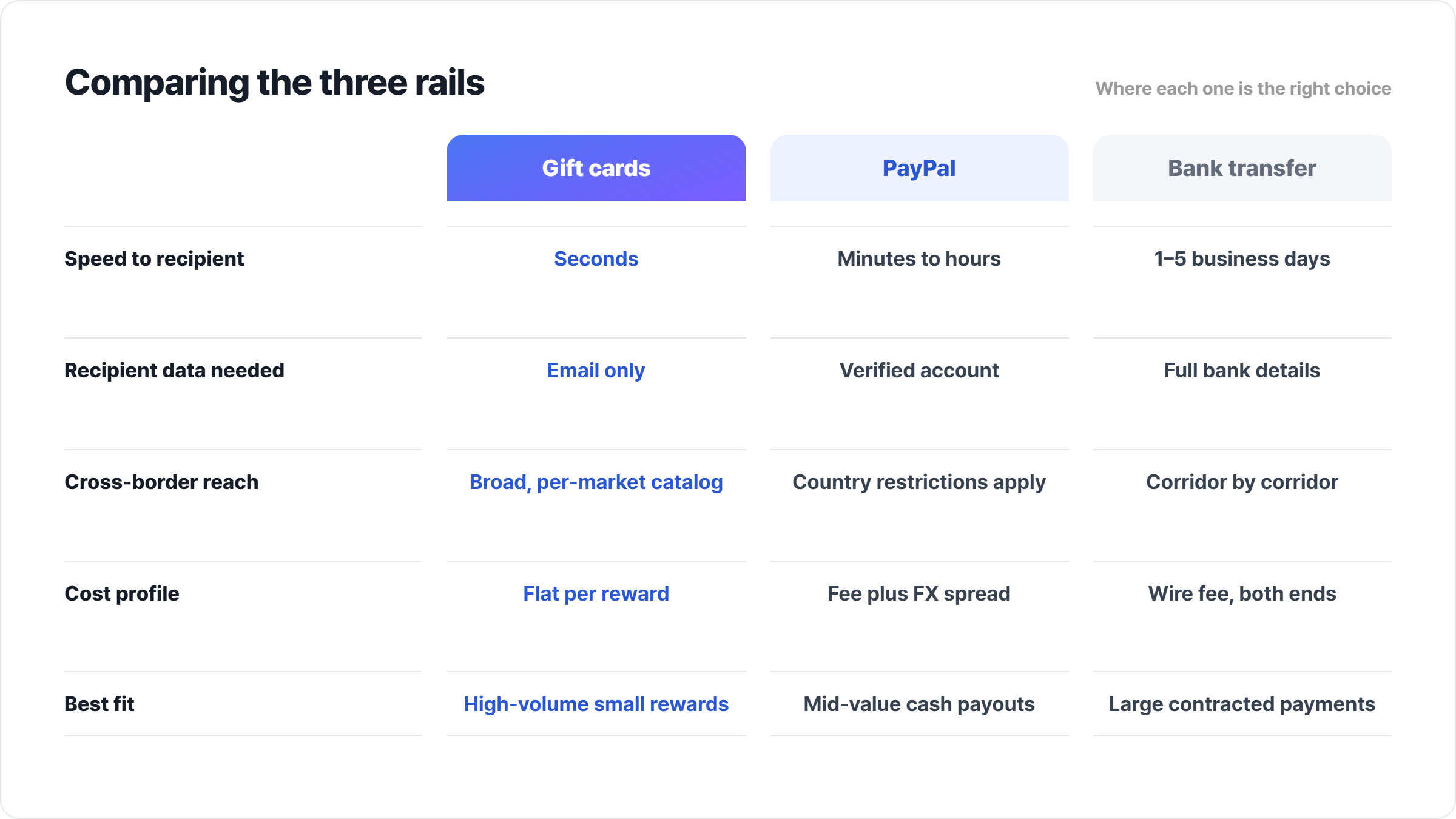
PayPal's appeal is familiarity. Most affiliates and creators already have an account, and integration is well documented. But three costs show up as a network grows past a handful of markets.
Bank transfers solve the "does everyone have an account" problem differently, but introduce their own friction: SWIFT and local ACH-equivalent transfers can take two to five business days to settle internationally, correspondent-bank fees are often deducted en route so the recipient gets less than the sender sent, and every new payee requires collecting and validating IBAN, SWIFT/BIC, and routing details, a data-collection burden that scales linearly with your partner count.
Neither rail is "wrong." Both are appropriate when a partner explicitly wants cash and has stable banking access. The gap opens for the segment of any affiliate or influencer network that doesn't: micro-affiliates in emerging markets, part-time creators without a business bank account, or partners in countries where card-linked payout services have limited coverage.
A gift card disbursement rail sidesteps several of the frictions above by design. Because the "account" required to receive a gift card is just an email address or a phone number, there's no KYC-heavy bank account collection step and no dependency on whether PayPal operates in the recipient's country. Delivery is near-instant once a payout is triggered through an API, which matters directly for the delay problem: instead of a multi-day settlement window, the reward or commission can land in the same session a campaign is approved.
This is also where the "spendability" tradeoff needs to be named honestly. A gift card payout is restricted to a retailer or a curated marketplace of retailers, not open cash, so it is not a universal substitute for every payout use case. It fits best as one rail in a mix: a fast, low-friction option for smaller or more frequent payouts, incentive bonuses, and markets where bank rails are weak, sitting alongside PayPal or bank transfer for partners who specifically need cash. Networks that have modeled this out in detail have found that giving partners a choice of rail, rather than forcing one, tends to reduce both payout support tickets and the number of "unpaid" disputes that come from partners who simply never received a bank-rail payout that got stuck in intermediary processing.
The infrastructure question underneath all of this is whether the payout system can be triggered programmatically, at the volume and cadence a performance-based network actually runs at, rather than through manual, one-off issuance. WINK's own guide to bulk gift card API integration covers what that programmatic layer needs to include: batch issuance, delivery tracking, and reconciliation, which are the same requirements an affiliate or influencer payout system needs regardless of which rail sits behind it.
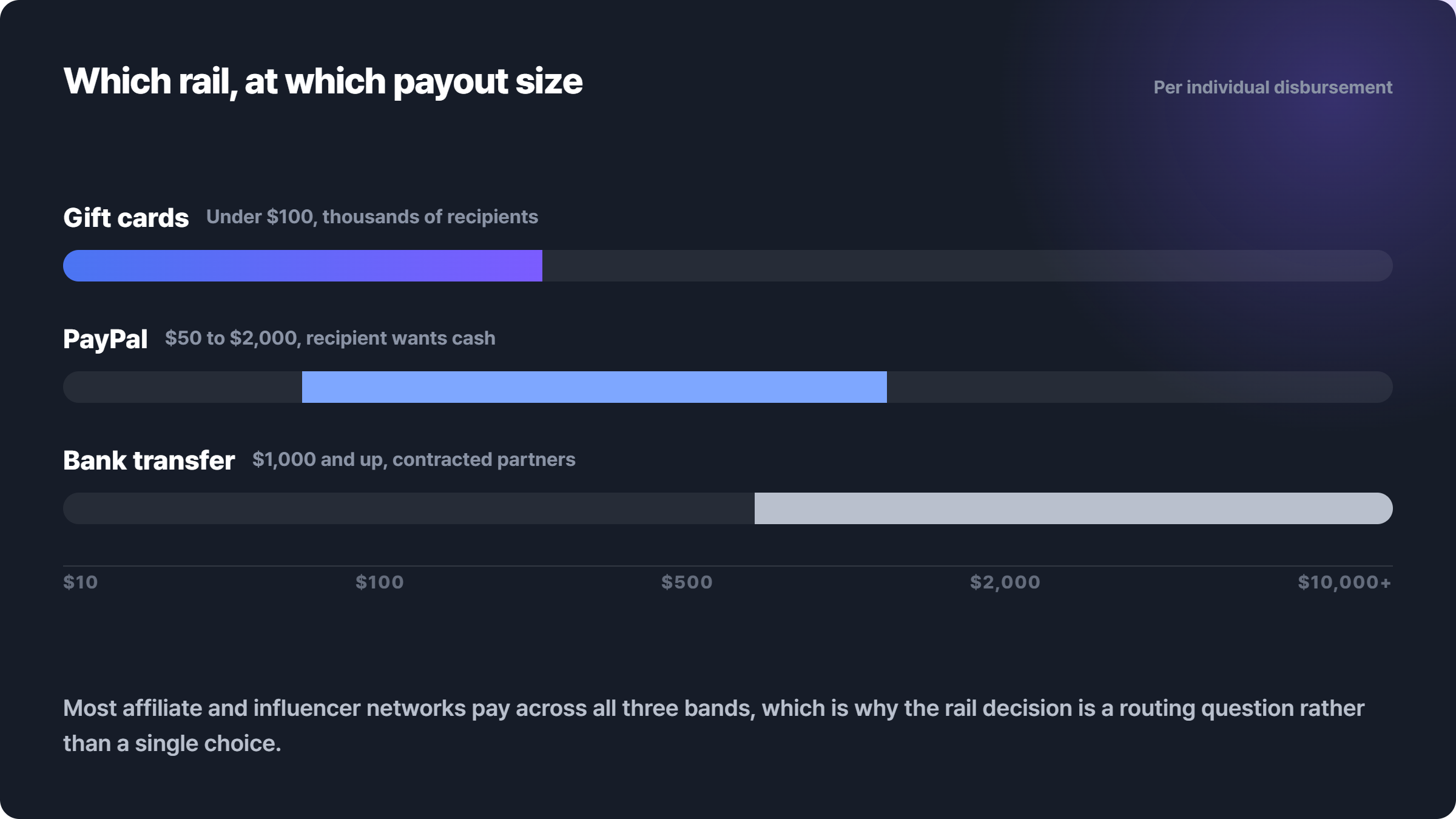
The decision is rarely "replace PayPal and bank transfer entirely." It's closer to a routing decision made per payout, based on three questions.
Networks that treat disbursement as a single-rail decision usually end up re-litigating it once they expand into a market where that rail doesn't work well. Building the payout logic to support more than one rail from the start avoids that rework.
Wincube Global operates the infrastructure layer for one of the disbursement rails in that mix. The company has processed over USD 220 million in gift card GMV in 2025 across a catalog of more than 30,000 gift cards spanning over 90 countries, giving affiliate and influencer networks a way to route payouts to markets and partners where PayPal coverage is thin or bank transfer settlement is slow.
For a network operator, the practical question is narrower than "which rail is best": it's whether adding a gift card option to an existing payout stack is worth the integration effort for the segment of partners where it solves a real problem, without disrupting the cash-based rails that already work for everyone else. If this is relevant to your team, Contact Us and we can walk through what it would look like.
Not entirely, and that isn't usually the goal. Gift card rails work best as an additional option for partners in markets with weak banking access or for smaller, frequent payouts, while PayPal and bank transfer remain appropriate for partners who specifically want cash.
Cross-border payments layer a cross-border surcharge on top of the standard processing fee, and currency conversion adds a separate spread when the payout isn't in the recipient's local currency, together pushing the effective cost meaningfully above a domestic transaction.
The ability to trigger issuance programmatically through an API at the volume and cadence the network actually operates at, rather than through manual, one-off processing, since that is what allows a new rail to scale with performance-based payout triggers instead of becoming an operational bottleneck.
Sources
Contact Email : win-obdteam@wincubemkt.com