Global Gift Cards
WINCUBE
CROSS BORDER GIFTCARD
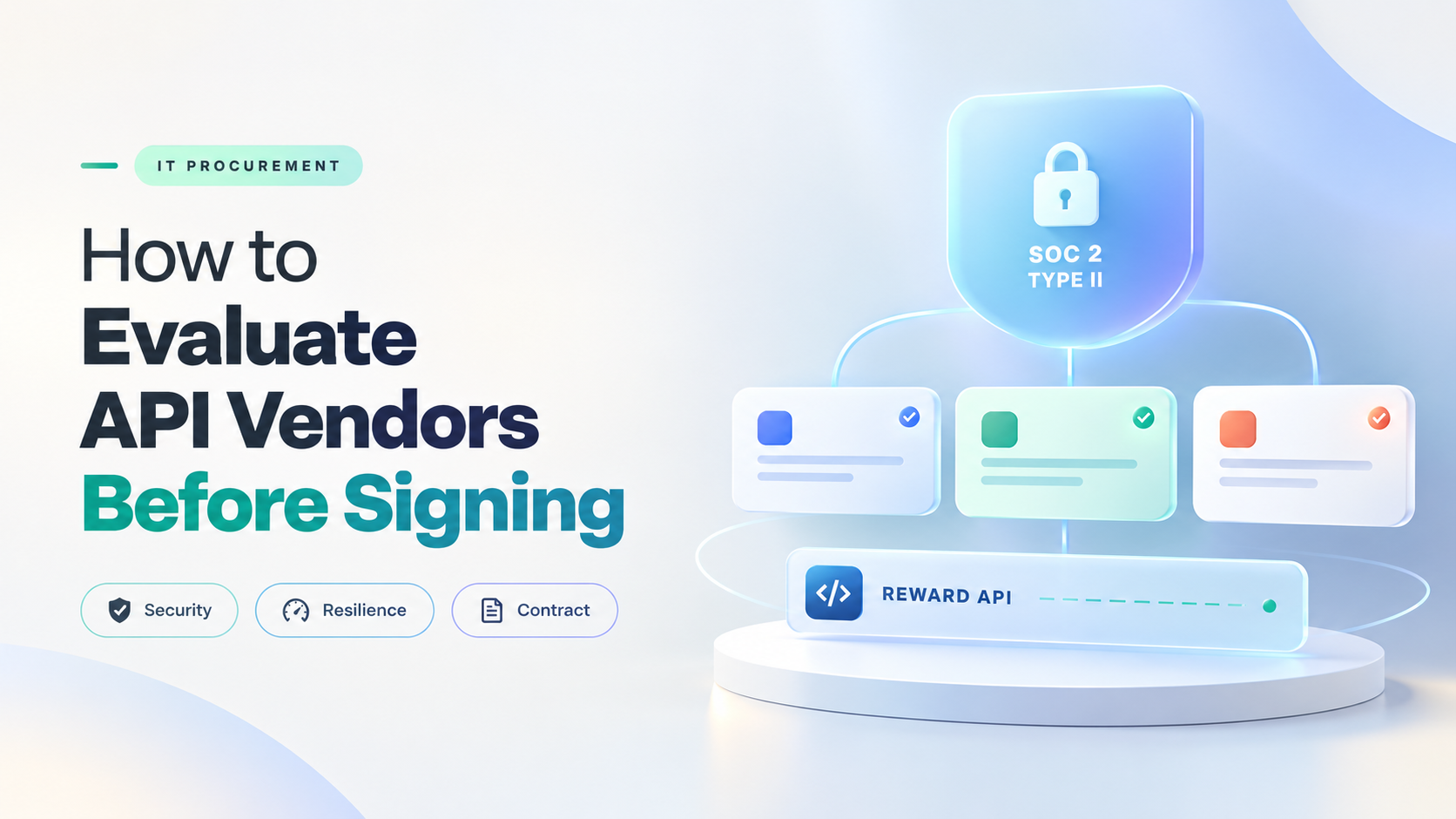

A marketing or HR team finds a gift card reward API that looks perfect for a loyalty program or incentive campaign, and then IT procurement gets a two-line request to "approve the vendor by Friday." The problem is that a rewards API is not a simple SaaS subscription: it touches customer PII, moves money-equivalent value across borders, and often plugs directly into production systems. So what should an IT procurement or security review team actually check before signing?
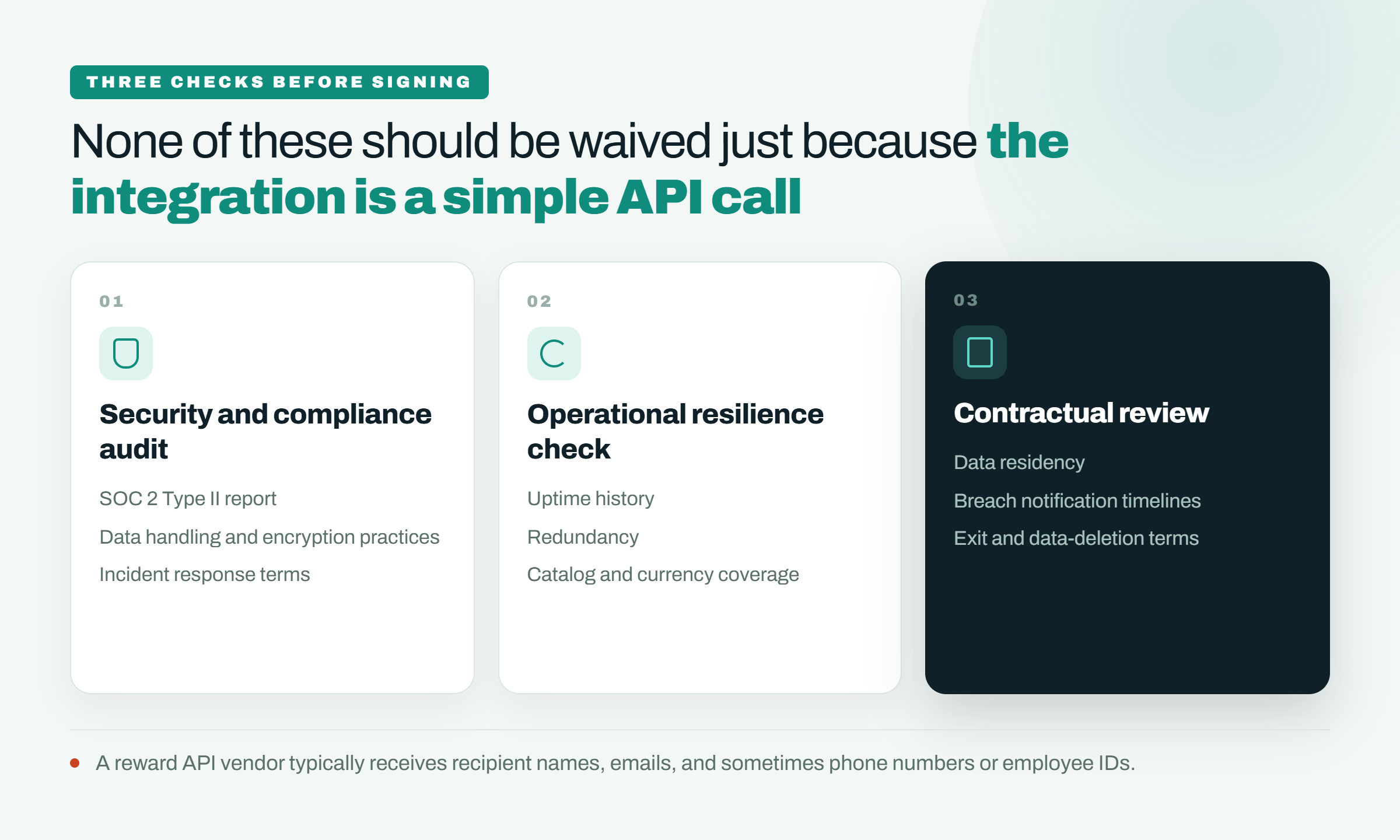
In short: IT procurement teams evaluating a gift card reward API vendor should run three checks before signing: a security and compliance audit (SOC 2 Type II report, data handling and encryption practices, incident response terms), an operational resilience check (uptime history, redundancy, catalog and currency coverage), and a contractual review (data residency, breach notification timelines, and exit/data-deletion terms). None of these should be waived just because the integration itself is a simple API call.
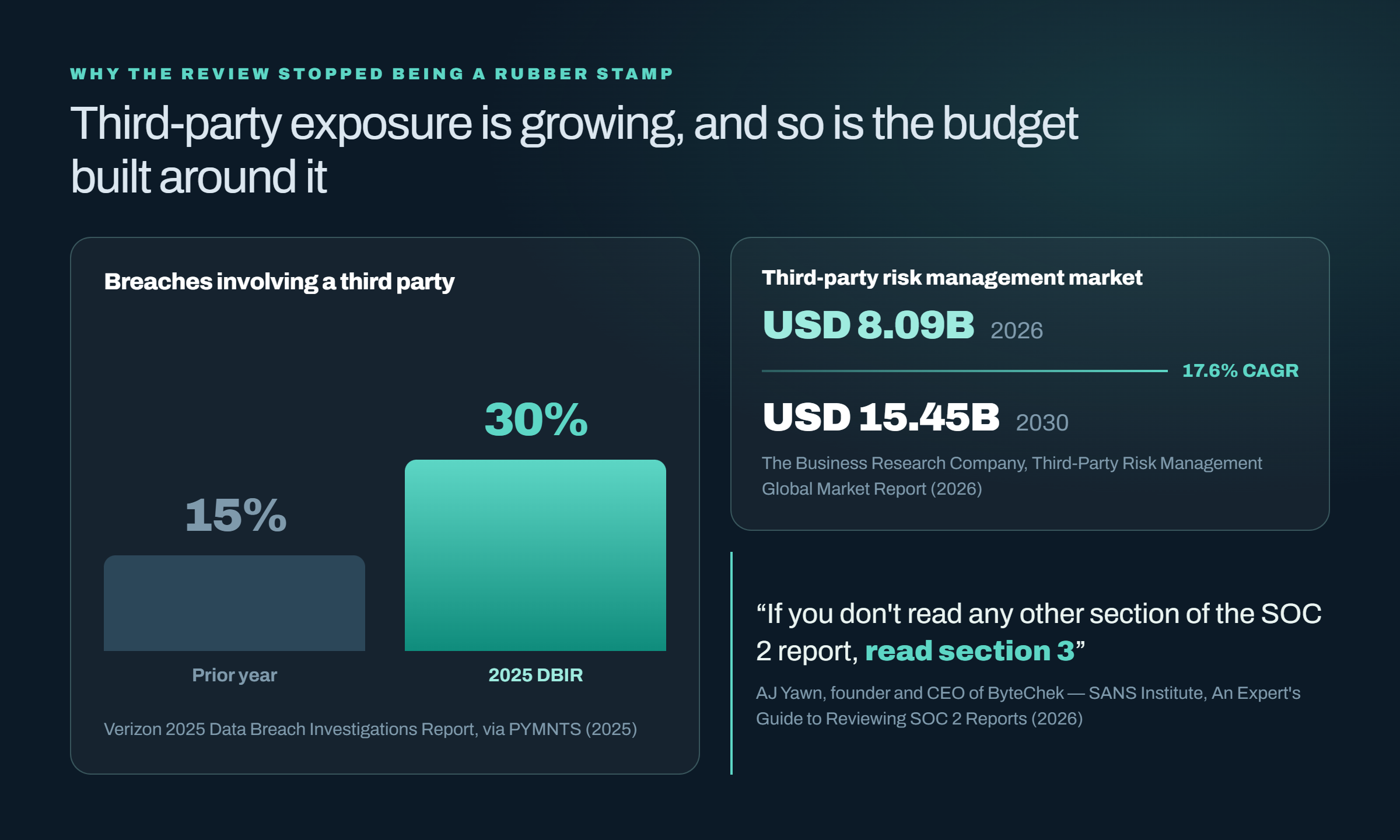
Third-party vendor risk has become one of the fastest-growing line items in enterprise security budgets. The global third-party risk management market was valued at roughly USD 8.09 billion in 2026 and is projected to reach USD 15.45 billion by 2030, growing at a compound annual growth rate near 17.6% (The Business Research Company, Third-Party Risk Management Global Market Report, 2026). That growth is not abstract: it reflects how many organizations have been forced to formalize vendor review after getting burned by a partner they never fully vetted.
The reason procurement teams can no longer treat this as a rubber-stamp step is in the breach data. According to Verizon's 2025 Data Breach Investigations Report, roughly 30% of data breaches involved a third party, up from 15% the year before (PYMNTS, 30% of Data Breaches Involve Victims' Third-Party Suppliers and Vendors, 2025). A reward API vendor sits inside that exposure window by definition, since it typically receives recipient names, emails, and sometimes phone numbers or employee IDs to deliver a gift card.
Reviewing the compliance documentation itself is where many procurement checklists fall short. AJ Yawn, founder and CEO of ByteChek and author of a SANS Institute guide on the topic, put it bluntly when writing about how to actually read a SOC 2 report rather than just filing it away: "If you don't read any other section of the SOC 2 report, read section 3" (SANS Institute, An Expert's Guide to Reviewing SOC 2 Reports, 2026). Section 3 is where the system description, scope, and subservice organizations live, and it is the section that tells you whether the SOC 2 report actually covers the parts of the vendor's system your data will touch.
It is tempting to route a gift card API through a lightweight vendor onboarding path because the integration surface looks small: an API key, a few endpoints, a webhook for delivery confirmation. But the risk profile is closer to a payments vendor than a typical SaaS tool.
A few reasons this category deserves full procurement rigor:
None of this means procurement should slow-walk every vendor evaluation into a months-long ordeal. It means the checklist needs to match the actual risk, rather than defaulting to "it's just an API" shorthand.
A SOC 2 Type II report (covering a period of time, not a point-in-time snapshot) is the baseline ask. But as the SANS guidance above notes, the scope section matters more than the cover page. Procurement teams should confirm:
If a vendor cannot produce a current SOC 2 report, or offers only a self-attested questionnaire, that is a gap to flag, not necessarily an automatic disqualifier, depending on your organization's risk appetite and the size of the program.
Because reward delivery requires PII, ask specifically how recipient data is encrypted in transit and at rest, how long it is retained after a card is delivered, and whether it is used for any purpose beyond fulfilling that transaction. A vendor that cannot answer retention questions precisely often has not built data lifecycle management into its product from the start.
Security review should be paired with an operational check: uptime history, redundancy across regions, and how the vendor handles catalog or currency gaps in the countries your program actually needs to reach. A vendor with strong security posture but thin coverage in your target markets will still create integration and support overhead later. Our guide on how to evaluate a digital rewards platform for a global workforce walks through the operational side of this evaluation in more depth.
The evaluation does not end at the security questionnaire. Procurement should confirm breach notification timelines (how many hours or days the vendor commits to), data residency requirements if applicable, and what happens to your data and unredeemed balances if the contract ends. These terms are often negotiable before signing and far harder to change afterward.
A few patterns are worth treating as genuine yellow or red flags rather than minor friction:
None of these automatically disqualify a vendor, but each one should trigger a direct conversation before the contract moves forward.
WINK by Wincube Global operates the infrastructure layer behind this exact evaluation: a gift card reward API built for organizations that need to move value across borders reliably and with a documented security posture. Wincube Global has processed over USD 220 million in gift card GMV in 2025 across a catalog of more than 30,000 gift cards spanning over 90 countries, and that scale is precisely why procurement diligence, catalog coverage, and delivery reliability matter as much as the initial integration experience. For more on how the underlying API model works, see what a bulk gift card API is and why platforms are adopting one.
If your procurement or security team is building out a vendor evaluation process for a rewards API and wants to compare notes on what a thorough review actually covers, this is a conversation worth having early rather than after a contract is already on the table. If this is relevant to your team, Contact Us and we can walk through what it would look like.
A SOC 2 Type II report should show which trust services criteria the vendor was audited against, over what time period, and whether any subservice organizations were carved out of scope. It should also disclose any testing exceptions and how management responded, which matters more for risk assessment than the report's cover letter or summary page.
It carries a different risk profile rather than a strictly higher one: reward APIs typically handle recipient PII and move cash-equivalent value, and often operate across multiple countries and currencies. That combination means procurement should evaluate data handling, cross-border compliance, and operational resilience alongside standard SaaS security criteria.
There is no fixed industry benchmark, but a review that only checks a box without reading the actual SOC 2 scope section or confirming breach notification terms in the contract is not a complete review, regardless of how quickly it is completed. Building a standard checklist in advance, rather than improvising per vendor, is what keeps thorough reviews from becoming slow ones.
Sources