Digital Gift Cards
CROSS BORDER GIFTCARD
API

When a SaaS renewal is 60 days out and the account looks flat, the fastest lever a Customer Success or RevOps team can pull is usually a discount. But that lever has a cost curve of its own: every point shaved off the renewal price resets the baseline for the next cycle, trains the buyer to wait for a better offer, and quietly erodes the net revenue retention number the board is watching. Is there a way to protect renewal rates without permanently discounting the contract?
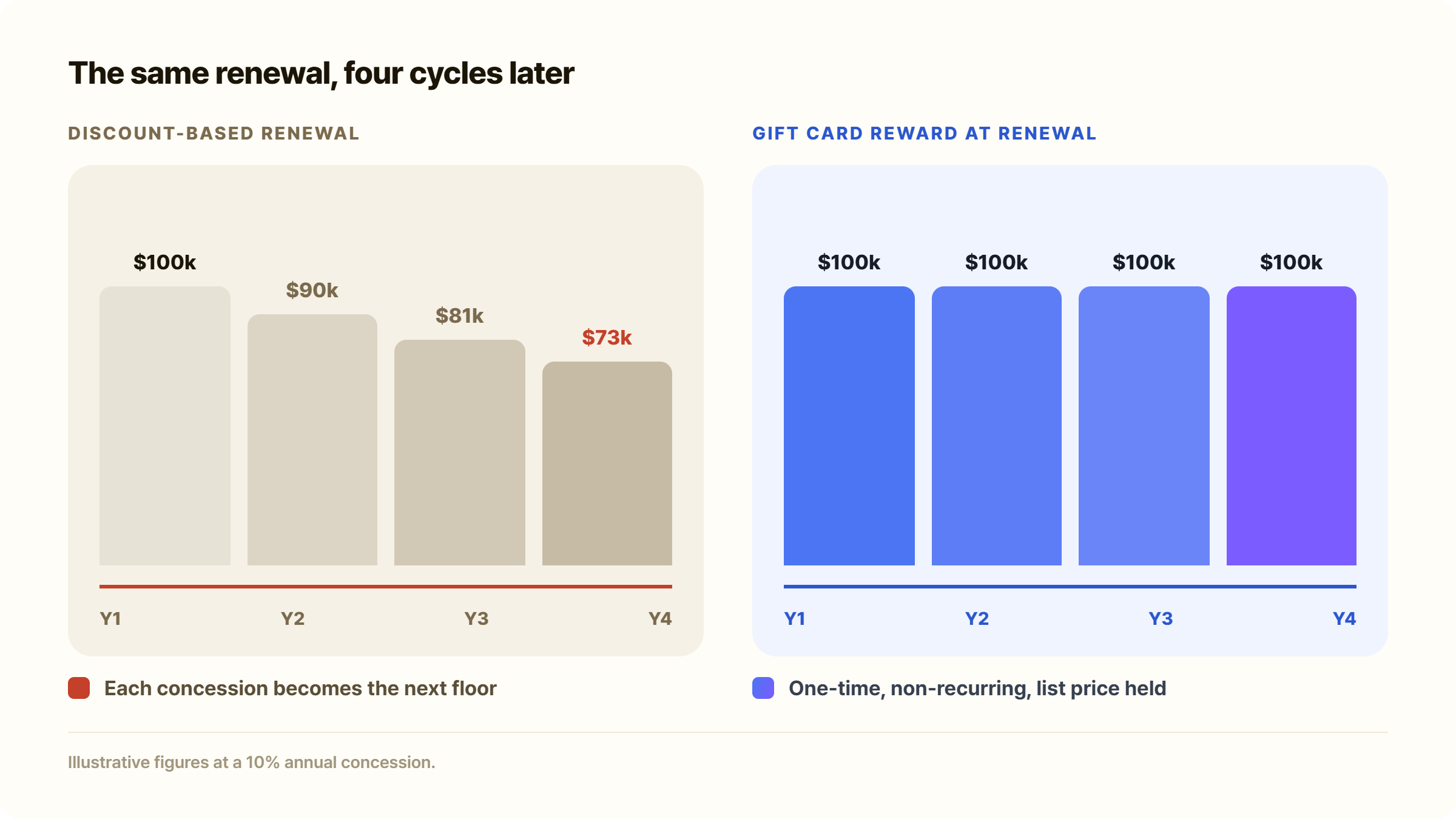
In short: Discount-based renewals buy short-term retention at the cost of long-term price integrity, since each concession becomes the new floor for the next negotiation. Gift card rewards tied to renewal and expansion milestones create a one-time, non-recurring incentive that motivates the same behavior, an on-time renewal or an upsell, without resetting the contract's list price. For SaaS platforms managing hundreds or thousands of renewals a year, that distinction is the difference between a renewal incentive infrastructure that scales and a discount habit that compounds against margin.
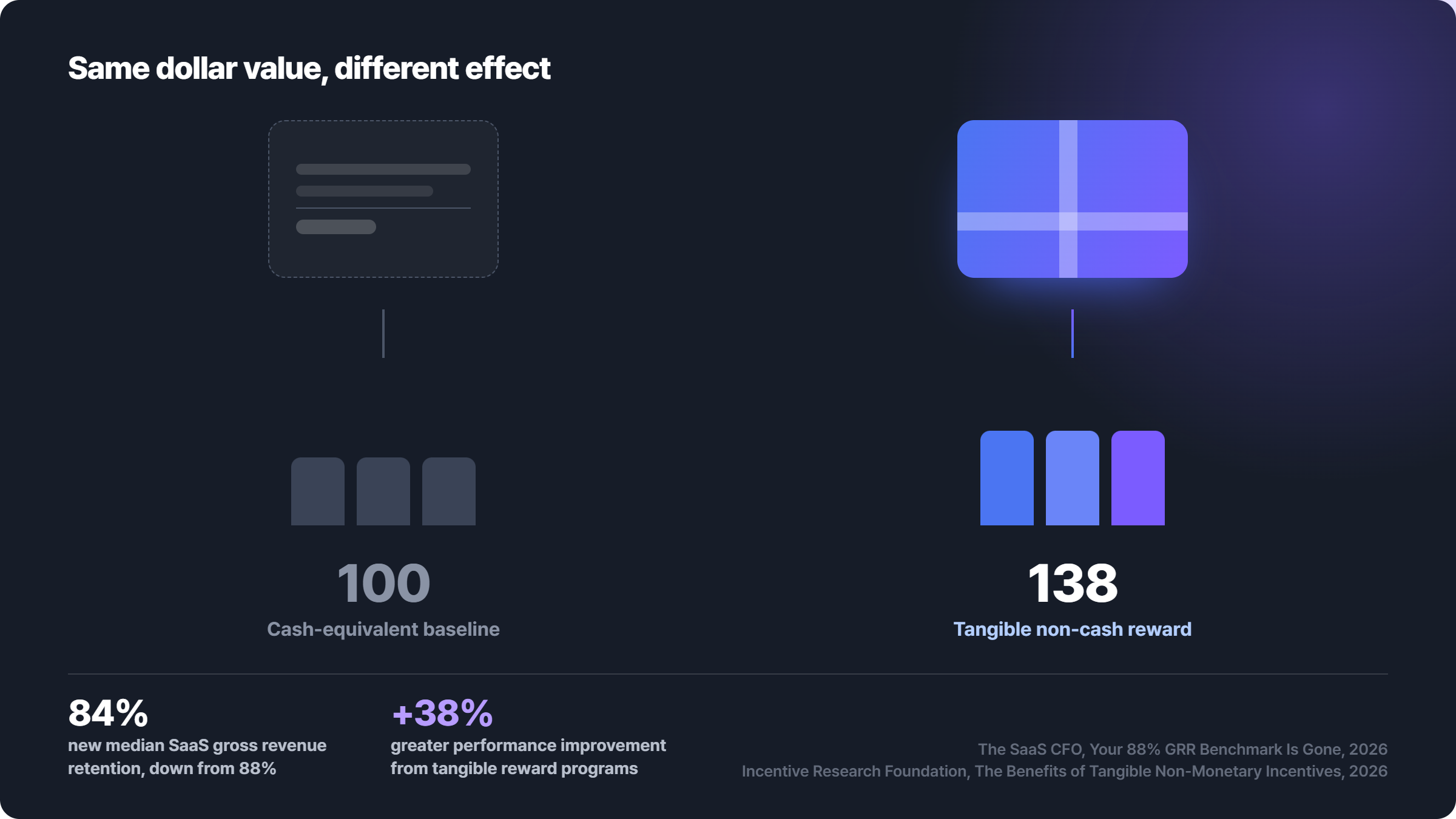
The pressure behind this decision has intensified. The median SaaS gross revenue retention benchmark fell from 88% to 84% in 2026, with the 75th percentile sliding from 95% to 91% (The SaaS CFO, Your 88% GRR Benchmark Is Gone. The New Median Is 84%., 2026). When the baseline for keeping revenue in place is dropping across the industry, RevOps leaders are under more pressure than ever to find a renewal lever that does not also erode the average contract value they are trying to protect.
The behavioral research behind incentive design points in a specific direction: tangible, non-cash rewards outperform cash-equivalent incentives of the same value. Programs built around tangible and experiential rewards, the category gift cards fall into, generate roughly 38% greater performance improvement than cash-equivalent programs (Incentive Research Foundation, The Benefits of Tangible Non-Monetary Incentives, 2026). A renewal discount is functionally cash: it lowers the invoice. A gift card reward is functionally different, even at an identical dollar value, because it is experienced as a reward rather than a price adjustment.
Every renewal discount sets a new reference price for the account. The next renewal negotiation does not start from the contract's list price, it starts from last year's discounted rate, and the buyer's procurement team remembers exactly what they paid. Over several renewal cycles this compounds: a modest concession made to save one at-risk account becomes the floor that account defends indefinitely, and any attempt to walk it back reads as a price increase rather than a return to normal.
Jay Bheda, co-founder of the customer success firm GainTrace, argues that the underlying issue is rarely the price itself. "Lead with the value you delivered, not the price. If you concede on price, trade it for a longer term or a commitment, never give it away," he writes, adding that a team that has genuinely delivered value can hold price "calmly and with evidence" (GainTrace, Why SaaS Renewals Keep Slipping (and How to Fix It), 2026). The same logic extends to the retention lever a CS team reaches for by default: a discount concedes on price by definition, while a gift card reward does not touch the contract's economics at all.
Gift card rewards for SaaS retention work on a different mechanism entirely. A reward tied to a renewal milestone, an early renewal, a multi-year commitment, or an expansion to a new team, sits outside the subscription price. It does not appear in the contract's unit economics, it does not lower the ACV baseline used for net revenue retention reporting, and it does not need to be matched or beaten at the next cycle because it was never a recurring term. For a RevOps team building renewal incentive infrastructure across a large book of accounts, that separation between the reward and the price is what keeps the incentive from turning into a permanent liability.
The practical challenge is operational, not conceptual: sending a locally relevant reward to a champion at a platform customer in Singapore looks nothing like sending one to a buyer in Brazil, and sourcing catalog options market by market does not scale past a handful of renewals a quarter. Platforms evaluating this shift as part of a broader rewards strategy have written about how to evaluate a digital rewards platform for a global workforce, and the same evaluation criteria, catalog breadth, delivery speed, redemption reliability, apply directly to a renewal incentive program aimed at external customers rather than internal employees.
For enterprise software renewal incentives specifically, the design question is usually where to draw the line between a reward and a concession. A pattern many CS and RevOps teams converge on: cap the reward's value at or below what an equivalent discount would have cost, deliver it only after the renewal or expansion is confirmed rather than as a pre-negotiation offer, and route it through a fixed catalog rather than an ad hoc gesture so the program stays auditable and repeatable across the account book. Framed this way, the reward behaves like a cost of retention that sits in a separate budget line from the subscription price, which keeps finance and RevOps aligned on what NRR and GRR are actually measuring.
The same structure extends naturally into expansion motions. A gift card reward for a champion who introduces a new department, or for a buying team that agrees to a multi-year term instead of an annual one, reinforces the same behavior a discount would try to buy, without permanently repricing the account for every renewal that follows.
Wincube Global, which has processed over USD 220 million in gift card GMV in 2025 across a catalog of more than 30,000 gift cards spanning over 90 countries, operates the kind of catalog and delivery infrastructure that a renewal incentive program depends on once it needs to reach customers and champions across more than one region.
For a platform business weighing whether to keep leaning on discount-based renewals or to build a renewal incentive infrastructure around non-cash rewards instead, the operational question is usually less about the concept and more about execution at scale: sourcing, delivery, and redemption across the countries where the customer base actually sits. If this is relevant to your team, Contact Us and we can walk through what it would look like.
No, it typically protects NRR rather than lowering it, because the reward sits outside the subscription price and does not reduce the invoiced amount used to calculate revenue retention. A discount reduces the ACV baseline the account is measured against every subsequent cycle, while a gift card reward is a one-time cost that never touches that baseline. This is one of the main reasons RevOps teams treat the two levers differently within their renewal incentive infrastructure.
Most programs cap the reward's value at or below what an equivalent discount would have cost and tie it to a specific, already-completed action, such as an on-time renewal signature or a multi-year commitment, rather than offering it during negotiation. Framing the reward as recognition for a completed commitment keeps it aligned with standard enterprise procurement and compliance expectations. Documenting the reward criteria in the renewal playbook also makes the program auditable across the full account book.
Yes, but it depends on the reward catalog covering the countries and currencies where the customer base actually sits, since a reward that only redeems locally in one market is not useful to a champion elsewhere. This is largely why platforms building a global renewal incentive program evaluate catalog breadth and delivery speed the same way they would evaluate any other piece of go-to-market infrastructure. Programs that skip this step tend to default back to cash or discounts simply because they are easier to deliver everywhere.
Sources