Digital Gift Cards
WINK
WINCUBE
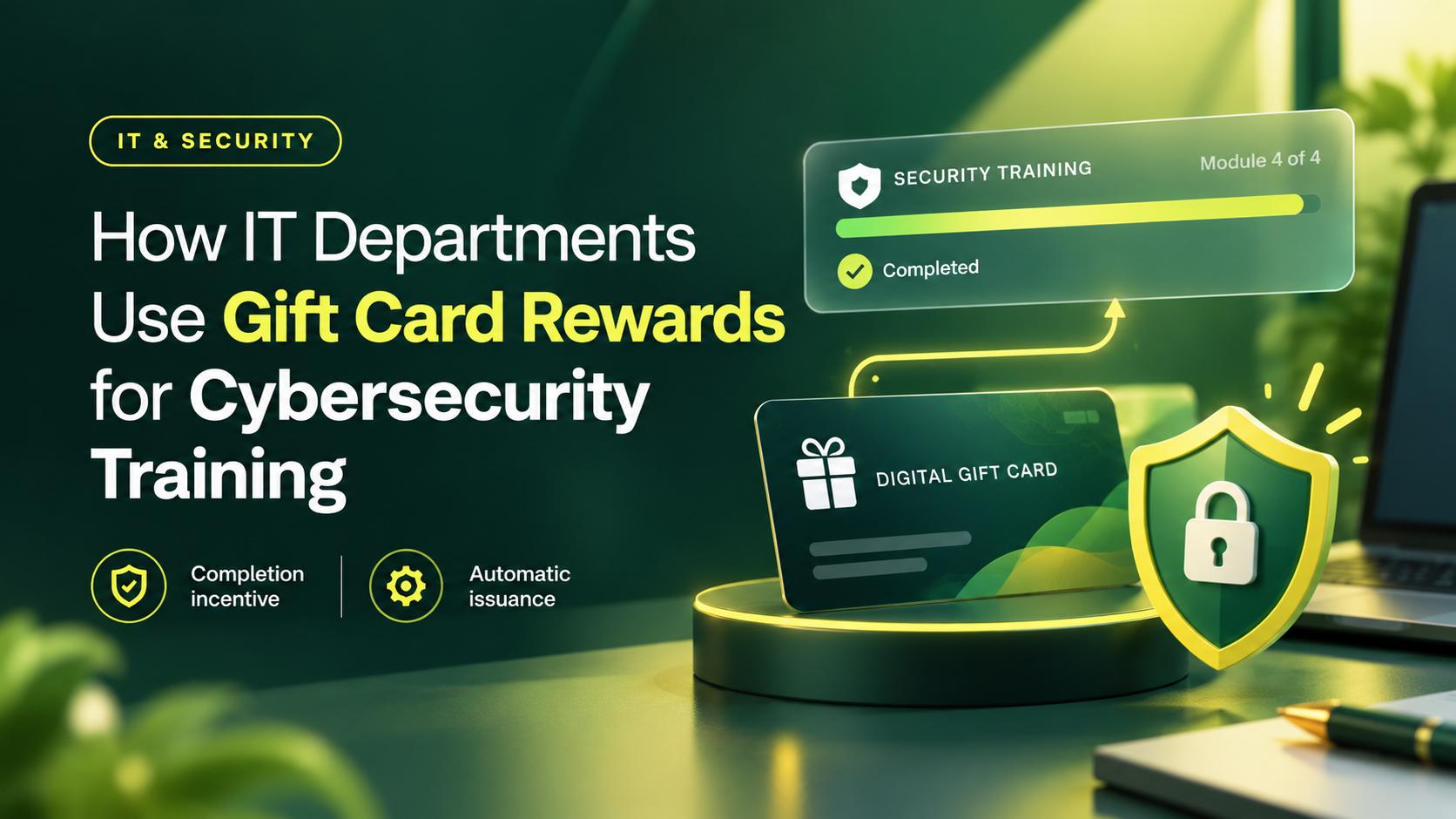

Every large organization runs mandatory cybersecurity training, and in almost every one, a stubborn slice of employees never finishes it. IT and security leaders chase down the same names quarter after quarter, escalate to managers, and still close out the cycle below target. The question those leaders are increasingly asking isn't how to build better training content. It's how to get the people who already have access to that content to actually complete it, and a growing number are answering that question with gift card incentives tied directly to completion.
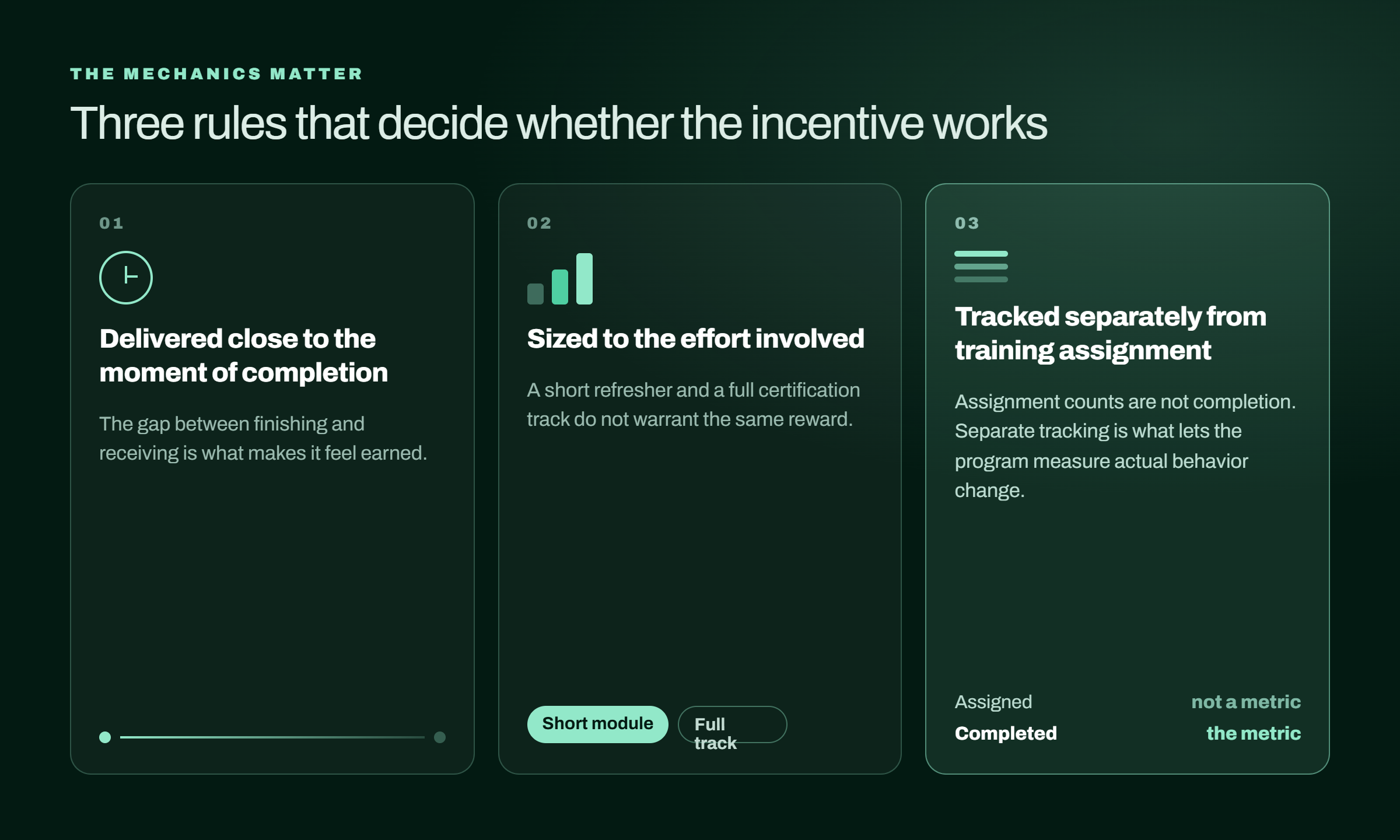
In short: IT departments use gift card rewards as a completion incentive layered on top of existing cybersecurity training platforms, issuing a digital gift card automatically when an employee finishes a required module or hits a completion deadline. This converts a compliance obligation into an immediate, tangible payoff, which reliably lifts completion rates compared to reminder emails and manager escalation alone. The mechanics matter: the reward should be delivered close to the moment of completion, sized to the effort involved, and tracked separately from simple training assignment so the program measures actual behavior change.
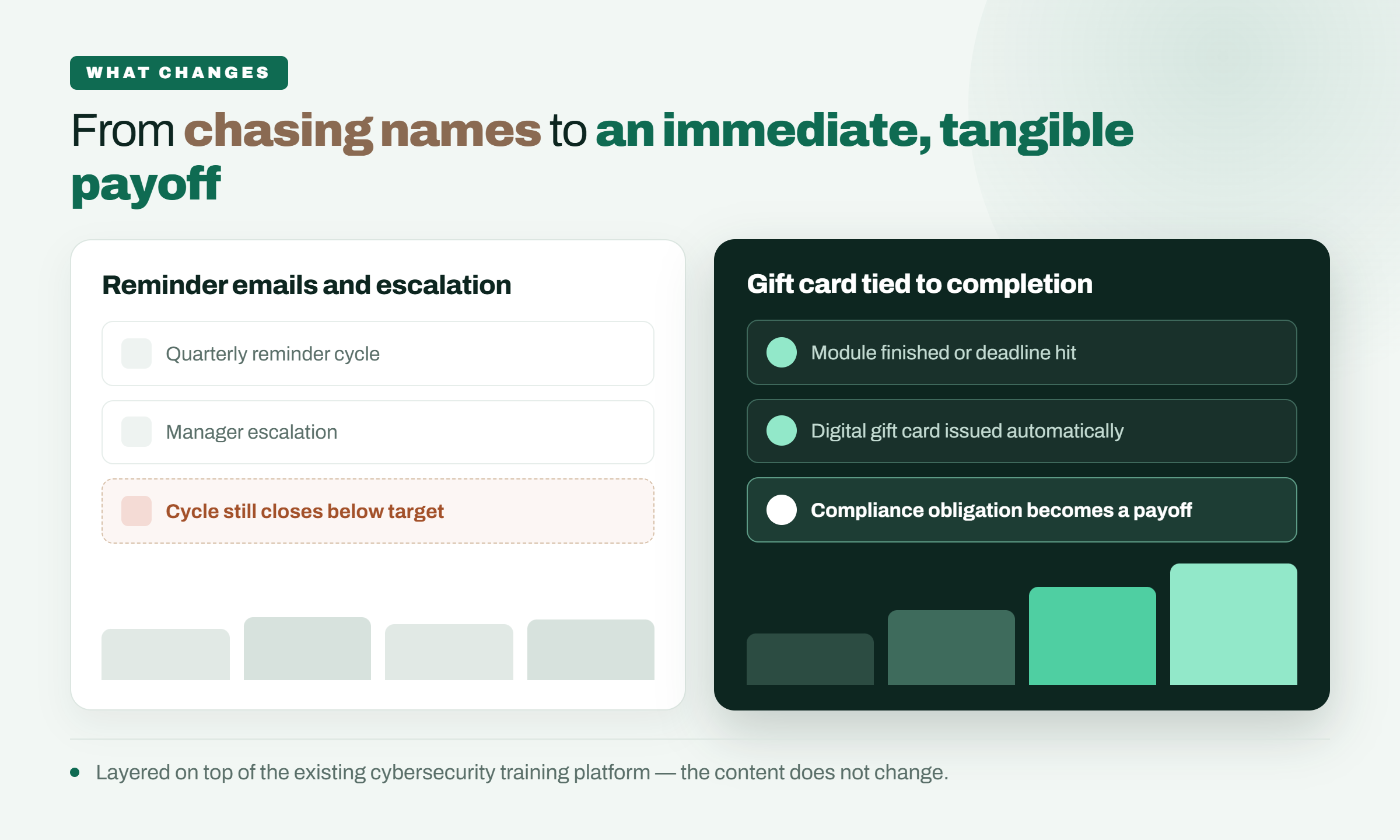
Mandatory doesn't mean prioritized. Most employees rank required security training below their actual job tasks, and without a deadline that carries real consequences, completion slides to the last week of the compliance window or past it entirely. Security and L&D teams have tried nudges, gamified dashboards, and manager pressure, with mixed results. A useful reference point: untrained employees fail phishing simulations at a 33.2% baseline rate, a number that falls to 4.2% after twelve months of continuous training, a 79% reduction (Hook Security, Security Awareness Training Statistics 2026: 25 Numbers, 2026). That gap only closes if people actually sit through the training in the first place, which is why completion, not just enrollment, has become the metric IT departments are held to.
Reward-based incentives address a specific failure mode: the training itself is fine, but the motivation to start it on time is not. L&D professionals have already moved in this direction outside of security specifically. Training magazine's incentive research found that a majority of learning and development professionals use incentive, award, or recognition programs in their current role, and roughly half use incentives specifically to drive training completion (Training Magazine, Incentivizing Training, 2026). Security teams are catching up to a practice that broader corporate learning functions have already validated.
A gift card program only works if it changes behavior, not just budget lines. Three design choices tend to separate programs that move completion rates from ones that quietly underperform.
Rewards that arrive weeks after a course is finished, bundled into a quarterly recognition batch, lose most of their behavioral pull. The incentive works best when it's issued automatically the moment an employee finishes the required module, so the payoff is associated with the action IT actually wants repeated: finishing on time. This is a workflow decision as much as a rewards decision, and it usually means connecting the training platform's completion event to an automated reward trigger rather than a manual approval queue.
A short annual refresher module doesn't need the same reward as a multi-hour role-based security certification. Matching the reward size to the time commitment keeps the program credible rather than either trivial or disproportionate, and offering a choice of gift card brands, rather than a single fixed option, respects that a distributed workforce has different preferences and different access to redemption options depending on where they're located. A single-brand card that isn't redeemable or appealing in an employee's country quietly defeats the purpose. For teams evaluating how to structure this kind of program for a workforce spread across multiple countries, How to Evaluate a Digital Rewards Platform for a Global Workforce covers the criteria that matter most when the reward has to work the same way in every office.
IT and security leaders need to be able to show, in the same report, both how many rewards went out and what completion rate resulted, broken out by team or region. Without that pairing, it's difficult to tell whether the incentive is driving the outcome or simply following it. Programs that report reward spend alongside completion lift give compliance and security leadership a clean way to justify renewing the budget the following cycle, particularly when a real-world result is available to point to: one case study involving a 12,000-employee financial services organization found that annual compliance training completion, which had been stuck at 72%, rose to 91% in the first cycle after the organization switched to instant reward delivery on course completion (All Digital Rewards, Training Completion Incentives, 2026).
Once a gift card incentive is live, the metrics that matter shift from "did people get the reward" to "did behavior actually change." That means tracking on-time completion rate against the prior cycle's baseline, the gap between assignment and completion date, and whether completion is improving fastest among the groups that previously lagged, since a program that only moves already-compliant employees isn't solving the actual problem.
It's also worth remembering that the incentive is a lever on top of program design, not a replacement for it. Melissa Van Dyke, President of the Incentive Research Foundation, has noted that "an incentive program or plan is much more than just the reward, and it is much more than a laboratory experiment" (Incentive Research Foundation, Motivating Today's Workforce: The Future of Incentive Program Design, 2022). In practice, that means the reward needs to sit inside a clear deadline, a simple redemption path, and a training experience that isn't itself the reason people were avoiding it.
Wincube Global, the company behind WINK, has processed over USD 220 million in gift card GMV in 2025 across a catalog of more than 30,000 gift cards spanning over 90 countries. For IT and security teams running a global or distributed workforce, that scale matters less as a headline number and more as a practical answer to a specific problem: a completion incentive program only works if the reward itself lands reliably, in a format employees actually want, wherever they happen to be logging in from.
Teams building a gift card incentive layer on top of existing training platforms are usually solving for the same handful of things: automated issuance tied to a completion event, brand variety that holds up across regions, and reporting that ties reward spend back to completion lift. If this is relevant to your team, Contact Us and we can walk through what it would look like.
Yes, when the reward is tied directly to the completion event rather than distributed separately. Programs that issue rewards automatically at the moment of completion, rather than in a delayed batch, tend to see the clearest lift because the incentive stays connected to the specific action the organization wants repeated.
There's no universal number, but the reward should scale with the time commitment of the training itself. A short annual refresher warrants a smaller reward than a multi-hour role-based certification, and keeping that ratio consistent across course types helps the program stay credible with employees rather than feeling arbitrary.
It can, but only if the reward catalog reflects where employees actually are. A single gift card brand that isn't redeemable or attractive in a given country undermines the incentive for that region, which is why IT departments running multi-country training programs typically need a platform offering multiple brands and delivery methods rather than one fixed reward.
Sources