Digital Gift Cards
Global Gift Cards
WINK
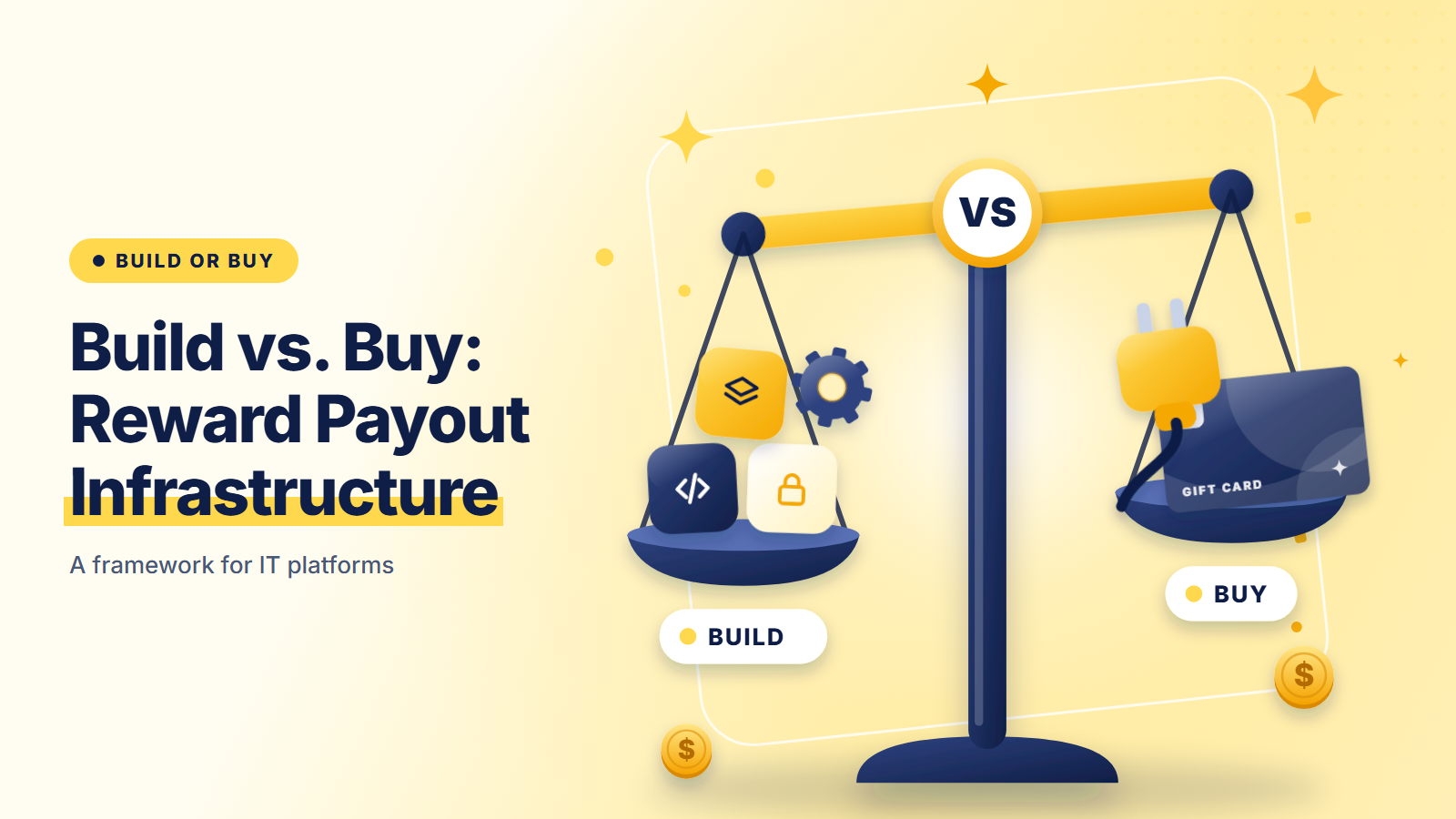

A product manager at a SaaS platform gets the same request every quarter: "Can we add rewards or incentive payouts to the product?" The instinct is to scope it like any other feature, estimate a sprint or two, and hand it to engineering. Then someone asks what happens when a user in Brazil, Japan, or Nigeria needs to redeem that reward, and the scope quietly triples. The real question isn't whether to add reward payouts. It's whether to build the infrastructure behind them or buy access to infrastructure that already exists.
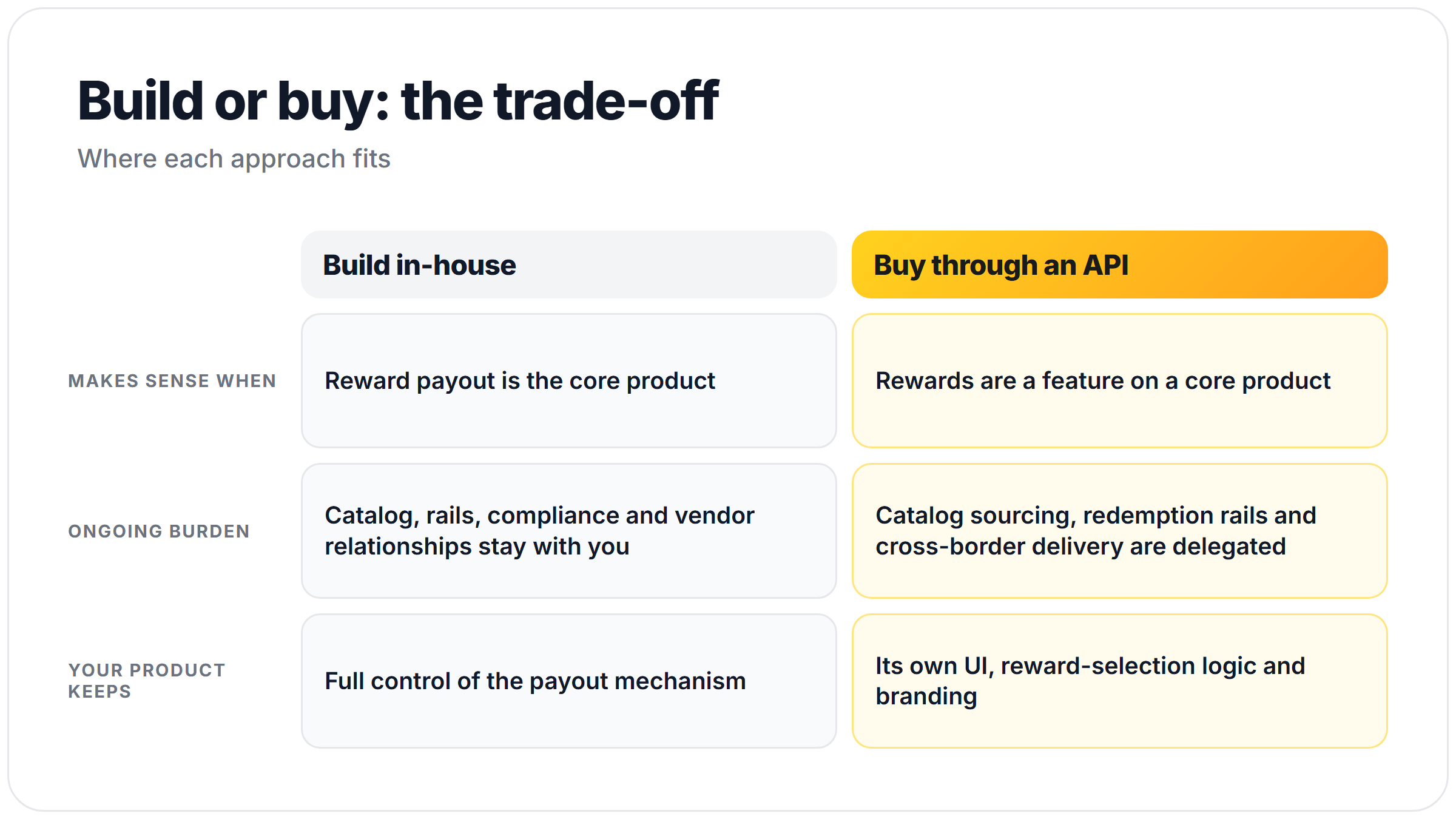
In short: For many IT and SaaS platforms, buying reward payout infrastructure through an API is often faster to launch and cheaper to maintain than building it, because the hard parts (currency coverage, local redemption rails, catalog maintenance, compliance) are ongoing operational burdens, not one-time engineering projects. Building makes the most sense when reward payouts are the core product itself, not a feature bolted onto one. The decision should be framed as a total-cost-of-ownership question, not a single sprint estimate.
Reward payouts get complicated quickly once they leave a single market, and that is what trips up teams that scope reward infrastructure like a normal feature. PYMNTS' reporting on embedded finance strategy notes that as adoption has widened, so has complexity: payments now span multiple geographies, currencies and regulatory regimes, fraud has grown more sophisticated, and compliance expectations have intensified (PYMNTS, The New Embedded Finance Playbook: Buy, Integrate, Scale, 2025). A reward payout system that looks manageable at a few hundred monthly redemptions can become hard to run at many times that volume, long after the initial build decision has been locked in.
The same tension shows up across the payments and fintech world, well beyond rewards. PYMNTS reports that Paulette Rowe, CEO of Stax, says the build, buy or partner decision now separates profitable SaaS platforms from stalled ones (PYMNTS, Vertical SaaS Platforms Find Path to Profits With Partners, Says Stax CEO, June 2025). The same logic applies to reward payouts: a decision made by an engineering team scoping a Q3 roadmap item can shape the platform's cost structure and roadmap capacity for years afterward.
The initial build estimate for reward payouts often covers only the visible layer: an API endpoint, a database of reward options, and a redemption confirmation email. What it can miss is everything underneath that layer.
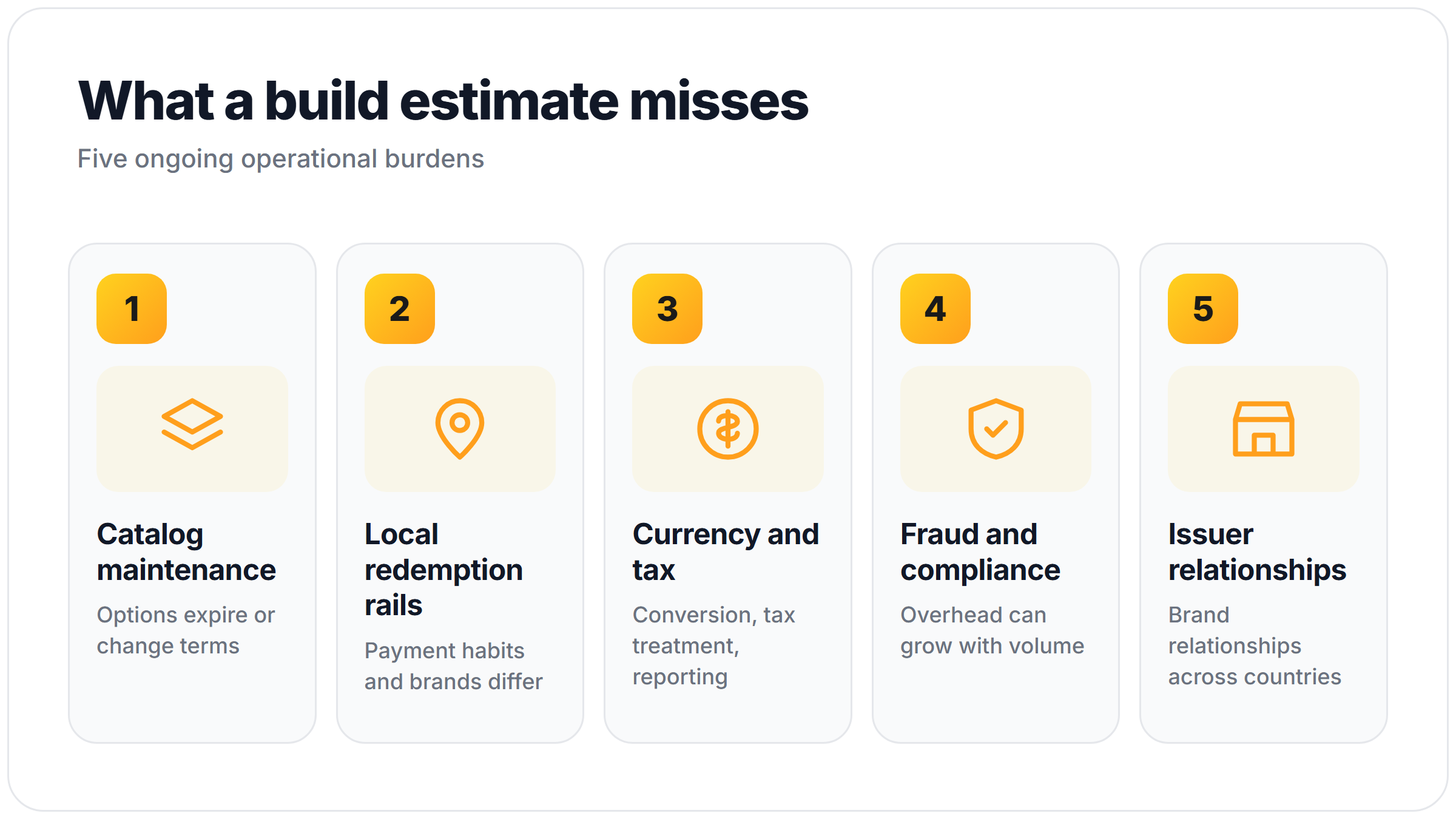
None of these are engineering problems that get solved once. They are operational functions that require ongoing headcount, vendor relationships, and monitoring, which is precisely why the total cost of ownership for a built solution can diverge sharply from the initial project estimate.
Rather than treating build vs. buy as a binary, IT platform teams evaluating reward payout infrastructure should work through four questions in order.
If the platform's entire value proposition is the reward experience itself, for example a rewards-first fintech app, building or deeply customizing may be justified. If rewards are a retention or engagement feature layered onto a core product like project management, HR software, or a marketplace, the payout mechanism itself is unlikely to be a competitive differentiator worth owning.
An initial build estimate rarely accounts for catalog refresh cycles, compliance updates, new-market expansion requests from sales, or the engineering time diverted from the core product roadmap every time a reward-related bug or outage occurs. Model the three-year cost, including the opportunity cost of engineering time not spent on the core product.
A platform serving a single country can often get away with a simpler build, because the local redemption landscape is narrower. A platform with users across a dozen countries is signing up to maintain a dozen sets of local reward relationships, which is a materially different commitment than a single-market build.
When a reward fails to redeem for a user in a market the platform doesn't have local expertise in, someone needs to diagnose whether it's a catalog issue, a currency issue, or an issuer-side outage. Before you buy, ask the vendor what support path exists for redemption failures, because that is the layer your own team would otherwise have to staff.
Buying reward payout infrastructure does not mean giving up control of the user experience. A well-designed API integration lets the platform keep its own UI, its own reward-selection logic, and its own branding, while delegating the parts that don't differentiate the product: catalog sourcing, redemption rails, and cross-border delivery. For platforms evaluating vendors, the practical questions worth asking during an IT vendor gift card API evaluation are less about price and more about catalog breadth, country coverage, API documentation quality, and how the vendor handles redemption failures. Wincube Global's guide to evaluating a bulk gift card API walks through the specific technical and operational criteria worth checking before signing on with any provider.
Wincube Global provides gift card infrastructure through real-time API integration and bulk fulfillment. It has processed over USD 220 million in gift card GMV in 2025 across a catalog of more than 30,000 gift cards spanning over 90 countries, with a Global Catalog of international brands alongside its Korean Catalog. For an IT or SaaS platform, that is infrastructure you can integrate instead of building catalog sourcing and fulfillment yourself.
For a platform team weighing whether reward payouts belong on the internal build roadmap, the more useful exercise is often not "can we build this" but "should this be where our engineering time goes for the next three years." If this is relevant to your team, Contact Us and we can walk through what it would look like.
It can be, mainly when reward payout is the core product rather than a supporting feature and the platform has the sustained operational capacity to maintain catalog relationships, local redemption rails, and compliance across every market it serves. For many platforms adding rewards as a retention or engagement layer, the ongoing operational burden can outweigh the control gained from building.
One commonly underestimated cost is ongoing catalog and vendor relationship maintenance, not the initial integration. Reward options and local redemption rails change continuously across markets, and that maintenance work scales with the platform's geographic footprint and transaction volume rather than staying fixed after launch.
Focus on country and currency coverage relative to your actual user base, the depth and clarity of the API documentation, how the vendor handles redemption failures and support escalations, and how frequently the catalog is refreshed. Price matters less than whether the vendor's operational reach actually matches where your users are.
Sources