Digital Gift Cards
Global Gift Cards
WINK
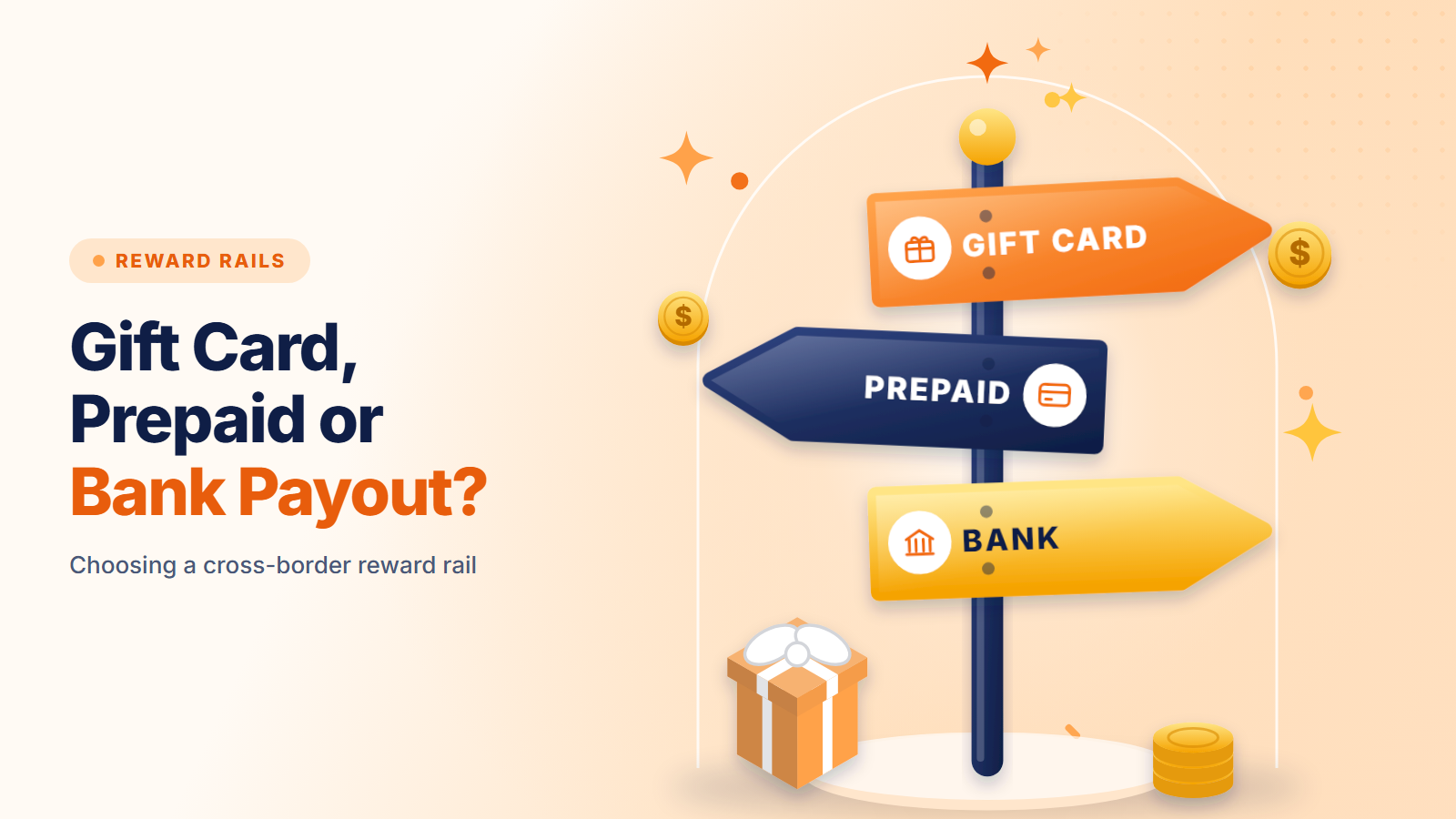

If you run rewards or payments for a global platform, you will eventually face the same question: when a recipient in another country has earned a reward, which rail should carry it? A local-brand gift card, a prepaid card and a bank payout can all deliver value across a border, but they behave very differently once the money leaves your account. Many comparisons you will find are written by sellers of one rail, and we sell gift cards, so we have built this framework on four criteria that apply to any rail: recipient experience, local redemption relevance, compliance, and reconciliation effort.
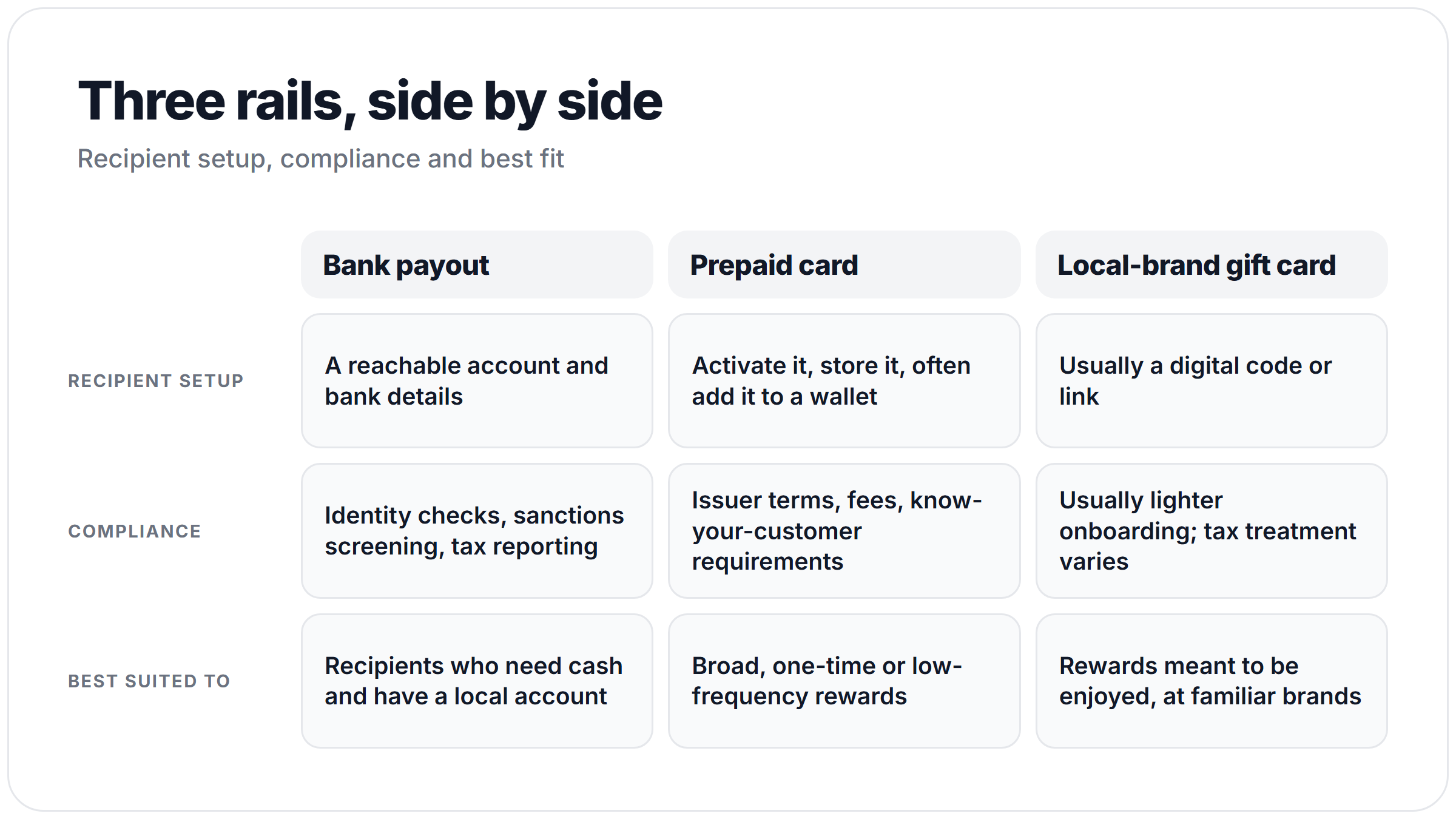
In short: No single rail wins everywhere. Bank payouts suit recipients who need cash and are reachable through a local account, prepaid cards suit broad, one-time or low-frequency rewards where recipients value flexibility, and local-brand gift cards suit rewards meant to be enjoyed rather than banked, especially where recipients already shop at familiar brands. Choose per market and per reward purpose, and score each rail against the same four criteria before you commit.
Cross-border money movement is a very large market, and the rails underneath it keep multiplying. FXC Intelligence estimated the total cross-border payments market, wholesale and non-wholesale combined, at $194.6 trillion in 2024 and forecast it to reach roughly $320 trillion by 2032 (FXC Intelligence, New data: cross-border payments market now worth over $194tn and is forecast to reach $320tn by 2032, 2025). Reward payouts are a tiny slice of that, but the point carries over: payment infrastructure is evolving quickly, and the default option is no longer the only option.
For a rewards team, the cost of a poor rail choice rarely shows up as a fee line. It shows up as a recipient who drops off before the reward reaches them, a finance team chasing mismatched records, or a compliance review that arrives after launch. That is why a structured comparison is worth the effort.
One payments executive frames the issue as one of local fit. Stuart Neal, CEO of Boku, argued that cross-border commerce would shift toward a "local-first" mindset in 2026 as more merchants realize that a card-centric approach leaves gaps where consumers favor local payment methods (The Power50, 2026). That view is about payments in general, but the same logic applies to rewards: a rail that feels native to the recipient may be more likely to be used.
Think about what the recipient must do to turn the reward into value.
A simple rule of thumb: the less the recipient already trusts or uses the rail, the more setup you are asking them to do, and the more likely some recipients are to drop off.
Relevance asks whether the reward can be spent on things the recipient actually buys. A global prepaid card may technically be accepted in many places, yet be awkward for local online merchants or domestic payment habits. A bank payout is the most flexible but turns the reward into ordinary money that disappears into daily spending. A local-brand gift card is the most specific, and that specificity is both its strength and its limit.
Consider a hypothetical example. A platform wants to thank a panel of contributors in a market where a handful of domestic retail, food and entertainment brands dominate everyday spending. A catalog of local-brand gift cards lets each recipient pick something they will genuinely use. In a market where recipients are mostly professionals who expect cash for services rendered, a bank payout is likely the better fit. The right answer changes with the audience, not just the country.
We explored this local-relevance idea from the supply side in The Future of Global Gift Cards Is Local, which looks at why recipients respond better to brands they recognize.
Compliance requirements differ by rail:
Rules on the tax treatment of rewards vary widely and change over time. Treat this section as general guidance only, and confirm the specifics for each market with local legal and tax counsel before you launch a program.
Reconciliation is the criterion that most comparisons skip, and finance teams feel it most. Ask three questions of each rail:
Bank payouts produce clean transfer records but can generate returns and failures that need manual follow-up when details are wrong. Prepaid cards add a layer of card-program reporting and balance tracking. With gift cards ordered through an API, you can keep a per-order record on your own side, but a catalog spanning many brands and currencies needs consistent data handling too. Whatever you pick, a single integration with a uniform order record can do more to reduce the ongoing workload than a small difference in unit cost.
Instead of choosing one rail for everything, score each combination of market and reward purpose.
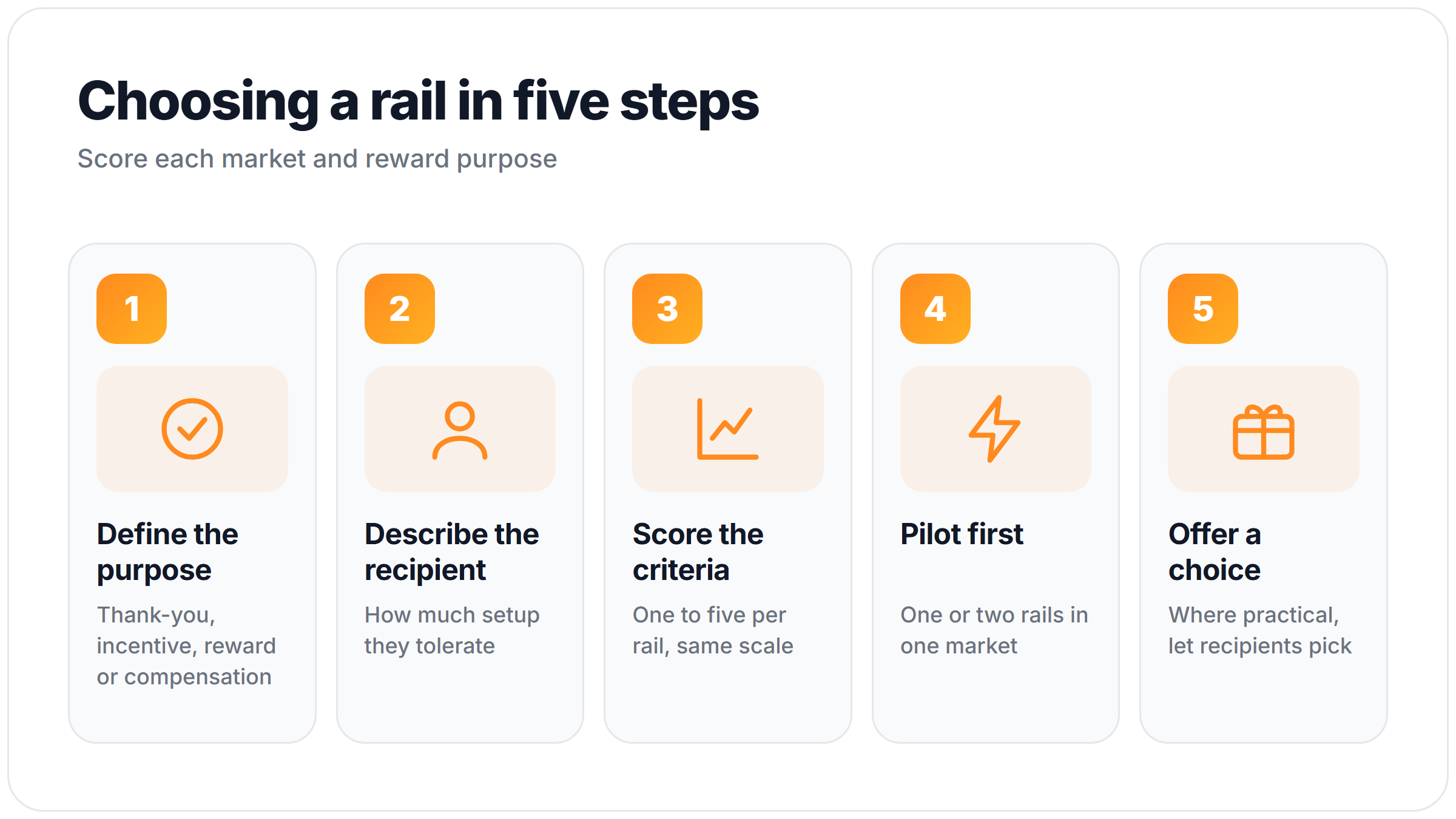
If you are also assessing platforms for a distributed audience, our guide to How to Evaluate a Digital Rewards Platform for a Global Workforce covers the questions to ask about coverage, delivery and reporting.
A note on fraud: any rail that delivers value digitally can be targeted, so build basic safeguards such as delivery verification, volume limits and monitoring for unusual redemption patterns into your design from the start.
Wincube Global works on the local-brand gift card side of this decision. It provides gift card infrastructure through real-time API integration and bulk fulfillment, and has processed over USD 220 million in gift card GMV in 2025 across a catalog of more than 30,000 gift cards spanning over 90 countries, with a Global Catalog of international brands alongside its Korean Catalog. For teams that conclude local-brand gift cards are right for some of their markets, that breadth gives you more brands to match against what recipients actually buy, through one integration.
That is not a claim that gift cards are the answer everywhere. Many programs end up with a mix, using bank payouts where cash is expected and gift cards where relevance and low friction matter more. If you are mapping out that mix, we are glad to share how a catalog-based approach works in practice. If this is relevant to your team, Contact Us and we can walk through what it would look like.
It depends on the audience, but local-brand gift cards often need the least setup because recipients receive a code or link and spend it at a familiar brand. Bank payouts need account details and prepaid cards need activation, so both add steps. Pilot with a small group to see which rail your recipients actually complete.
Cash lands directly in the recipient's account, but the trade-off is more onboarding, identity checks and potential payout failures when bank details are wrong. Tax and reporting treatment varies by country, so confirm the details with local counsel.
Yes. One approach is to match the rail to the reward purpose and market, for example bank payouts for compensation and local-brand gift cards for appreciation rewards. Using one integration and one record format across rails can keep reconciliation manageable.
Sources