Digital Gift Cards
Global Gift Cards
CROSS BORDER GIFTCARD
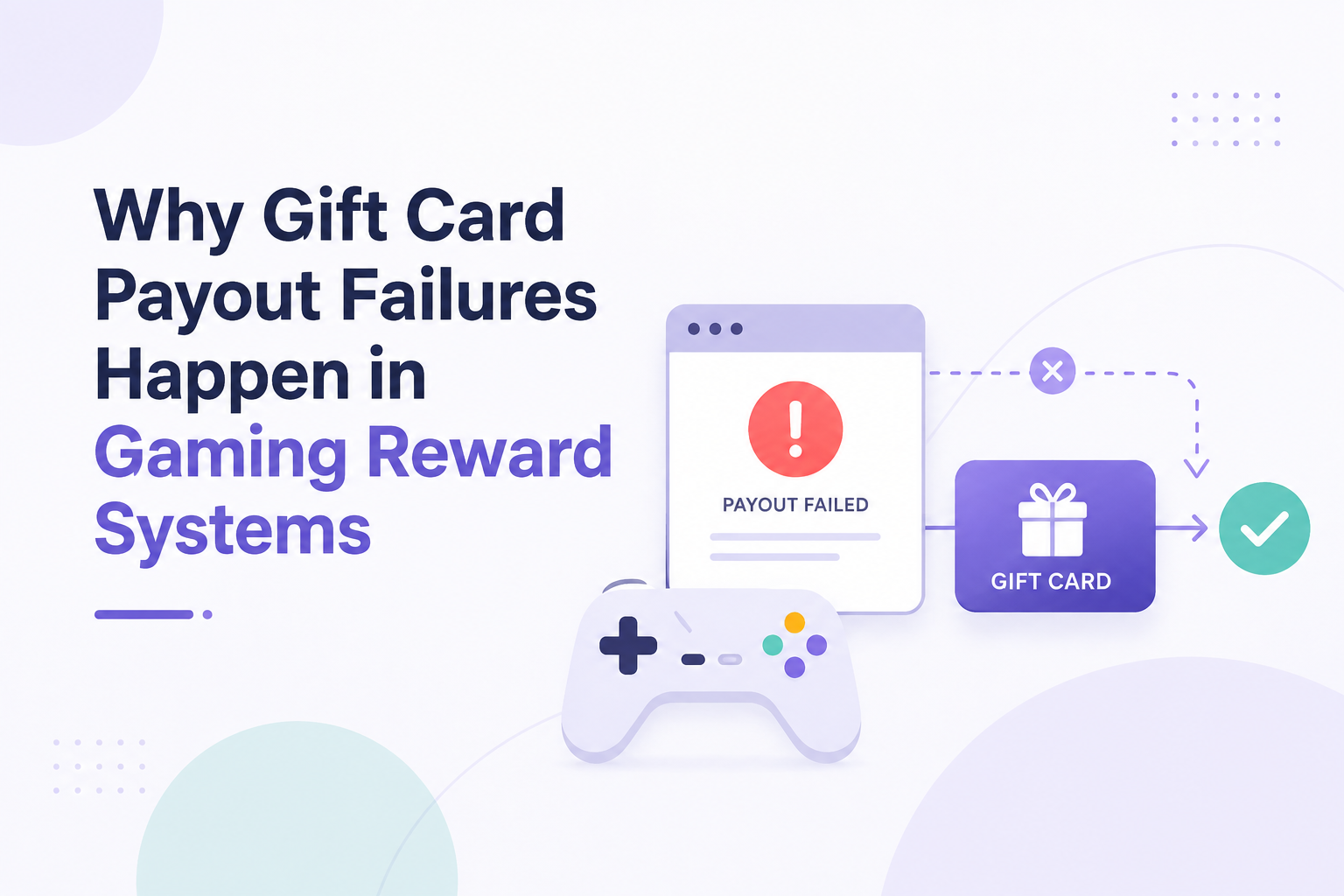

A player finishes a tournament, taps "claim reward," and the app hangs for a few seconds before finally showing a spinner timeout. They tap again. Ten minutes later, support gets a ticket: the player received two gift cards instead of one, or received none at all while the platform's ledger insists the payout succeeded. For engineering and product leads building reward and payout systems on top of third-party gift card APIs, this is not a hypothetical edge case. It is one of the most common and most expensive failure modes in gaming reward delivery, and it almost always traces back to the same root cause: a payout request that was retried without a way to tell the system it had already been fulfilled.
In short: Gift card payout failures in gaming reward systems are rarely caused by the gift card itself; they are caused by how the request to issue that card was sent, retried, and reconciled across an unreliable network. Webhook timeouts, client-side retry taps, and reconciliation jobs all create the conditions for the same reward event to fire more than once. Idempotent APIs, where every payout request carries a unique key that the provider uses to guarantee a single execution no matter how many times the request arrives, close this gap and turn a fragile payout flow into one that engineering teams can trust at scale.
The pressure on these flows is only growing. The global market for virtual currency, the adjacent category of digital value that gaming platforms increasingly issue alongside or instead of cash payouts, is forecast to grow from USD 3.05 billion in 2025 to USD 3.43 billion in 2026, and reach USD 5.48 billion by 2030 at a compound annual growth rate near 12.4% (The Business Research Company, Virtual Currency Global Market Report, 2026). As more of a gaming platform's economy moves through automated, API-driven payout rails rather than manual disbursement, the volume of reward events that can be duplicated, dropped, or double-processed scales right along with it.
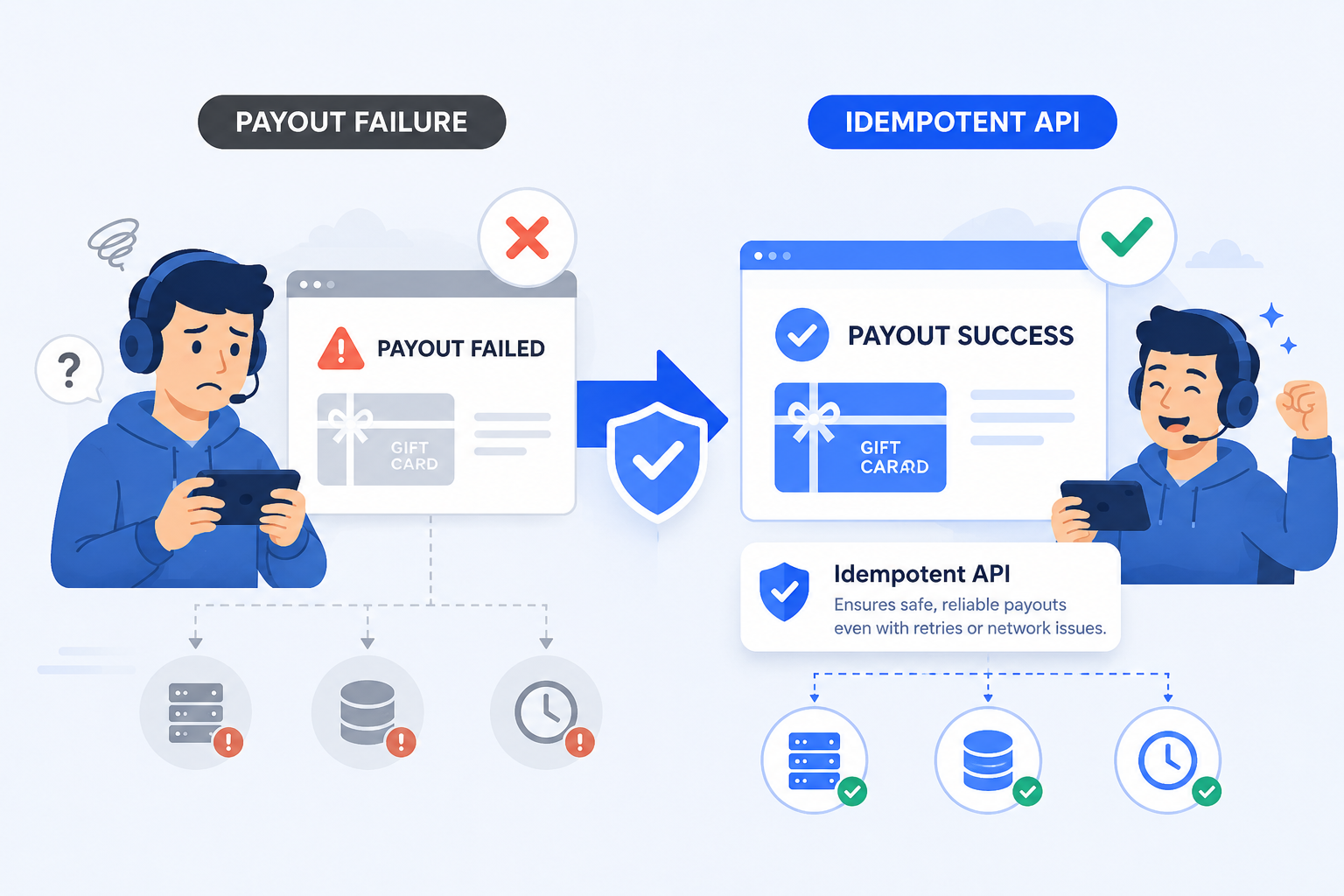
Most engineering teams assume payout failures mean the gift card provider's system went down. In practice, the far more common failure is a duplicate: the reward was issued correctly, but the platform's own retry logic, or the provider's, caused it to be issued again.
When a gaming platform calls a gift card API to fulfill a reward, the response often arrives asynchronously through a webhook: the platform submits the payout request, and the provider confirms success or failure via a callback once the card is issued. Most webhook-delivery systems operate on an at-least-once guarantee, meaning the provider will retry delivery if it does not receive a timely acknowledgment from the platform's endpoint. A slow database write, a brief spike in traffic during a tournament, or a deploy that restarts the listener mid-request are all ordinary conditions that can delay that acknowledgment past the provider's timeout window. The provider, having no way to know the first delivery actually succeeded, retries. If the platform's handler processes that retried webhook as a brand-new event rather than recognizing it as a duplicate, the player gets paid twice.
The same pattern shows up on the request side, not just the callback side. A player's app that shows a loading spinner for a few extra seconds during a network hiccup invites exactly the behavior described in the opening scenario: an impatient tap, or an automatic client-side retry built to improve perceived reliability, resubmits the same "claim reward" action. Without a mechanism to recognize that this is the same intent expressed twice, the platform's backend has no way to distinguish "the player wants two rewards" from "the player's first request just hasn't confirmed yet."
Gaming platforms commonly run batch jobs that reconcile pending rewards against payout status, especially for tournament payouts or milestone-based loyalty programs processed in bulk. If that job's query for "rewards not yet confirmed as delivered" overlaps with rewards that were, in fact, delivered but whose confirmation record hasn't yet landed due to normal processing lag, the job can re-issue payouts that already went out. This is a timing problem, not a bug in either system individually, but it produces the exact same player-facing symptom: a duplicate gift card.
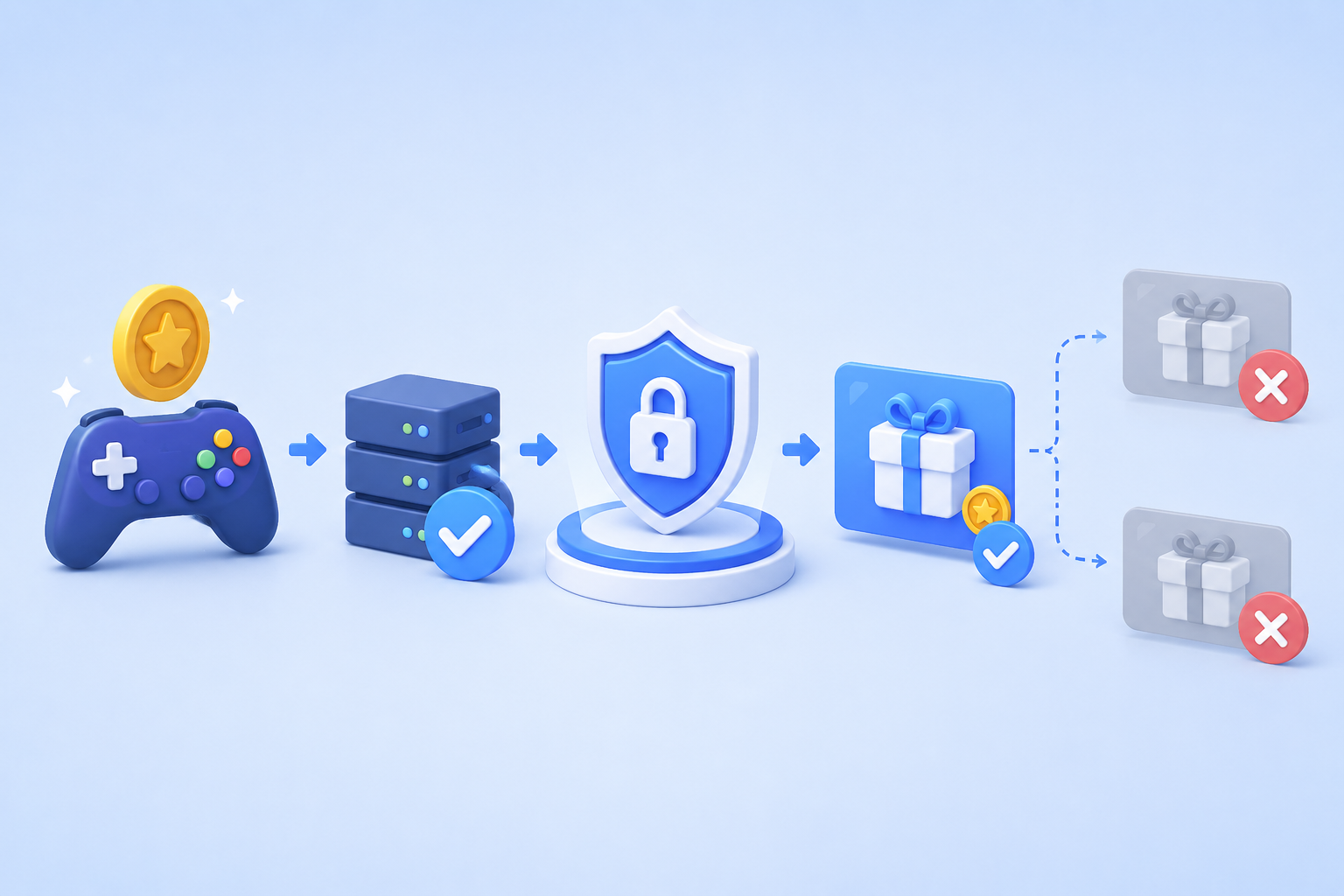
An idempotent API is one where making the same request multiple times produces the same result as making it once. In the context of gift card payout APIs, this means the platform generates a unique idempotency key, typically derived from the specific reward event, such as a player ID combined with a tournament ID and reward tier, and attaches that key to every payout request tied to that event.
When the provider receives a request with a key it has already processed, it does not issue a second card. Instead, it returns the original result: the same gift card code, the same transaction status, the same confirmation the platform received the first time. This holds true whether the duplicate request came from a webhook retry, a client-side double-tap, or a reconciliation job re-submitting the same payout. The deduplication happens at the provider's system of record, not in the platform's own retry-handling code, which means the safety net doesn't depend on every engineer on the team remembering to write defensive checks correctly every time.
This is a meaningfully different guarantee than simply "handling errors gracefully." Error handling assumes the platform can tell success from failure. Idempotency assumes it sometimes can't, and makes that ambiguity safe by default rather than requiring the platform to resolve it before acting.
A frequent implementation mistake is generating a new random ID for every request attempt, treating idempotency the same as basic request tracing. An idempotency key needs to represent the underlying business event, not the individual network call. If a retry generates a new key because it's technically a new HTTP request, the provider has no way to recognize it as a duplicate of the original, and the entire protection collapses. The key should be deterministic and reproducible from the reward event itself, so that the fifth retry of the same claim generates the identical key as the first attempt.
Beyond adopting an idempotent provider API, a few structural choices determine whether a gaming platform's reward flow is actually resilient in practice.
None of these require abandoning automation or slowing down the player experience. They require treating "this request might be a duplicate" as the default assumption for any payout call, rather than an exception to handle after the fact.
WINK is published by Wincube Global, which has processed over USD 220 million in gift card GMV in 2025 across a catalog of more than 30,000 gift cards spanning over 90 countries. Reward and payout reliability at that scale depends on the same principle covered above: every payout request needs a way to be recognized as a duplicate before it becomes a duplicate card in a player's hands. If your team is evaluating how a gift card API partner handles idempotency, webhook retries, and reconciliation for reward or payout flows, we're happy to talk through how those mechanics work in practice, with no pressure and no obligation.
What is idempotency in a gift card payout API? Idempotency means that sending the same payout request multiple times, whether due to a webhook retry, a client-side retry, or a reconciliation job, produces exactly one gift card issuance rather than one per request. The API recognizes repeated requests by a unique key and returns the original result instead of processing the action again.
Why do webhook retries cause duplicate gift card payouts in gaming platforms? Most webhook systems guarantee at-least-once delivery, meaning the provider will resend a callback if it doesn't get a timely acknowledgment from the platform. If the platform's handler treats every incoming webhook as a new event rather than checking whether it has already processed that event ID, a retried webhook can trigger a second reward issuance for the same original event.
How is an idempotency key different from a regular request ID? A regular request ID is often generated fresh for each network call, including retries, which means it can't be used to detect duplicates. An idempotency key needs to be derived from the underlying business event, such as a specific player's specific reward claim, so that every retry of that same event produces the identical key and the provider can recognize it as a repeat rather than a new request.
Sources
Related reading: In-Game Reward Payouts: Gift Card APIs vs. Building an In-House Wallet System
If this is relevant to your team, Contact Us and we can walk through what it would look like.
Contact Email : win-obdteam@wincubemkt.com