Digital Gift Cards
Global Gift Cards
CROSS BORDER GIFTCARD
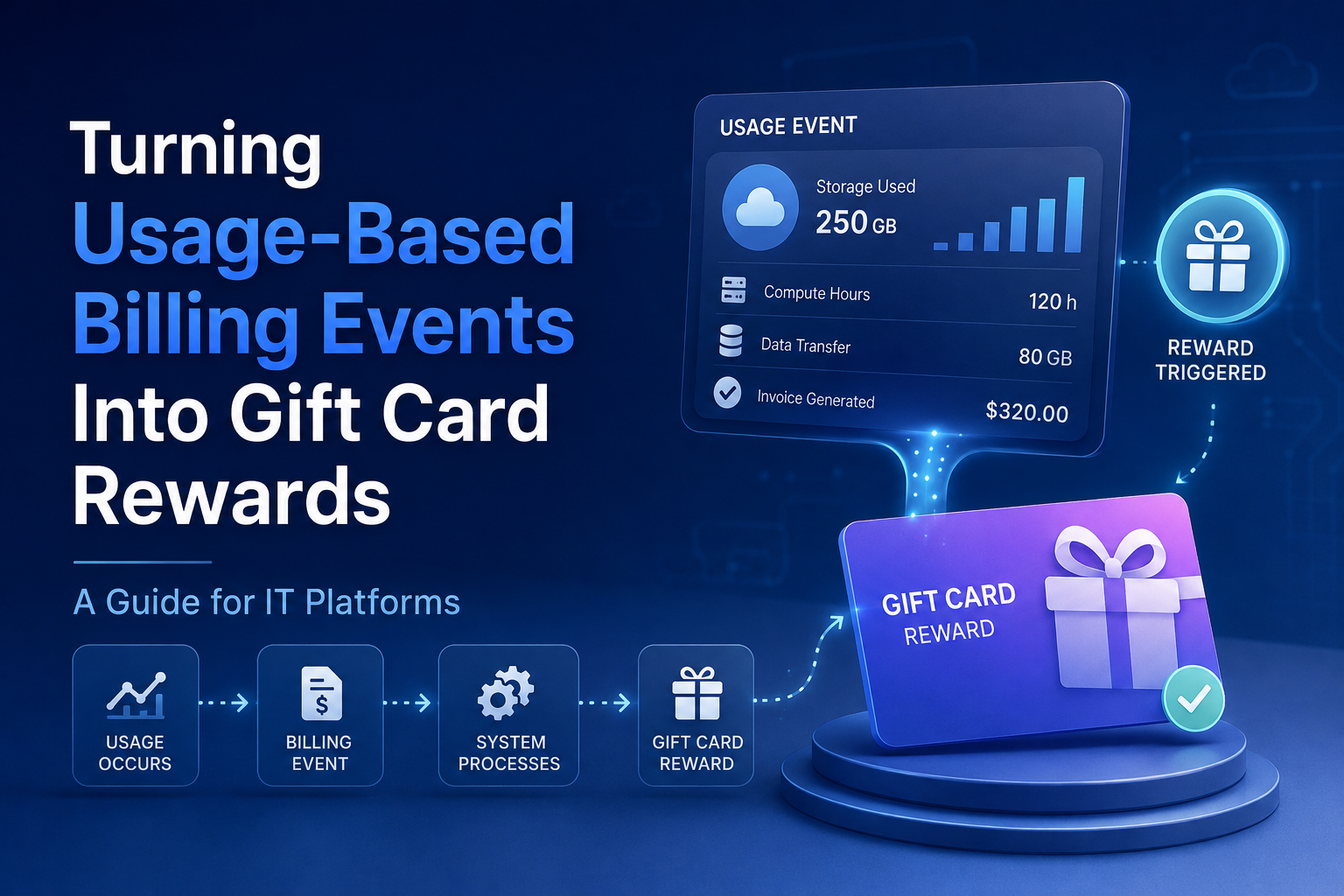

A customer crosses a usage threshold on your metered plan at 2 a.m. on a Tuesday. Nobody on your growth team sees it happen, no email goes out, and the moment that could have nudged that account toward an upgrade or a renewal passes unmarked. For platforms billing on consumption rather than seats, this is the recurring gap: the billing system knows exactly when a customer's behavior signals intent, but that signal rarely reaches anyone who could act on it. The question this guide answers is how to close that gap by wiring billing events directly into gift card reward triggers.
In short: IT and SaaS platforms running usage-based billing can convert specific metering events, such as hitting a usage tier, completing a first billable action, or renewing after a consumption spike, into automated gift card rewards by listening to billing webhooks and routing qualifying events to a rewards API. This turns billing data that already exists into a real-time incentive layer for conversion and retention, without building a separate loyalty system from scratch.
Usage-based pricing has moved from a niche SaaS tactic to a mainstream default. PYMNTS reports that roughly 46% of companies now run a hybrid model combining a base subscription with usage-based charges for high-cost features, and that Gartner projects 70% of businesses will prefer usage-based pricing over per-seat models by 2026 (PYMNTS, AI Pushes SaaS Toward Usage-Based Pricing, 2026). That shift matters for this topic specifically because every one of those metered events, an API call, a compute-hour, a message sent, is a timestamped, structured record that can double as a trigger condition, something a flat per-seat subscription rarely offers.
The reward side of the equation is just as measurable. PYMNTS Intelligence also finds that reducing friction around earning and redeeming rewards directly influences purchase conversion, and that at least 65% of shoppers say rewards and easy digital navigation factor into their purchase decisions (PYMNTS, Flexible Rewards Push Merchants and Issuers to Rethink Loyalty, 2026). For a billing-triggered reward program, that statistic is a reminder that the reward itself has to be frictionless to redeem, since a clunky redemption flow can cancel out the goodwill a well-timed trigger creates.
There's also a growth argument for usage-based pricing itself that reinforces why billing events are worth instrumenting in the first place. Kyle Poyar, VP of Market Strategy at OpenView, has argued that companies with usage-based pricing grow faster than peers running flat subscriptions, largely because usage data lets them land new customers, expand within accounts, and retain them more precisely than a fixed-seat model allows (OpenView, Usage-Based Pricing 2.0, 2021). Billing-triggered rewards are one concrete way platforms act on that same usage data instead of just measuring it.
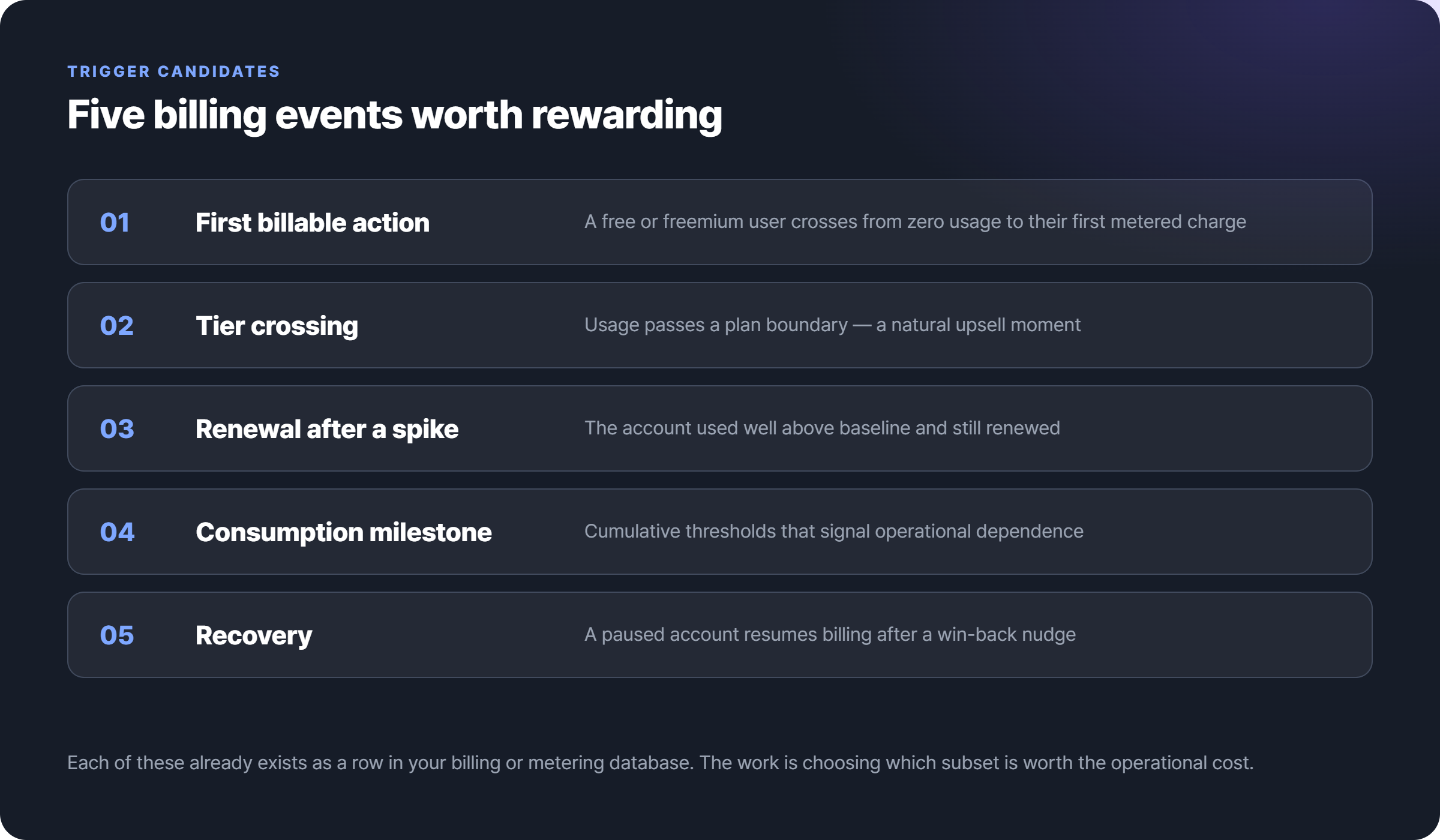
Not every line item in a metered invoice deserves a reward trigger. Growth and billing teams generally get the most conversion lift from a short list of event types:
The common thread is that each of these events already exists as a row in your billing or metering database. The work is in deciding which subset is worth the operational cost of a reward, not in generating new data.
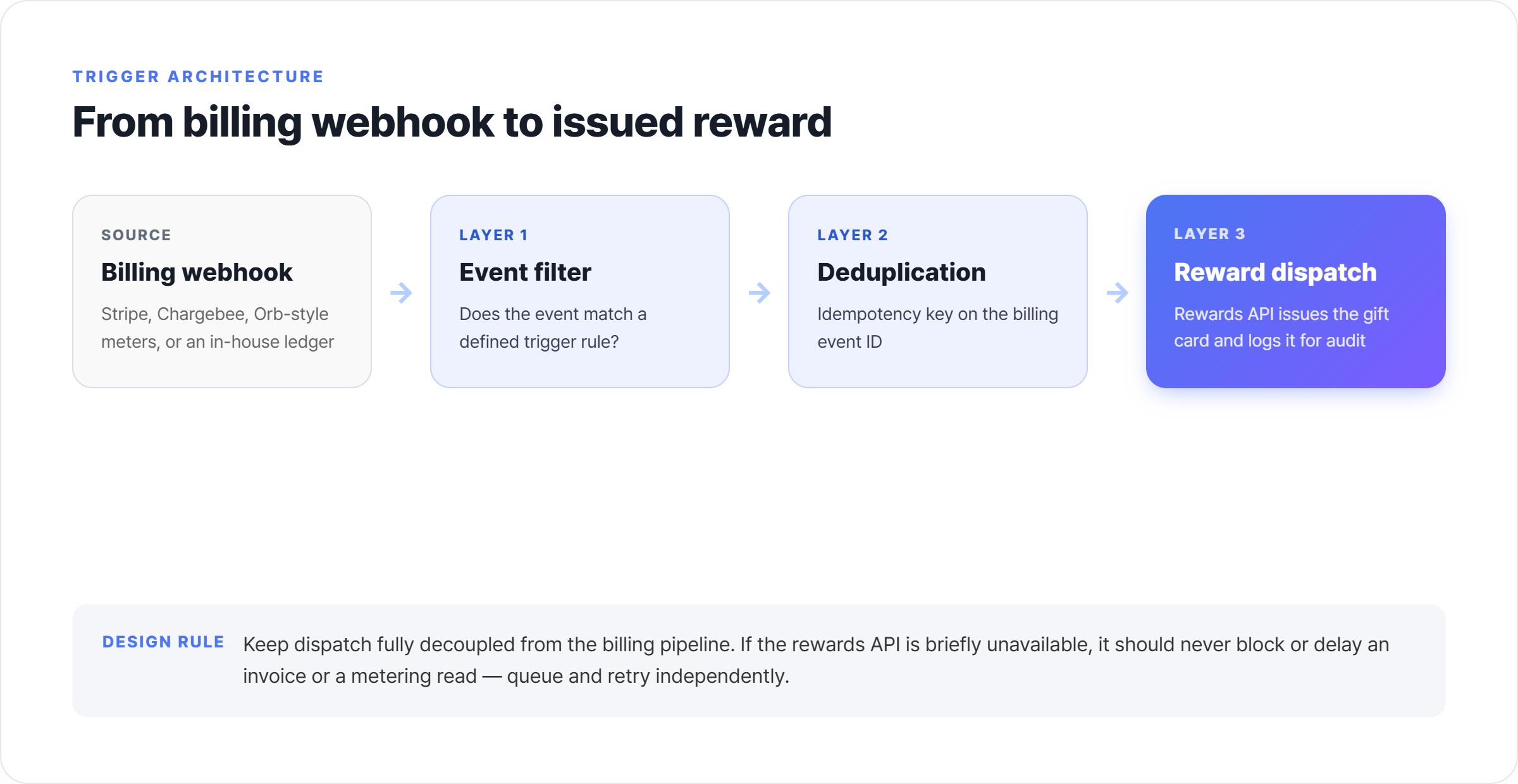
Most usage-based billing stacks (Stripe Billing, Chargebee, Orb-style meters, or an in-house ledger) already emit webhooks for invoice creation, usage-threshold breaches, and payment success. The practical design pattern for turning those into rewards has three layers:
1. Event filter. A lightweight rule engine sits between the billing webhook and the reward system, checking whether the event matches a defined trigger (for example, "usage_threshold.reached" AND tier == "growth" AND account_age > 30 days). This prevents every routine invoice from generating a reward. 2. Deduplication and idempotency. Billing systems can retry webhook delivery, and metering events can double-fire during backfills. The trigger layer needs an idempotency key, typically the billing event ID, so the same threshold crossing never issues two rewards. 3. Reward dispatch. Once a qualifying, de-duplicated event is confirmed, the system calls a rewards API to issue a gift card to the account's designated contact, logs the transaction against the billing event ID for audit purposes, and (optionally) notifies the customer success or growth team.
A useful design constraint: treat the reward dispatch step as fully decoupled from the billing pipeline itself. If the rewards API is briefly unavailable, that should never block or delay an invoice or a metering read. Queueing the reward dispatch and retrying it independently keeps the billing system's core job, accurately charging customers, isolated from the incentive layer's uptime.
Timing matters more than most teams expect. A reward tied to a billing event loses most of its psychological effect if it arrives days later attached to a monthly digest email; the connection between the action and the reward has to be legible to the recipient. Dispatching within minutes of the qualifying event, ideally as its own notification rather than folded into a billing receipt, preserves that connection.
Value tiering typically follows the significance of the event rather than a flat amount across the board. A first-billable-action reward is usually a modest, low-cost card meant to acknowledge the moment. A tier-crossing or renewal-after-spike reward can be proportionally larger, since it corresponds to meaningfully higher account value. Building this tiering logic directly off the billing event's own metadata, such as the dollar delta between the previous and new tier, avoids the need for a separate reward-sizing model.
One practical detail platforms often underestimate is catalog reach. A billing-triggered reward program built for a global usage-based platform needs gift cards that are redeemable in the countries where metered accounts actually sit, not just the platform's home market, which is where a broad, API-accessible catalog becomes a real constraint rather than a nice-to-have. Platforms evaluating this build should also weigh how their reward dispatch integrates at scale; the same considerations that apply to bulk gift card API integration for other reward use cases apply directly here, since billing-triggered rewards are, in effect, a bulk, event-driven dispatch pattern.
Wincube Global, which has processed over USD 220 million in gift card GMV in 2025 across a catalog of more than 30,000 gift cards spanning over 90 countries, provides the reward-dispatch layer that a billing-event trigger system calls into. For an IT or SaaS platform building this kind of integration, the relevant question is less about the trigger logic, which most billing stacks already support, and more about whether the reward catalog behind it can actually reach every country where metered accounts are located, and whether the API can absorb event-driven, unpredictable dispatch volume rather than only scheduled batches.
If you're mapping out which billing events in your own metering pipeline are worth turning into rewards, or want to see how a gift card API handles event-triggered, non-batch dispatch, it's worth a conversation to see whether the fit makes sense for your platform's specific billing stack.
If this is relevant to your team, Contact Us and we can walk through what it would look like.
A billing event triggered reward is a gift card or incentive that a platform issues automatically when a specific event occurs in its usage-based billing system, such as a customer crossing a usage tier, completing a first billable action, or renewing after a consumption spike. The reward is dispatched programmatically, typically through a webhook-to-API integration, rather than through a manually scheduled marketing campaign.
Standard loyalty programs usually run on their own event schema, points earned per purchase or per login, that's separate from the billing system. A billing-event triggered reward instead reuses the metering and invoicing data a usage-based platform already generates, so the trigger conditions are billing-native (tier crossings, renewal-after-spike, first billable charge) rather than a parallel points ledger the platform has to maintain.
Growth and billing teams generally see the strongest response from first-billable-action events, since they mark the moment a trial or freemium user starts generating revenue, and from tier-crossing events, since they coincide with a natural upsell decision point. Renewal-after-usage-spike events are more retention-focused, rewarding customers who have already shown deep reliance on the product.
Sources
Contact Email : win-obdteam@wincubemkt.com