Digital Gift Cards
WINK
WINCUBE

Every autumn, procurement and marketing-ops teams face the same question: should the year-end client gifting program go out as one large order, or be released in waves by region and recipient group? The answer shapes your catalog lock dates, how much regional delivery risk you carry, and when budget leaves the books.
In short: A single bulk order works best when one region, one catalog and one approval cycle cover most recipients. Staggered release usually fits multi-region programs better, because local holidays, catalog availability and delivery lead times differ by market. For many global programs, a hybrid is the practical choice: lock the catalog early in one commitment, then release gifts to each region on its own schedule.
Both structures can deliver the same gift to the same person. What changes is when decisions become irreversible.
A bulk order concentrates decisions early. You approve the recipient list, select the catalog options and commit the budget in one step. That is efficient, but late changes get harder. If a client contact leaves, a region changes its holiday timing or a catalog item is retired, you may have little room to adjust.
Staggered release spreads those decisions across several smaller releases. You gain flexibility, but you take on more coordination, and each wave needs its own approval and tracking.
Gift cards are a large part of this decision. The Incentive Research Foundation's 2026 industry outlook found that gift cards account for about 30% of program allocations in North America and 34% in Europe (Incentive Research Foundation, Industry Outlook for 2026: Merchandise, Gift Cards, and Event Gifting). When a format carries that much of the program, its timing rules deserve a deliberate plan.
The market behind this is large. Coresight Research estimated that the US corporate gifting market would grow from $258 billion in 2022 to $312 billion by 2025 (PR Newswire, Rapidly Growing Corporate Gifting Market Estimated to Reach $312 Billion by 2025). That figure covers the broad US market, not only gift cards, but it shows why year-end gifting draws so much planning attention.
Kevin Payne of GiftNow, which sponsored that research, said of the corporate gifting market, "We felt it was bigger than previous estimates, but how much bigger we didn't know" (PPAI, Industry Reaction: Corporate Gifting Market May Be Much Larger Than Previously Known). The takeaway for planners is that spend is often bigger and more fragmented than internal budgets assume, which is a reason to map every region's share before choosing a structure.
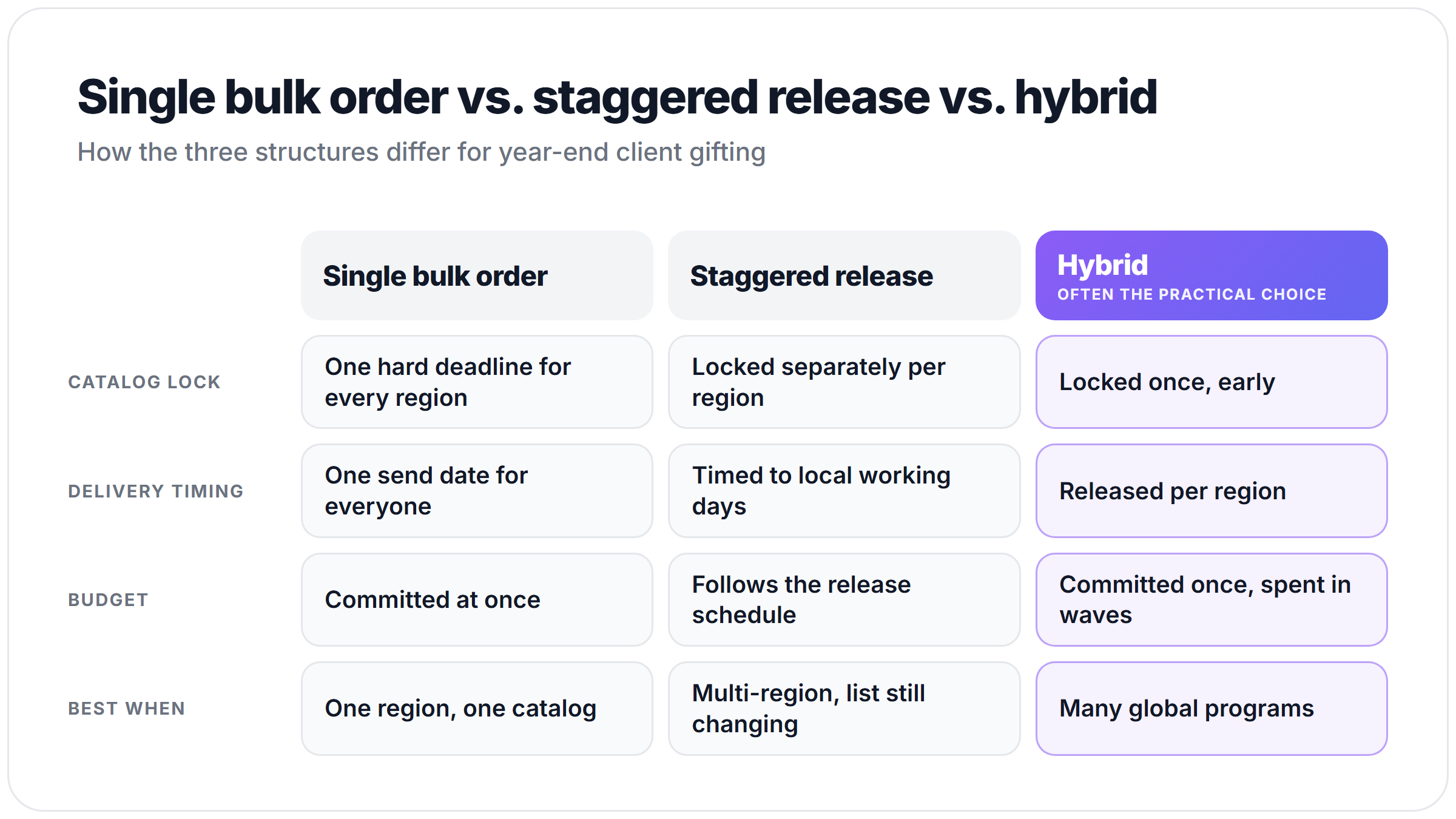
With a single bulk order, the catalog lock date is the hard deadline for the whole program. Every region's options must be confirmed at once, so the earliest-closing market effectively sets the date for everyone.
With staggered release, you can lock each region's catalog separately. A region with simple digital delivery can lock later, while a region that needs more review can lock earlier. The trade-off is that you now manage several lock dates, and a missed one affects only that wave rather than the whole program.
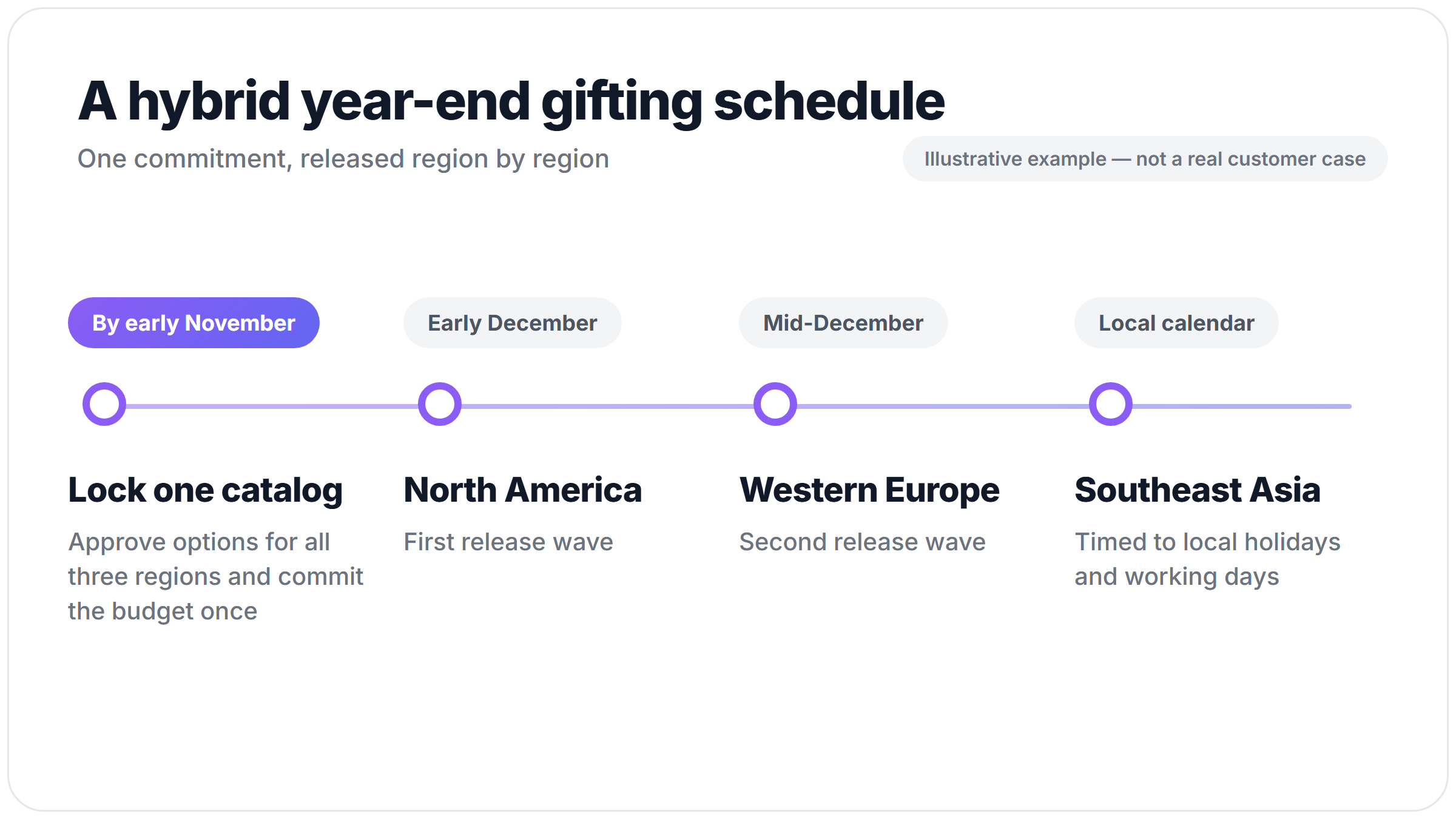
A useful habit is to confirm the catalog options per region by early November, even if some releases go out in December. Holiday gifting catalog lock dates are not only a vendor issue. They are also an internal approval issue, because legal, finance and regional leads each need time to sign off.
Digital gift cards remove most physical shipping risk, but they do not remove timing risk. Recipients in different markets observe different holidays, work calendars and email habits. A gift that arrives during a regional shutdown may sit unread until January.
A bulk order sends everything on one date. That is simple, but it treats a recipient in a market with a long year-end closure the same as one with normal business hours. Staggered release lets you time each wave to local working days, which can improve the odds that the gift is actually opened and used.
If your program also includes physical items, add shipping time on top. Carrier capacity tightens in the weeks before year-end, so physical components usually need earlier lock dates than digital ones. Splitting physical and digital into separate waves is a common way to manage this.
Budget timing is where the two structures differ most for finance teams.
If your organization has a use-it-or-lose-it year-end deadline, check how your finance team treats funds that are committed but not yet delivered. Accounting treatment varies by company and jurisdiction, so confirm it with your finance and tax advisors before choosing a structure.
The following questions help narrow the decision:
Consider a hypothetical example. A software company plans gifts for clients in North America, Western Europe and Southeast Asia. It locks one catalog for all three regions by early November and commits the budget in one step. It then releases North American gifts in early December, European gifts in mid-December, and Southeast Asian gifts timed to local calendars. This is an illustration, not a real customer case, but it shows how a single commitment and staggered release can work together.
For teams building this on an API rather than manual orders, the logic is the same: commit and configure once, then schedule release by group. Our overview of what a bulk gift card API is and why platforms adopt one explains how programmatic ordering supports this kind of scheduling.
Wincube Global has processed over USD 220 million in gift card GMV in 2025 across a catalog of more than 30,000 gift cards spanning over 90 countries. That breadth matters for year-end programs because a multi-region plan depends on having suitable options in each market, not only in the largest ones.
Whether you choose one bulk order, staggered release or a hybrid, the practical goal is the same: settle catalog choices early, keep delivery timing flexible, and give finance a clear view of when spend lands. There is no single right structure, and the best one depends on your regions, recipient list and fiscal calendar. If this is relevant to your team, Contact Us and we can walk through what it would look like.
Many teams aim to confirm catalog options by early November, ahead of the final release dates. This leaves time for legal, finance and regional approvals. The exact date depends on your internal sign-off process and on any physical items in the program.
Not necessarily. The total gift value can be the same under either structure. Staggering mainly adds coordination work, and budget timing can shift between fiscal periods, so check with your finance team.
Yes. Many global programs commit to the catalog and budget once, then release gifts by region or recipient group. This keeps planning simple while letting delivery timing follow local calendars.
Sources