Digital Gift Cards
Global Gift Cards
CROSS BORDER GIFTCARD
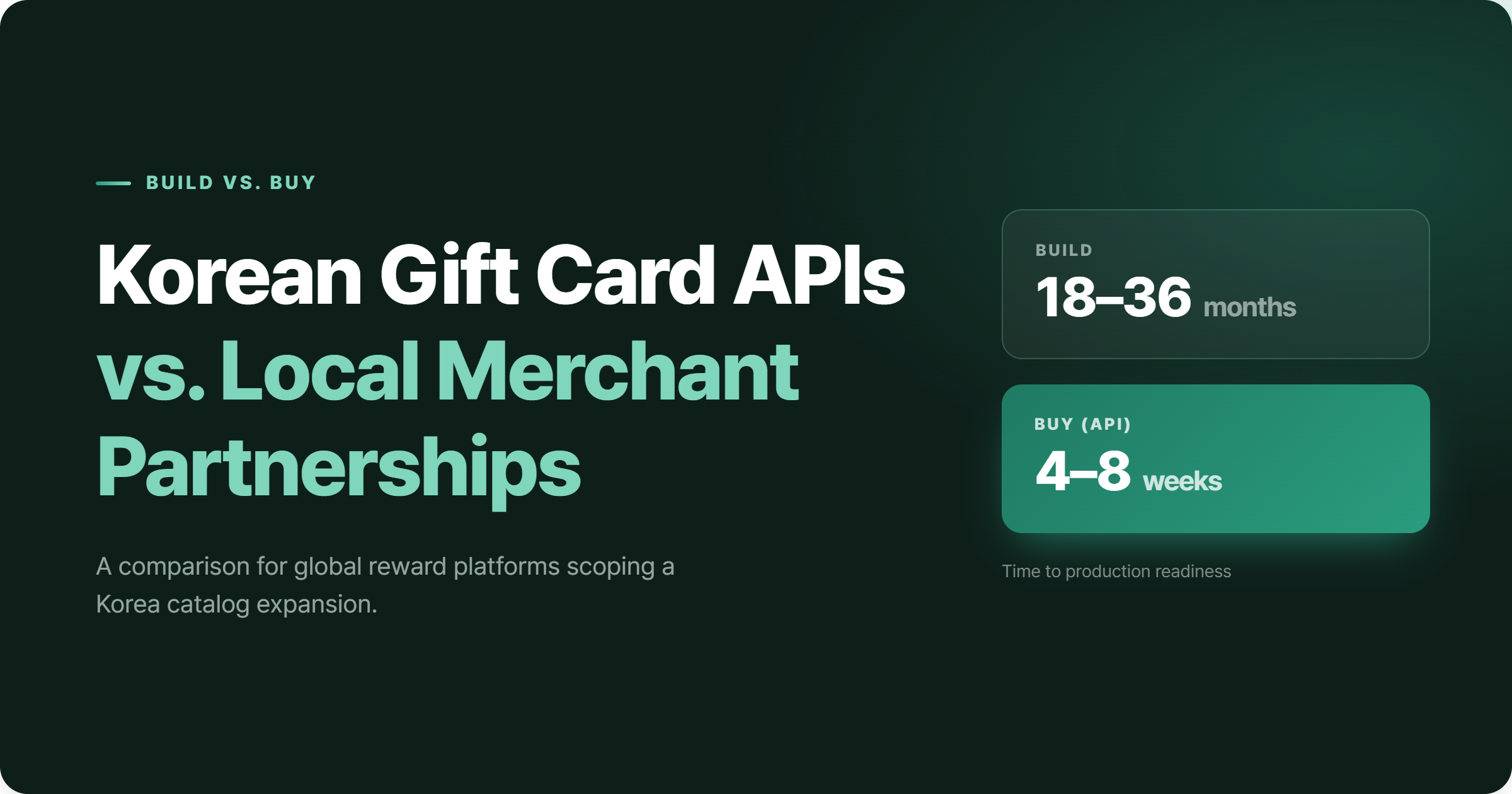

A procurement lead at a global rewards platform gets a request to add Korean gift cards to the catalog, and the first real decision isn't which brands to list. It's whether to negotiate directly with Korean merchants and build a settlement pipeline in-house, or to plug into a gift card API that already handles sourcing, currency conversion, and delivery. That single choice determines the next twelve months of engineering time, compliance exposure, and how fast the catalog actually ships.
In short: for most global reward and gifting platforms, buying access to Korean gift card inventory through an API is faster and lower-risk than building direct local merchant partnerships, because Korea's payment rails, KRW settlement requirements, and merchant fragmentation add operational overhead that rarely pays off unless Korean commerce is the platform's core product. Building in-house only makes sense when Korea is a strategic, high-volume market where owning the merchant relationships directly creates a durable pricing or exclusivity advantage.
The stakes of getting this decision right are rising as the category grows. The global gift card market is projected to reach USD 3,037.35 billion by 2030 at a compound annual growth rate of 15.1% (The Business Research Company, Gift Cards Global Market Report, 2026), which means the infrastructure choice a platform makes now will be carrying meaningfully more transaction volume within a few years, not less.
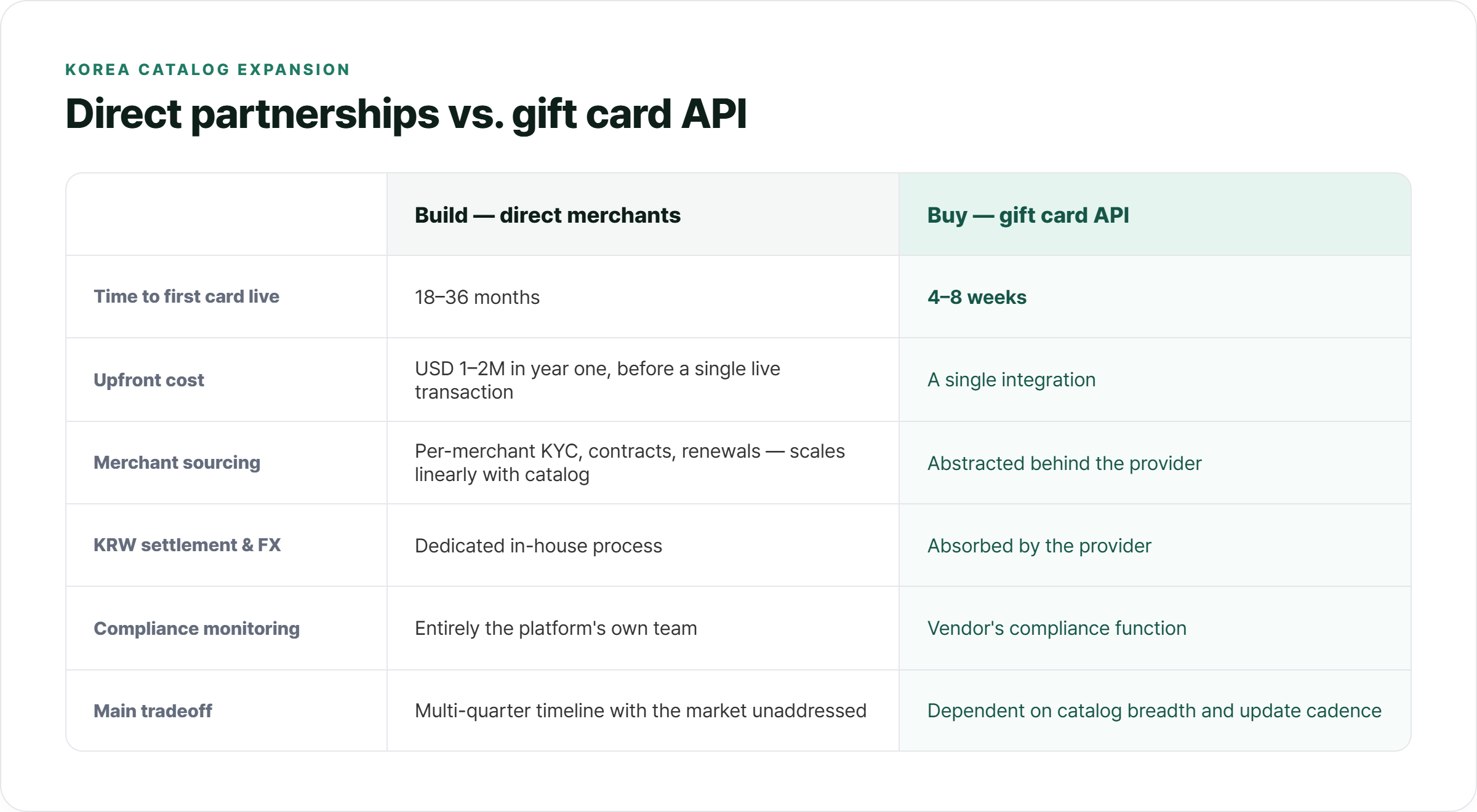
The cost side of "build" is also better documented than most teams expect going in. Teams that build cross-border payment infrastructure from scratch commonly spend USD 1 million to 2 million in the first year alone before processing a single live transaction, and a full in-house build typically takes 18 to 36 months versus 4 to 8 weeks to reach production readiness on an existing API (xflowpay, Build vs Buy in Cross-Border Payments: The $3M Mistake, 2026). Korean merchant sourcing carries its own version of that same curve: KYC on individual merchants, KRW-denominated settlement, and local tax and reporting obligations all have to be solved before the first card ships, regardless of how good the commercial terms look on paper.
Dan Pilling, a former payments CIO at Barclays who now advises on payments modernization, noted how much the build-versus-buy economics have shifted: "Years ago, what could have been a multi-year, tens-of-millions of pounds project is now something that can be available to a bank relatively quickly and cheaply, thanks to PaaS offerings" (Volante Technologies, Build, buy, or both: A CIO's perspective on payments modernization, 2026). That framing applies directly to Korean gift card sourcing: the sourcing negotiation is the easy part, and the ongoing settlement and compliance burden is where in-house builds tend to underestimate cost.
Korea's domestic commerce runs on infrastructure that doesn't resemble a typical Western or even broader Asian market. Mobile-first payment habits are deeply entrenched, and localized wallets and authentication flows dominate everyday transactions rather than card-on-file checkout. transaction value in South Korea's mobile point-of-sale market alone is projected to rise from USD 123 billion in 2025 to USD 387 billion by 2030 (PCMI, South Korea 2025: Payments & Ecommerce Data, 2026), underscoring how much of Korean commerce already runs through channels a foreign platform has no native connection to.
For a platform trying to build direct merchant relationships, that means every layer of the stack has to be solved independently: sourcing agreements with individual Korean merchants or brand issuers, KRW settlement and FX conversion back to the platform's base currency, compliance with Korean data localization and consumer protection rules, and fraud controls tuned to local card and wallet behavior. None of this is exotic, but all of it is Korea-specific, which means none of it transfers to the next market the platform wants to add.
Building direct relationships with Korean merchants can make sense when Korea is not just one market among many but a strategic priority in its own right. A platform sourcing enough volume to justify dedicated legal, compliance, and settlement infrastructure may find that owning the relationship directly yields better margins or exclusive inventory over time.
The tradeoffs to weigh honestly:
A gift card API abstracts the merchant relationships, currency conversion, and delivery mechanics behind a single integration. The practical draw is speed: a platform can typically go from evaluation to a live Korean catalog in weeks rather than the year-plus timeline a direct build usually requires. The API provider also absorbs the ongoing burden of merchant renewals, KRW settlement, and regulatory monitoring, which means the platform's engineering team spends its time on catalog presentation and redemption experience rather than payment plumbing.
The tradeoff is that a platform buying through an API is dependent on the provider's catalog breadth and update cadence. That's a real constraint, but for most reward and gifting platforms where Korea is one market among dozens, it's a reasonable one, especially compared against the alternative of maintaining Korea-specific infrastructure indefinitely for a market that represents a fraction of total catalog volume. WINK's earlier piece on what a bulk gift card API actually does and why platforms are adopting one covers the integration mechanics in more depth for teams evaluating this path.
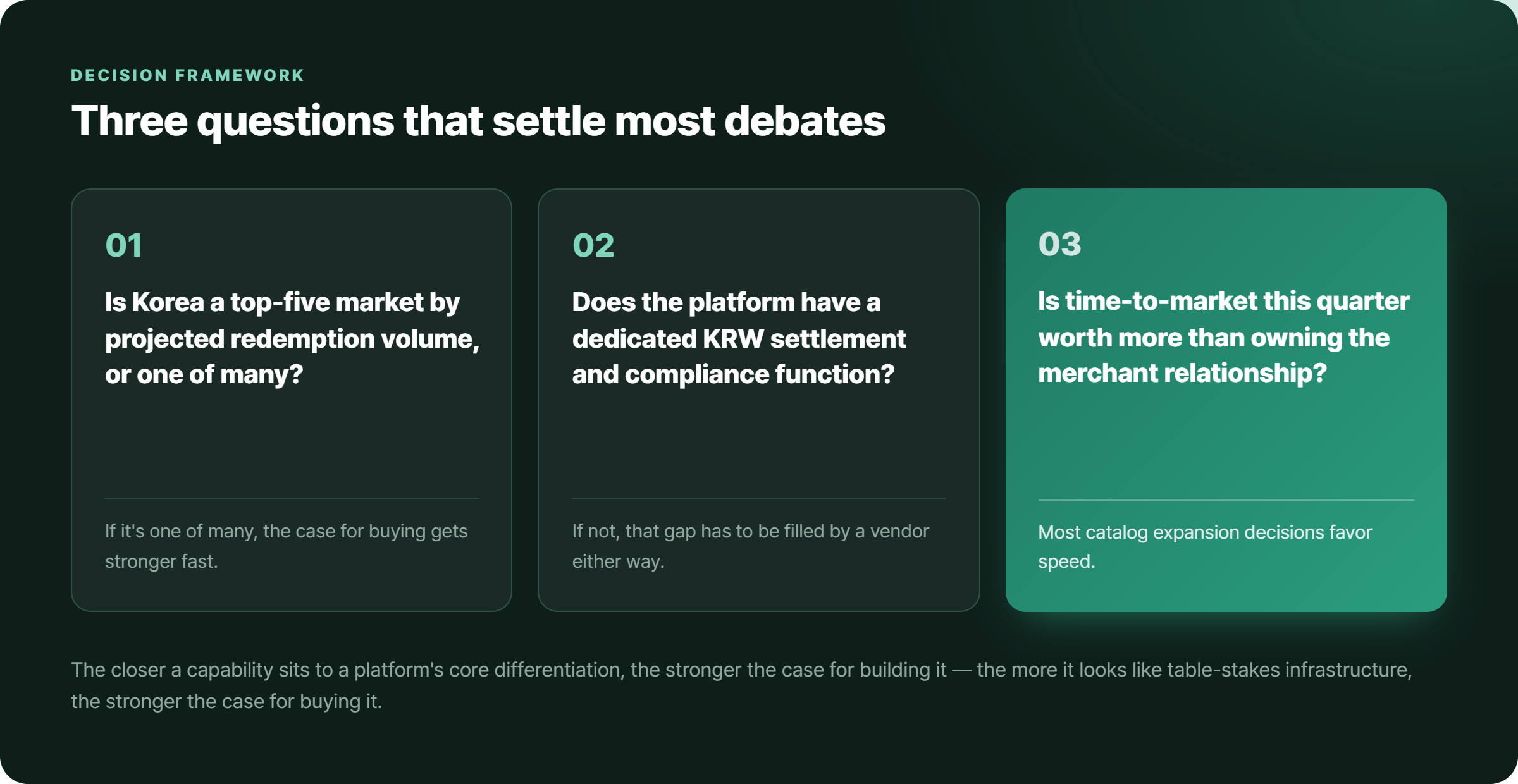 Three questions tend to settle most build-versus-buy debates for Korean gift card distribution:
It's worth noting this decision isn't unique to gift cards. WINK's related piece, "Build vs. Buy: Should AI Platforms Build Their Own Reward Redemption System?", covers the same tradeoff from the redemption-infrastructure side rather than the sourcing side, and the two arguments reinforce each other: the closer a capability sits to a platform's core differentiation, the stronger the case for building it, and the more it looks like table-stakes infrastructure, the stronger the case for buying it.
Wincube Global is a primary supplier / aggregator of the Korean gift card market, boasting a strong lineup of directly supplied gift card products.
For teams actively scoping a Korea catalog expansion this quarter, the honest build-versus-buy answer usually depends more on volume projections and internal compliance capacity than on which merchants happen to be willing to talk. Wincube Global has processed over USD 220 million in gift card GMV in 2025 across a catalog of more than 30,000 gift cards spanning over 90 countries, and operates on the "buy" side of this decision for platforms that would rather not build Korean merchant sourcing and KRW settlement in-house. If this is relevant to your team, Contact Us and we can walk through what it would look like.
Usually not in the first one to two years. Direct builds carry upfront legal, KYC, and KRW settlement infrastructure costs that a gift card API absorbs into a single integration, and those costs tend to recur annually as merchant contracts renew rather than being one-time.
An API integration can typically go live in weeks once catalog and settlement terms are agreed, while direct merchant partnerships commonly take a year or more once legal, compliance, and KRW settlement infrastructure are accounted for.
It makes sense when Korea represents a large enough share of total redemption volume to justify dedicated compliance and settlement infrastructure, or when exclusive merchant relationships create a pricing or catalog advantage the platform considers core to its product.
Sources
Contact Email : win-obdteam@wincubemkt.com