Digital Gift Cards
Global Gift Cards
CROSS BORDER GIFTCARD

An AI agent inside your platform just approved a loan application in under two seconds, flagged a referral as valid, and confirmed a user completed onboarding, all before a human ever looked at the case. Then the reward for that action sits in a queue for three days because the payout step still runs on a spreadsheet and a finance team's manual approval. For product and operations teams building AI-driven fintech and agent platforms, this gap between decision speed and disbursement speed has become one of the most visible seams in an otherwise automated system.

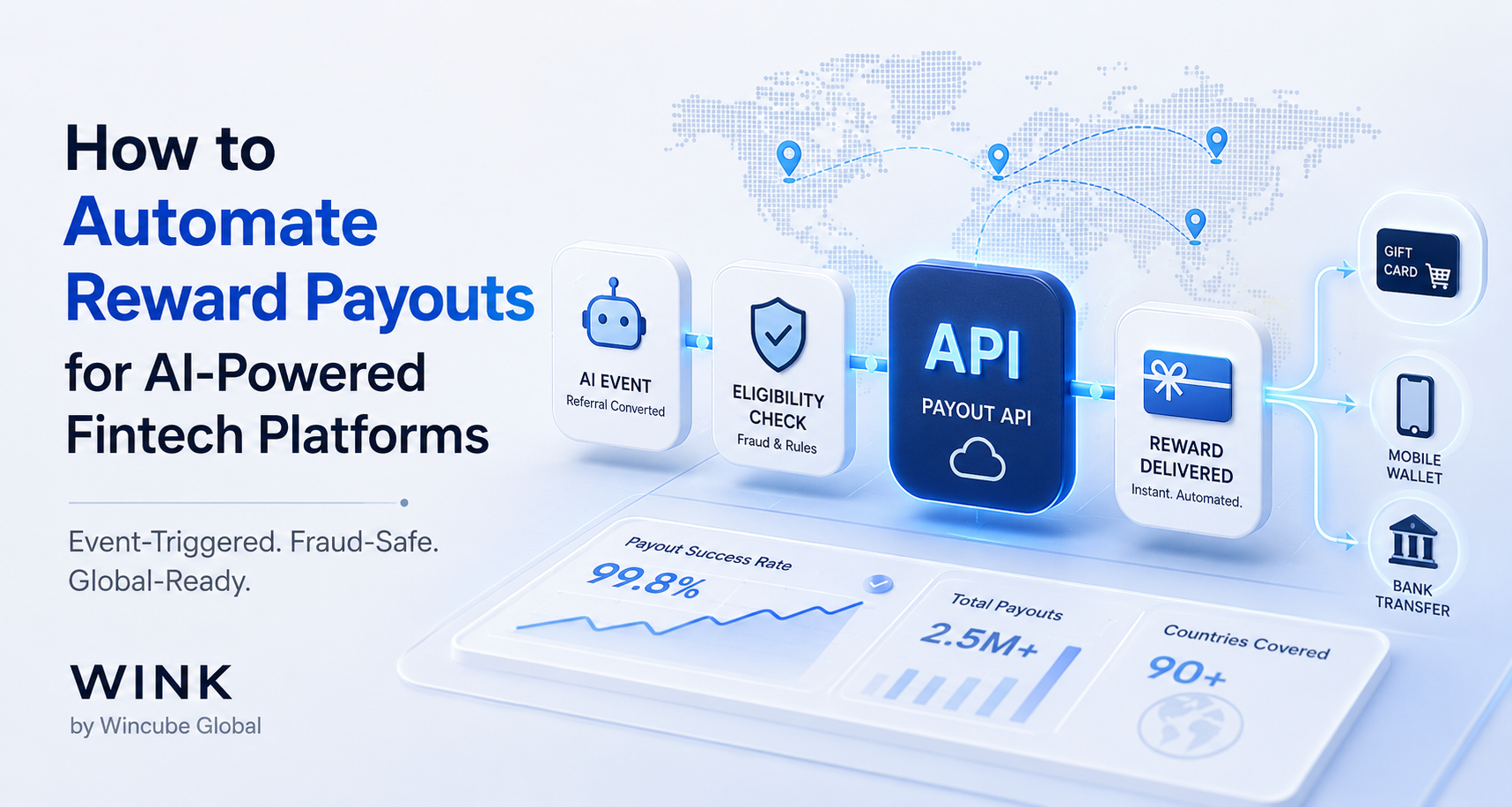
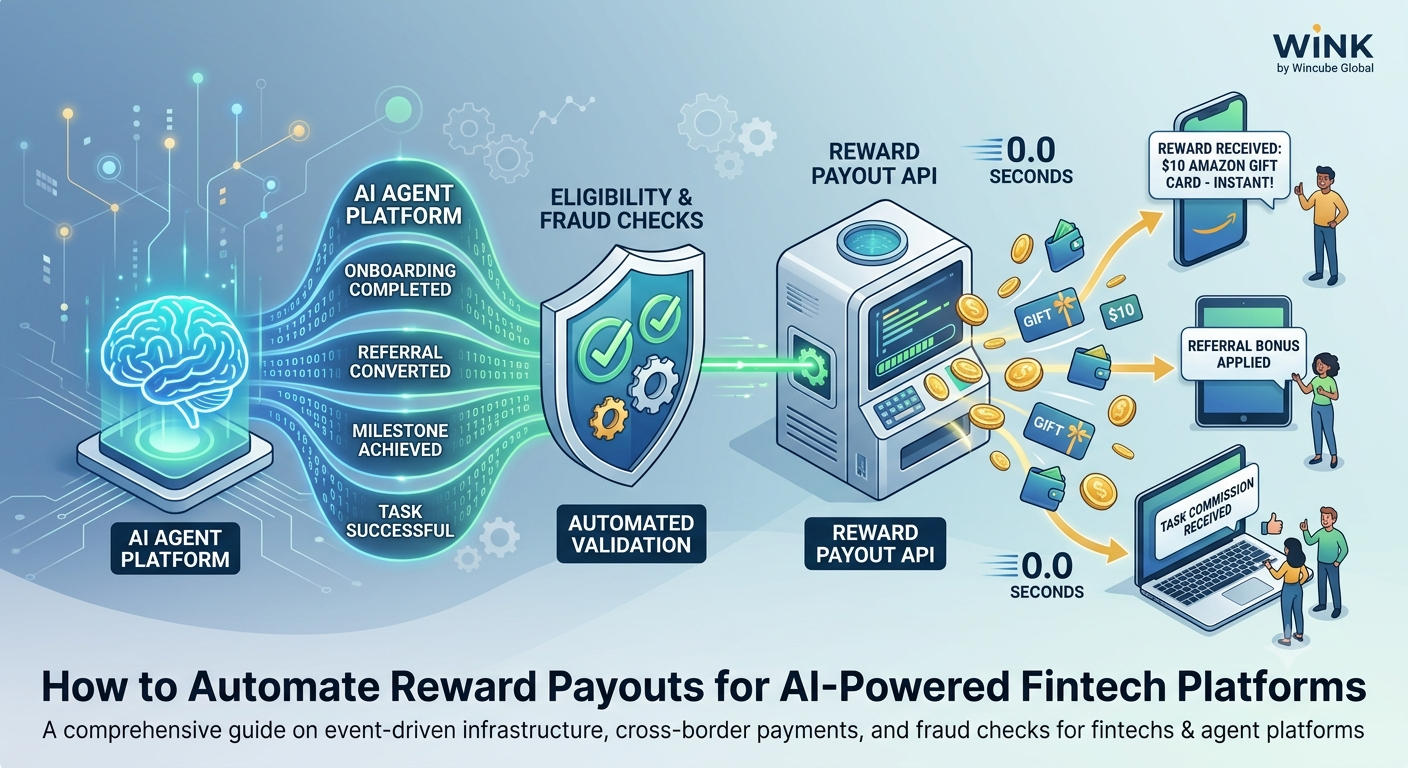
In short: Automating reward payouts means connecting the events your AI platform already generates, such as onboarding completions, referral conversions, or milestone triggers, directly to a payout API that can validate eligibility, select a reward, and disburse it without a human in the loop. This guide walks through the architecture for event-triggered payouts, the eligibility and fraud checks that keep automation safe, and the cross-border considerations that matter most for global fintech and agent platforms. It closes with practical guidance on avoiding the most common automation mistakes.
Embedded finance is already reshaping how SaaS and fintech platforms think about money movement inside their products. Fifty-four percent of B2B platforms surveyed report direct revenue increases from embedded finance, with the gains concentrated among platforms already generating significant volume through their own infrastructure (PYMNTS, Embedded Payments Give SaaS a Lifeline as AI Reshapes Workflows, 2026). Reward payouts are a natural extension of that same embedded-finance logic: instead of routing incentive spend through a separate manual process, platforms are folding it into the same event-driven infrastructure that already runs their core product.
Traditional incentive programs were built around batch cycles: a marketing or ops team would export a list of qualifying users once a week or once a month, run it through an approval chain, and issue rewards in bulk. That model breaks down on an AI-powered platform for a simple reason: the AI is making qualification decisions continuously, not on a schedule. A fraud model might clear a transaction at 2am. A referral engine might confirm a conversion the moment a second user completes checkout. If the reward only ships days later, the platform loses the behavioral reinforcement that made the incentive worth paying for in the first place.
Event-triggered payouts close that gap by treating "reward eligible" as just another event in the same pipeline that already handles onboarding, transactions, and account status changes. When an AI agent or rules engine emits an event such as `referral.converted` or `onboarding.completed`, that event can call a payout API directly, with the disbursement completing in the same session rather than in a follow-up batch job days later.
This matters most for three types of AI-powered platforms:
Building this correctly means separating three concerns that are easy to conflate: the event that signals eligibility, the checks that confirm the event is legitimate, and the rail that actually moves value to the recipient.
Start by inventorying which systems can legitimately originate a reward-triggering event. In most AI platforms, this includes the onboarding or KYC pipeline, the fraud and risk engine, the referral tracking system, and any agent orchestration layer that completes tasks on a user's behalf. Each of these should emit a structured event (via webhook or message queue) rather than writing directly to a payouts table, so the payout logic stays decoupled from whichever system generated the trigger. This also makes it easier to add new event sources later without re-architecting the disbursement layer.
Automation without a checkpoint is how incentive programs get drained by bots and repeat-account abuse. Before an event reaches the payout API, it should pass through an eligibility layer that checks for duplicate accounts, velocity limits (how many rewards a single identity has claimed in a given window), and any AI-confidence threshold from the model that generated the event. Many teams build this as a lightweight rules engine sitting between the event bus and the payout call, so eligibility logic can be tuned without touching the payout integration itself.
The payout API is where the eligibility decision becomes a real reward: a gift card, prepaid balance, or cash disbursement delivered to the recipient. For platforms operating across multiple markets, this is also where local currency, denomination, and delivery method choices get resolved automatically rather than manually per region. A bulk gift card API is one common pattern here: instead of issuing one reward at a time through a UI, the platform calls an API endpoint that can issue a single reward or a batch, matched to the eligibility event, with delivery handled programmatically through email, SMS, or in-app link.
The API contract should include, at minimum: an idempotency key tied to the triggering event (so a retried webhook doesn't double-pay a user), a status callback so the platform knows when a reward has actually been delivered versus merely queued, and a rejection path that routes flagged events to human review instead of silently failing.
AI-powered platforms rarely serve a single country, and reward payouts inherit all the complexity of cross-border payments the moment a platform scales internationally. A few issues come up consistently:
The practical fix is to keep the local market logic in a configuration layer that the payout API reads from, rather than hard-coding reward type or delivery method into the event-trigger code itself. That way, expanding into a new country is a configuration change, not a re-engineering effort.
Teams that have gone through this migration tend to hit the same handful of problems:
Wincube Global, which has processed over USD 220 million in gift card GMV in 2025 across a catalog of more than 30,000 gift cards spanning over 90 countries, provides the API layer that many AI-powered fintech and agent platforms plug into for the disbursement side of this architecture. The catalog breadth and country coverage matter specifically for the cross-border configuration problem described above, since a platform expanding into a new market can extend its existing payout integration rather than sourcing a new reward provider for each region.
If your team is scoping how an automated reward payout flow would fit into your platform's existing event architecture, it's worth mapping out which of your systems already emit eligibility-relevant events before evaluating any specific API provider, since that groundwork determines how much of the automation you can build on infrastructure you already have.
What is an automated reward payout API? It's an API that lets a platform trigger a reward disbursement, such as a gift card or cash payout, directly from an application event like onboarding completion or referral conversion, without a manual approval step in between.
How do AI platforms decide which events should trigger a payout? Most platforms route candidate events through an eligibility layer that checks identity uniqueness, claim velocity, and any confidence score from the AI model that generated the event, before the event is allowed to call the payout API.
Is automated payout infrastructure only relevant for large platforms? No. Because event-triggered payouts replace manual batch processing rather than adding headcount, smaller platforms often see the automation pay off faster since they have less legacy manual process to unwind.
Sources
Contact Email : win-obdteam@wincubemkt.com