Digital Gift Cards
Global Gift Cards
CROSS BORDER GIFTCARD
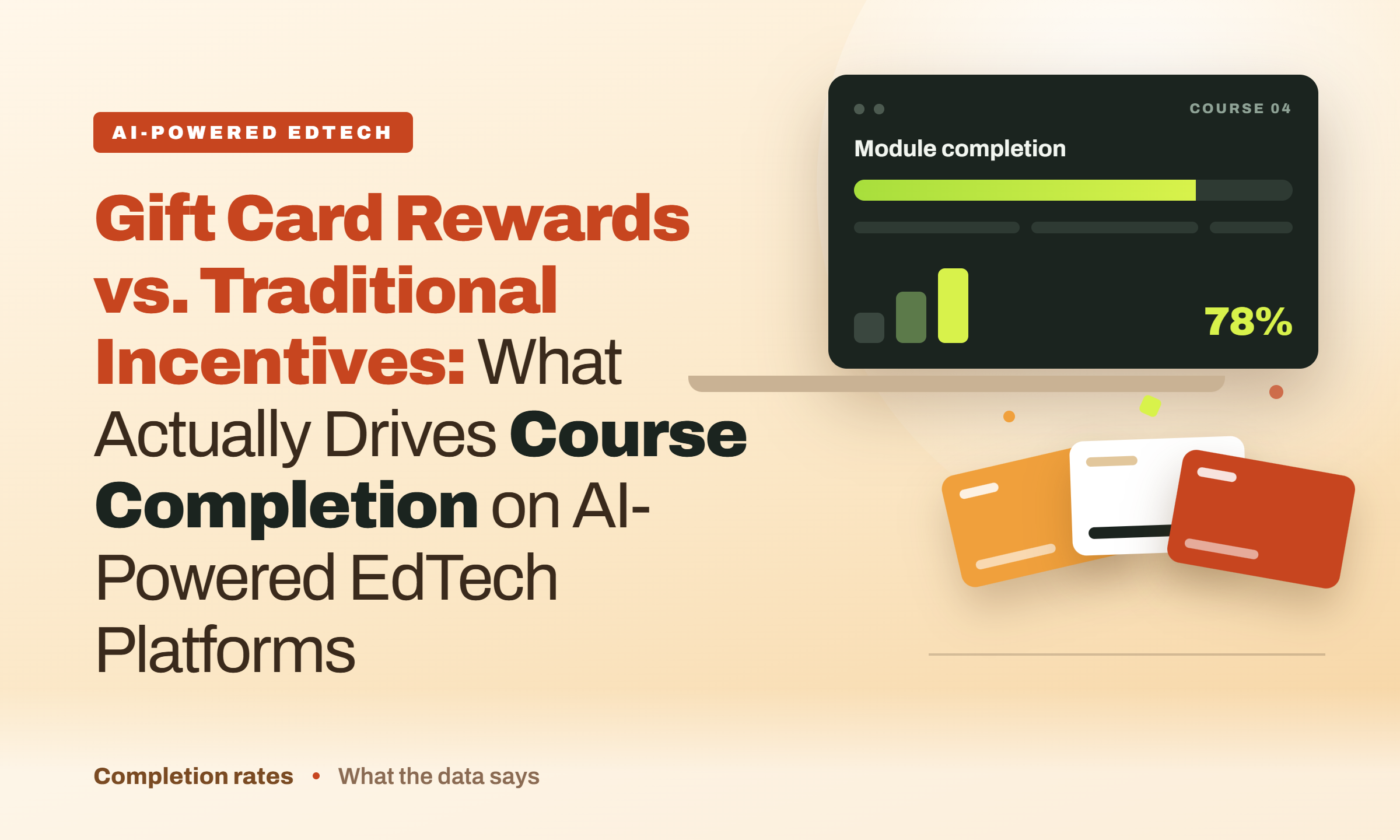

A learner signs up for an AI-personalized course, finishes the first two modules in a single sitting, earns a badge, and never opens the platform again. Growth and retention teams at AI-powered learning platforms know this pattern well: engagement spikes early and completion collapses somewhere in the middle. The question isn't whether incentives help. It's which incentives actually change behavior once the novelty of a new AI tutor or adaptive path wears off, and whether a badge on a profile page carries the same weight as a reward a learner can actually spend.
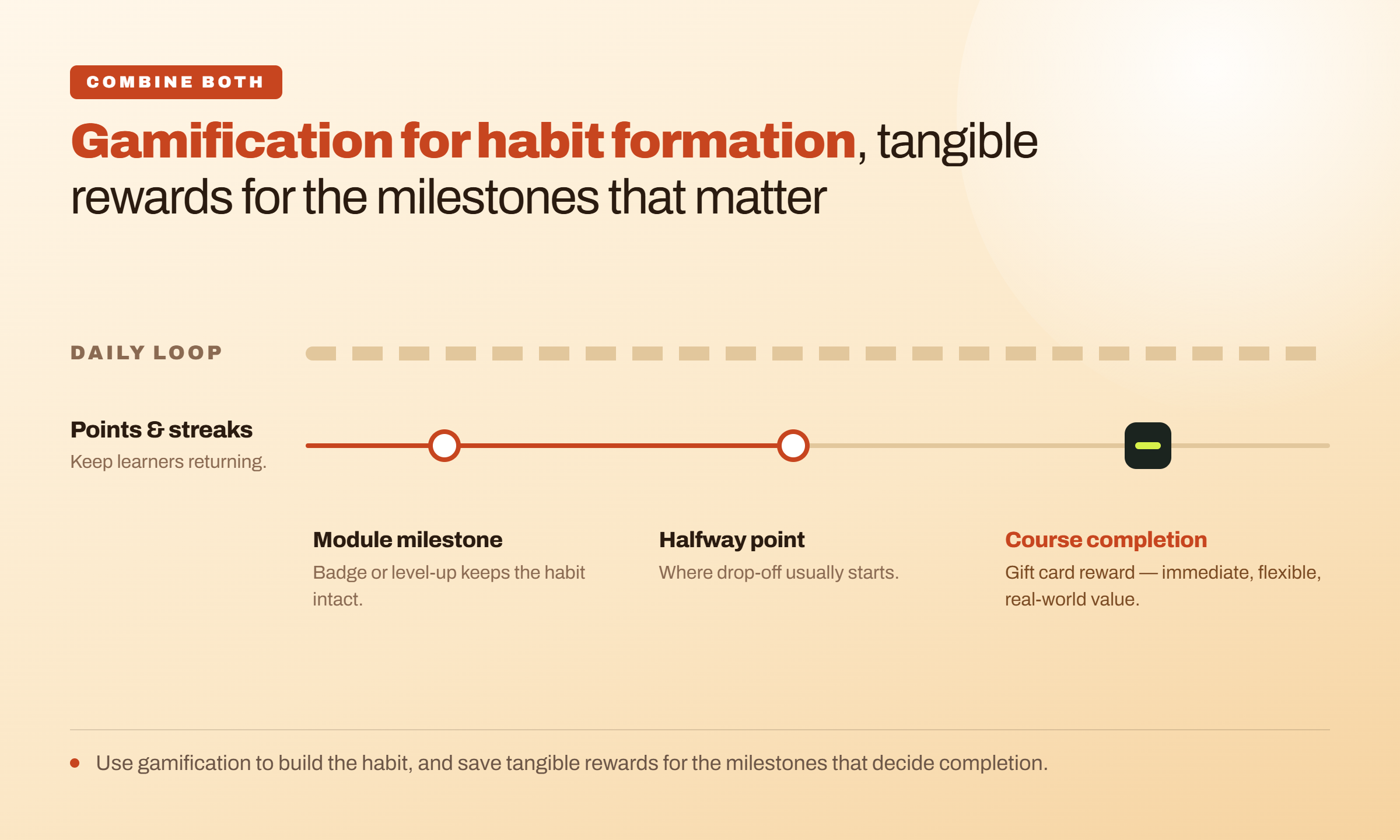
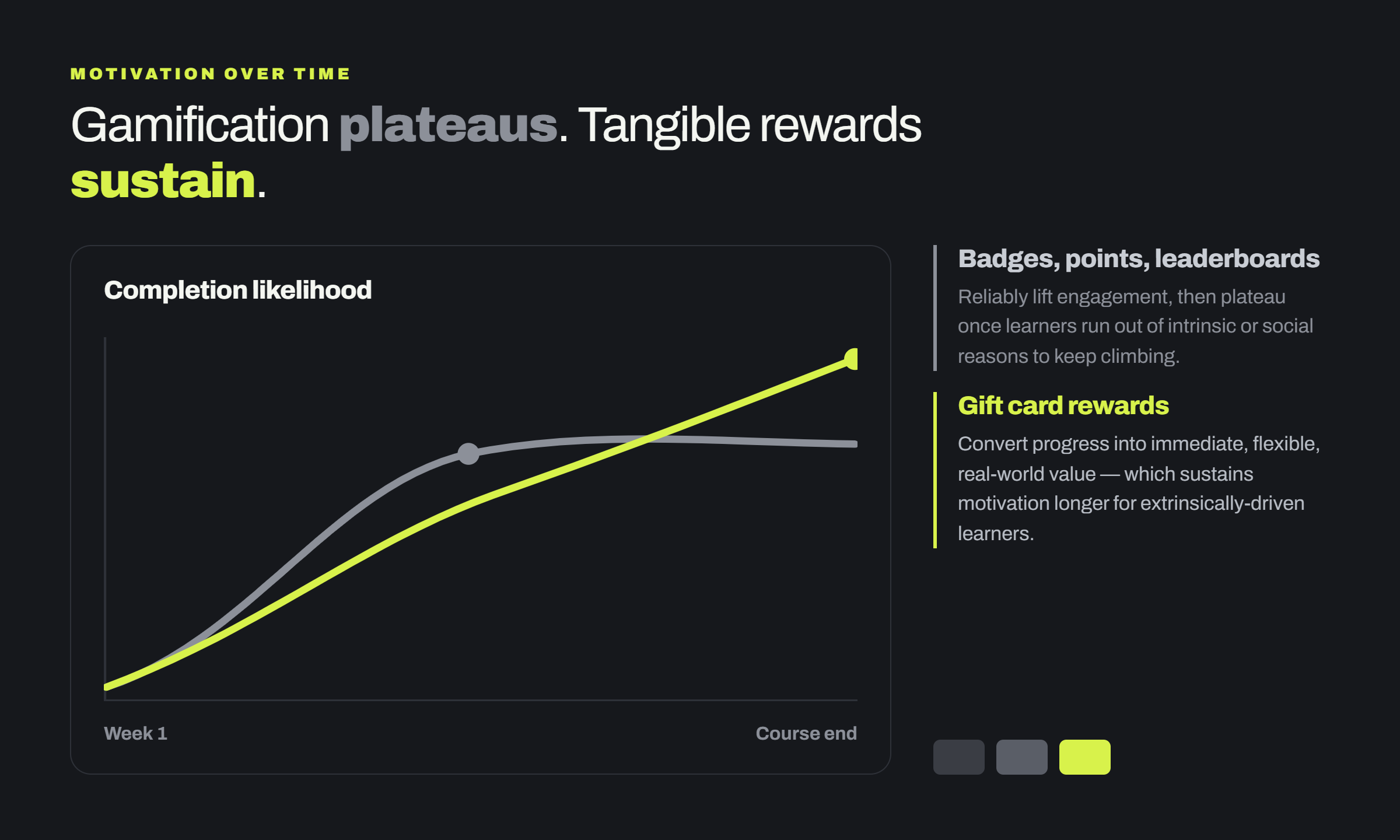
In short: Traditional gamification mechanics like badges, points, and leaderboards reliably lift engagement and completion, but their effect tends to plateau once learners run out of intrinsic motivation or social reasons to keep climbing a leaderboard. Gift card rewards work differently: they convert progress into something with immediate, flexible, real-world value, which research on incentive design suggests sustains motivation longer for extrinsically-driven learners. The strongest completion strategies on AI-powered platforms tend to combine both, using gamification for habit formation and tangible rewards for the milestones that matter most.
The AI-in-eLearning category itself is growing quickly enough that this question is becoming urgent for platform teams: the market is set to expand from USD 5.08 billion in 2025 to USD 5.67 billion in 2026, a compound annual growth rate of 11.8 percent, as more platforms layer AI-driven personalization onto their course delivery (The Business Research Company, Artificial Intelligence (AI) In eLearning Global Market Report 2026, 2026). As more platforms compete on the same AI-personalization features, the reward layer around that content becomes one of the few remaining levers a growth team can pull to differentiate retention outcomes.
Badges, points, streaks, and leaderboards are the default incentive layer on most learning platforms, largely because they're cheap to implement and easy to instrument. The evidence for their short-term effect is real. One documented corporate eLearning case study found that introducing gamification mechanics into a training program lifted completion from an average of 32 percent to 67 percent (eLearning Industry, A Case Study On Gamification In Corporate eLearning, 2026). That's a meaningful jump, and it's the reason nearly every AI-powered learning platform ships some version of progress bars, streak counters, or achievement badges.
The limitation shows up over longer horizons and with more diverse learner populations. Gamification mechanics work best on learners who are already inclined toward mastery and status signals, the type of person who enjoys watching a progress bar fill in or comparing themselves to a leaderboard. For a large share of adult learners on B2B and workforce-training platforms, particularly those taking a course because an employer or certification body requires it rather than because they're intrinsically curious, a badge has no exchange value. It doesn't buy anything, it doesn't signal status outside the platform, and once the initial novelty fades, it stops functioning as a reason to log back in. This is precisely the segment where growth teams see completion curves flatten despite an otherwise well-designed gamification layer.
AI personalization compounds the problem in an interesting way. As adaptive learning paths get better at predicting exactly what a learner needs next, the platform experience itself becomes more efficient, but not necessarily more emotionally rewarding. A perfectly tailored micro-lesson can still feel like homework. That's a gap that status-based rewards were never designed to close.
Gift card rewards operate on a different psychological register. Instead of asking a learner to value an abstract status symbol, they hand the learner something immediately convertible to a purchase they actually want, at the moment they've earned it. That distinction matters most for exactly the learner segment where gamification underperforms: extrinsically motivated adults, workforce trainees, and learners in markets or demographics where a leaderboard ranking carries little social currency.
For AI-powered platforms specifically, gift cards also solve a personalization problem that badges can't. A platform that already uses AI to tailor course content to an individual learner's goals, pace, and skill gaps can extend that same personalization to the reward itself, letting a learner in one country redeem toward a streaming subscription while a learner elsewhere redeems toward a retail brand or a ride-hailing app they actually use. A single fixed reward, whether it's a badge, a certificate, or even a flat cash bonus, can't flex the same way across a global learner base with different spending habits and preferred brands.
The practical design question for retention teams isn't "gamification or gift cards." It's where each mechanism earns its place in the journey:
The platforms getting the most out of this aren't choosing one mechanism over the other; they're sequencing them deliberately. A workable structure looks like this: gamification mechanics carry the bulk of day-to-day engagement because they're low-cost and can fire constantly without a finance team noticing, while gift card rewards are reserved for milestones that genuinely predict long-term retention, first-module completion, midpoint checkpoints, and full course or certification completion.
There are a few practical constraints growth teams run into once they try to operationalize this. Reward delivery has to be near-instant, since the motivational effect of a reward decays the longer a learner waits to receive it. Catalog breadth matters more than most teams expect: a rewards program that only offers two or three brand options in one currency will underperform with a global or diverse learner base, because the reward stops feeling personalized the moment it doesn't match what a learner actually wants. And the operational overhead of running a global reward catalog, handling currency conversion, tax treatment, and delivery across dozens of countries, is exactly the kind of infrastructure problem that pulls engineering time away from the AI and content work a learning platform is actually trying to differentiate on.
None of this requires abandoning badges or leaderboards. It requires treating the reward layer with the same rigor as the personalization engine sitting underneath it, matching reward type to learner motivation and course stage rather than defaulting to whichever mechanic was easiest to ship first.
Wincube Global, which has processed over USD 220 million in gift card GMV in 2025 across a catalog of more than 30,000 gift cards spanning over 90 countries, provides the reward infrastructure layer that lets AI-powered learning platforms plug global, brand-diverse gift card rewards into a course-completion flow without building that catalog and delivery logic in-house. For a platform experimenting with milestone-based rewards, or looking to extend an existing points and badges system with a tangible payoff at completion, this kind of infrastructure is worth a look when the team is ready to explore what a hybrid rewards model could look like for its own learner base. There's no need to overhaul an existing gamification setup to start; even a single completion milestone is a reasonable place to begin testing what moves the needle.
Related reading: Why AI Platforms Are Embedding Gift Card Rewards Into User Engagement Loops
If this is relevant to your team, Contact Us and we can walk through what it would look like.
Do gift card rewards actually outperform badges and certificates for course completion? The available evidence points to gamification mechanics driving strong short-term completion gains, while gift cards tend to sustain motivation longer for extrinsically-driven learners because they carry immediate, real-world value rather than status alone. The strongest results tend to come from combining both rather than replacing one with the other.
Which point in a course is the right moment to introduce a gift card reward? Milestones that predict long-term retention work best: completing the first module, hitting a mid-course checkpoint, and finishing the full course or certification. The final completion moment is typically where a gift card reward has the most influence on whether a learner pushes through the last stretch.
Does adding gift card rewards to an AI learning platform require replacing the existing gamification system? No. Gamification mechanics like streaks and progress bars remain useful for day-to-day engagement because they're low-cost and frequent. Gift card rewards work best layered on top, reserved for the milestones where a tangible payoff matters more than an incremental badge.
Sources
Contact Email : win-obdteam@wincubemkt.com