Digital Gift Cards
Global Gift Cards
CROSS BORDER GIFTCARD
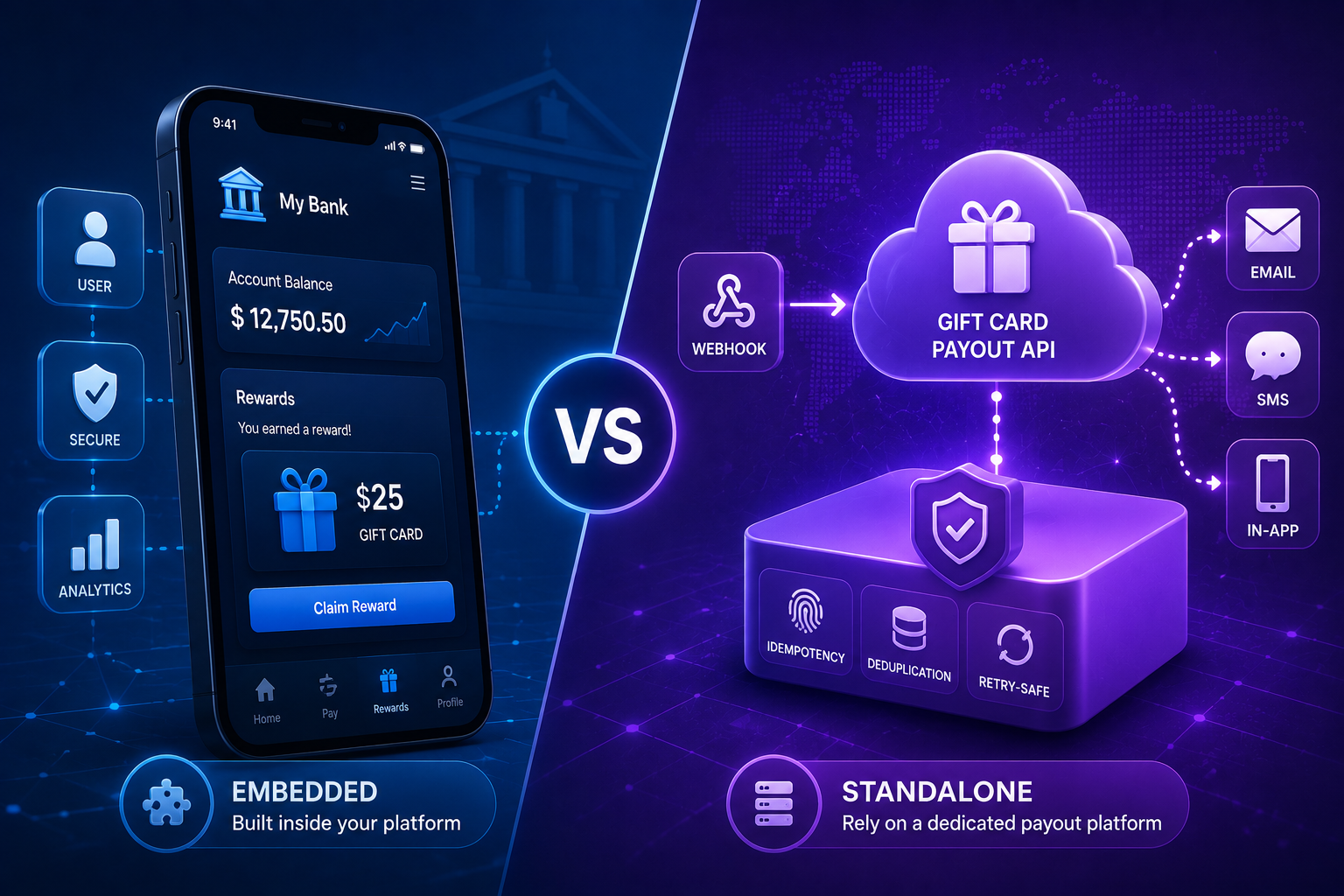

A fintech app decides to reward users with gift cards for referrals or cashback milestones, and the first real design question isn't which brands to offer. It's where the payout logic should live: bolted onto the payment gateway the app already uses to move money, or routed through a separate, purpose-built rewards layer. For a banking or fintech product manager who has to ship this feature without destabilizing core payment flows, that architecture choice shapes engineering effort, compliance exposure, and how the reward experience actually feels to end users for years after launch.
In short: embedded payment gateway integration for rewards keeps gift card payouts inside the same rails that already process transactions, which is fast to wire up but ties reward logic to payment-processing constraints. Standalone rewards infrastructure decouples gift card fulfillment from the payment stack entirely, trading a bit more integration effort for flexibility in catalog breadth, compliance scope, and how quickly the reward program can evolve on its own timeline. Most banking and fintech teams end up choosing a hybrid: embedded triggers for the payout event, standalone fulfillment for the actual gift card.
This decision is becoming more common, not less. Ninety percent of surveyed fintechs now offer embedded payments as a core product capability, which makes "embedded by default" the prevailing pattern for how financial features, including reward payouts, get added to an app (PYMNTS, 90% of FinTechs Offer Embedded Payments as Competition Intensifies, 2026). That default matters for gift card rewards specifically, because it means most product managers are inheriting an embedded-first mindset even in cases where the reward use case doesn't actually need it.
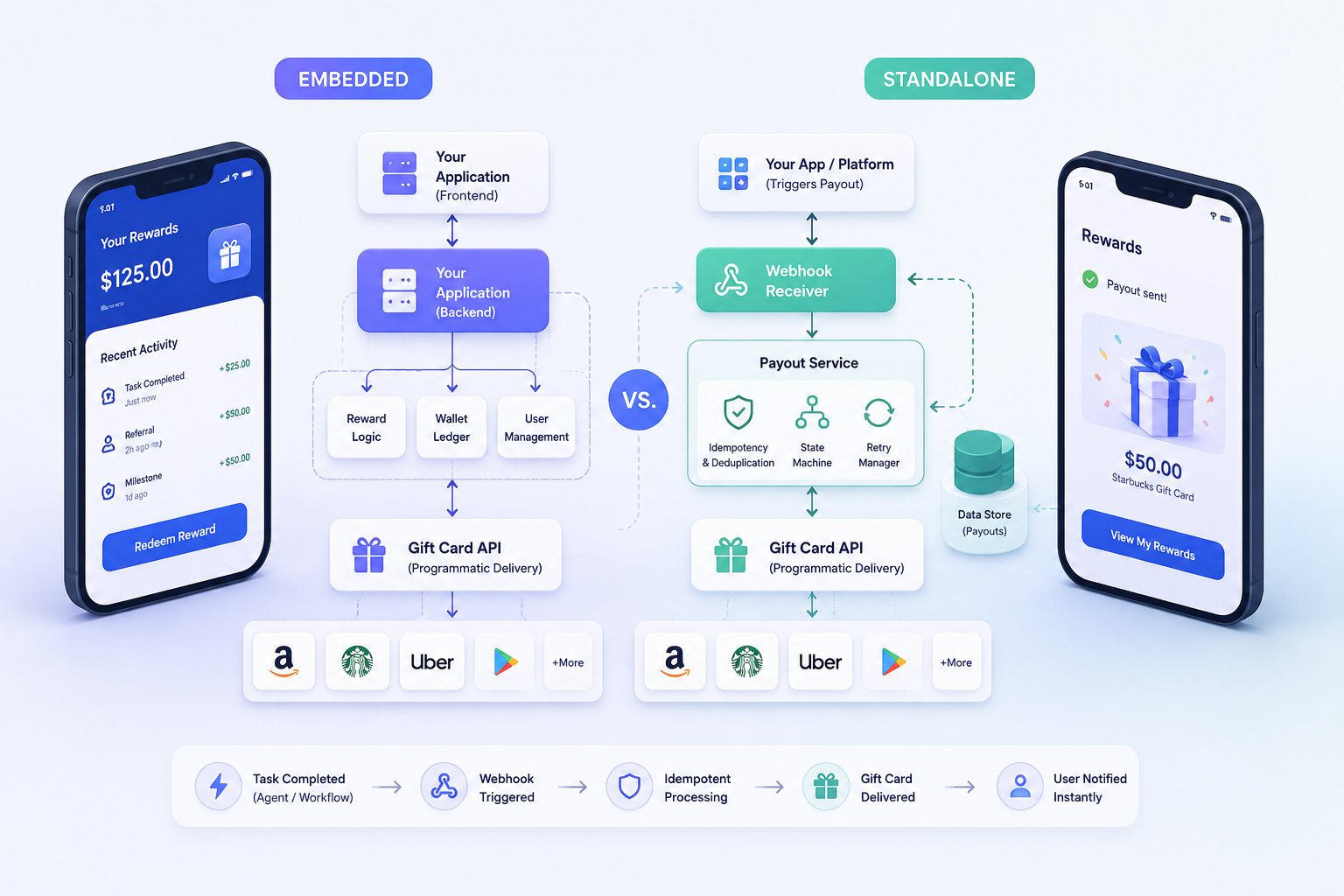
For a digital banking or fintech app, "embedded" reward architecture means gift card payouts are triggered and settled through the same payment gateway (PG) already used for core money movement: disbursements, card transactions, KYC-linked payout rails. The reward is, technically, just another payout type flowing through infrastructure the team has already integrated, tested, and gotten compliance sign-off on.
"Standalone" architecture means gift card fulfillment runs through a separate rewards or incentives API, decoupled from the payment gateway. The app's core payment stack still handles money movement into the user's account or balance; a distinct system handles catalog selection, gift card issuance, delivery, and redemption tracking.
Neither is objectively better. The mistake is treating this as a generic build-vs-buy question rather than an architecture question with specific downstream consequences: what happens to the reward program when the PG changes its terms, when the catalog needs to expand into new markets, or when reward rules need to change faster than the payment compliance review cycle allows. Those consequences are where the embedded-versus-standalone choice actually earns its keep.
Routing gift card payouts through the existing PG has real advantages for a lean product team:
The trade-offs tend to surface later, not at launch:
Decoupling gift card fulfillment into its own infrastructure shifts the trade-offs the other way:
The cost is real but bounded: one more vendor and API to integrate, and a reconciliation layer that needs to be stitched back into the app's existing finance and reporting dashboards so gift card spend doesn't become a blind spot.
.png?width=1672&height=941&name=Embedded%20vs.%20Standalone%20(2).png)
A few questions tend to surface the right answer faster than a generic feature comparison:
Teams that answer "yes, coverage will need to grow" or "reward rules change faster than compliance cycles" tend to be better served by standalone infrastructure integrated through a dedicated payment gateway integration for rewards, even if it means a slightly longer initial build.
WINK by Wincube Global publishes this kind of architecture guidance because gift card reward payouts are exactly the layer we build for, separate from core payment processing. Wincube Global has processed over USD 220 million in gift card GMV in 2025 across a catalog of more than 30,000 gift cards spanning over 90 countries, which is the kind of scale and coverage that's difficult to replicate inside a payment gateway's own rewards module.
For a banking or fintech product manager weighing embedded against standalone, the practical question is usually about future flexibility: will the reward program need to grow into new markets, new denominations, or new redemption rules faster than the core payment stack can accommodate. If that question is on the table, it may be worth a conversation about what a dedicated rewards layer could look like alongside the existing payment infrastructure, no architecture commitment required up front.
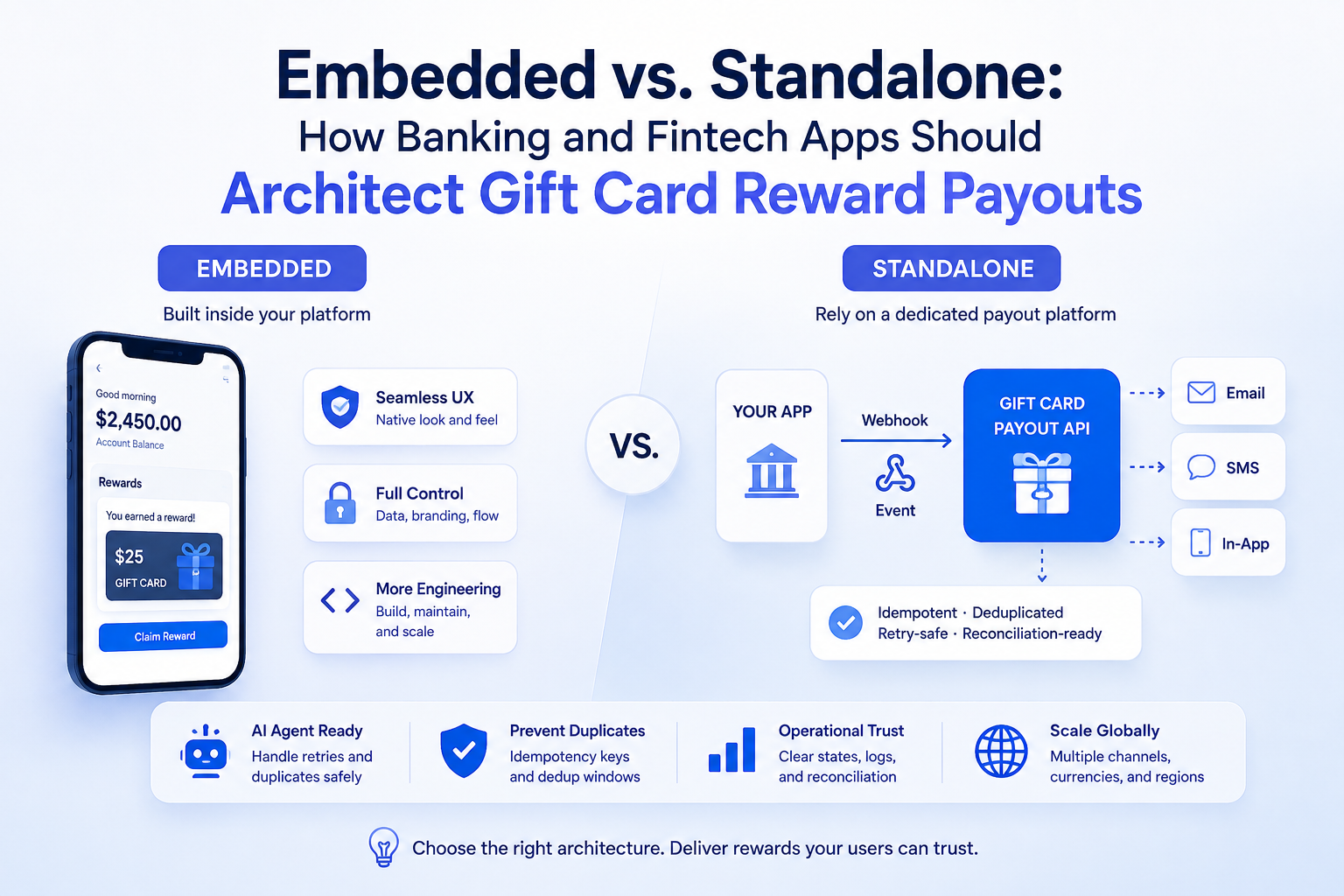
What's the main difference between embedded and standalone gift card reward payouts for a fintech app? Embedded payouts route gift card rewards through the same payment gateway already used for core money movement, reusing its compliance and settlement logic. Standalone payouts use a separate, purpose-built rewards system for catalog, fulfillment, and redemption, decoupled from the payment stack entirely.
Does an embedded payment gateway integration for rewards limit gift card selection? It can. Most payment gateways treat rewards as a secondary feature, so their catalog breadth and country coverage are usually narrower than what a dedicated gift card rewards platform offers, since that platform's core focus is catalog depth rather than payment processing.
Is a hybrid approach possible for fintech reward payouts? Yes, and it's common. Many banking and fintech apps use the payment gateway to trigger the reward event (a referral completing, a cashback threshold being hit) while routing the actual gift card fulfillment through standalone rewards infrastructure, combining fast payout triggers with broader catalog flexibility.
Sources
Related reading: How to Automate Reward Payouts for AI-Powered Fintech Platforms
Contact Email : win-obdteam@wincubemkt.com