Digital Gift Cards
WINK
WINCUBE

Every December, People Ops teams face the same handoff problem. Performance tiers are final in the HRIS, finance has approved the reward budget, and someone has to turn a spreadsheet of employee IDs and tier codes into gift card orders that reach the right people in Seoul, Singapore, and San Francisco. Most of the risk in year-end reward programs sits in that handoff, not in choosing the gift card, so the core question is how to move HRIS data into a gift card API safely, accurately, and on schedule.
In short: Treat the HRIS-to-gift-card handoff as a small data pipeline with five stages: export a frozen snapshot of approved tiers, map each tier to a reward value by country, validate and normalize each record, deduplicate with stable idempotency keys, and send orders to the gift card API only after a human approval gate. For employees in Korea, add checks for KRW denominations, mobile phone formats, and Korean-language delivery messages. That structure lets you automate the repetitive work while keeping a person accountable for what actually gets sent.
Data moving between systems is a well-documented weak point in pay operations. In Finity's UK Payroll Efficiency Report 2026, a survey of 342 finance and payroll professionals, 63% reported frequent or occasional problems when transferring data between systems, including mismatched data, duplicate entries and failed transfers (IT Brief UK, UK payroll errors persist as delays and manual work rise, 2026). Year-end bonus rewards have the same structure: one system produces the list, and another system has to act on it.
The cost of getting this wrong is not trivial at enterprise scale. A March 2026 UKG and KPMG study of more than 300 senior leaders at large multinational companies found that 38% reported $1 million to $5 million in annual payroll losses. The report estimates that organizations lose 2-4% of total labor spend to "payroll leakage," meaning consistent, unintended losses from inefficient processes, system limitations and even fraud (UKG Newsroom, UKG and KPMG: Nearly 40% of Employers Suffer Millions of Dollars in Preventable Losses Annually Due to Global Payroll Errors, 2026). Gift card rewards are often paid outside the payroll run, which can make them easy to overlook in the controls that payroll teams already have.
Practitioners see the same root causes. Varun Monteiro, CEO of Finity, said that "complexity, disconnected systems and insufficient automation are creating negative experiences for payroll teams" (IT Brief UK, 2026). A reward pipeline built directly against a gift card API addresses two of those three: it removes a manual re-keying step, and it gives you one place to enforce rules.
The goal is not to automate everything end to end. The goal is to automate the steps that are deterministic, such as formatting, validation, and deduplication, and keep the steps that need judgment, such as final approval, in human hands.
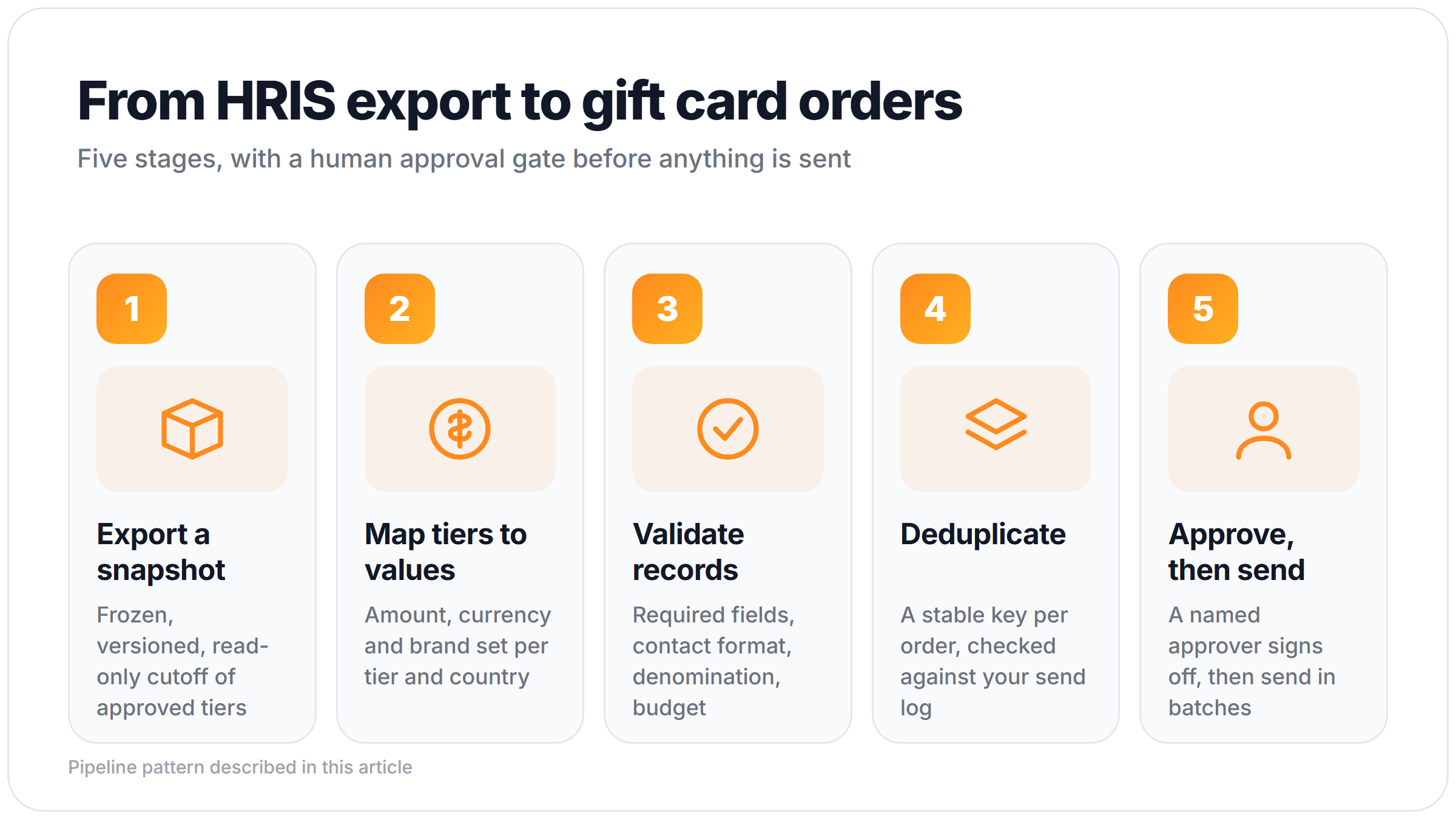
Don't let the reward job read live HRIS data. Export a snapshot of approved tiers at a defined cutoff time, assign it a version ID, and store it somewhere read-only. A typical record looks like this:
If a manager changes a tier after the cutoff, that becomes a new snapshot version with its own review, not a silent edit to the file already in flight.
Keep the tier-to-value mapping in a separate configuration table owned by HR and finance, not hardcoded in the integration. Each row maps a tier and country to a currency, an amount, and an eligible gift card brand set. This matters because the same tier rarely translates into one global number. A T1 reward may be denominated in USD for US staff and in KRW for Korean staff, and the available gift card denominations differ by market. When you set amounts, lead with the USD budget figure and record the local-currency equivalent alongside it so finance can reconcile both views.
Validation is where most errors get caught cheaply. Useful checks include:
Records that fail go to an exception queue with a readable reason, not into a log no one checks.
Duplicate rewards are the most visible failure in this kind of program, and they usually come from retries, not from bad data. Build an idempotency key for each order from stable values, such as the program ID, the snapshot version, and the employee ID. If your provider's API supports idempotency keys, send the key with every order request. Either way, record each key in your own send log and check it before any retry, so a retried call cannot create a second order. Also deduplicate within the file itself, since HRIS exports sometimes contain the same employee twice after a transfer between entities.
Before any order goes out, generate a summary for a named approver: headcount by country, total value by currency, count of exceptions, and a sample of records. Approval should be an explicit action, not a timeout. After approval, send orders in batches, store each API response against its idempotency key, and reconcile accepted and failed orders back to the snapshot. For more on how batch ordering works at the API level, see What Is a Bulk Gift Card API and Why Platforms Are Adopting One.
Korean teams often get the same pipeline with a few extra rules attached, and building them in from the start saves rework in December.
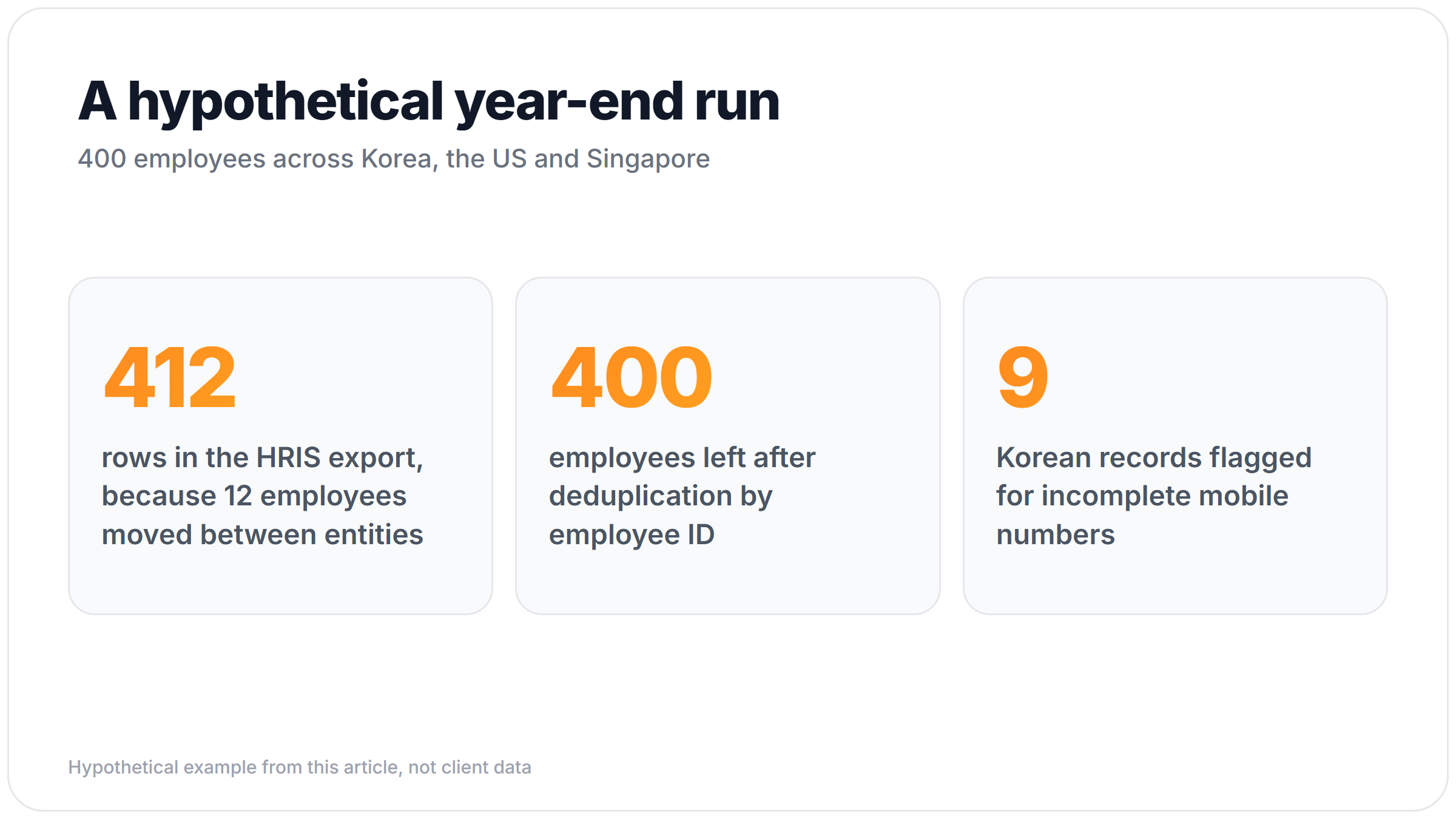
As a hypothetical example, imagine a company with 400 employees across Korea, the US, and Singapore. Its HRIS export contains 412 rows because 12 employees moved between legal entities mid-year. Deduplication by employee ID brings that back to 400, validation flags 9 Korean records with incomplete mobile numbers, and the approver sees one clean summary before anything is sent. None of those steps needs a person to retype a single row.
A brief security note: reward pipelines handle redeemable value, so keep API credentials in a secrets manager, restrict who can trigger a send, and never email gift card codes in bulk spreadsheets.
Wincube Global offers real-time API integration and bulk fulfillment for gift cards, the delivery methods a pipeline like this connects to. The company has processed over USD 220 million in gift card GMV in 2025 across a catalog of more than 30,000 gift cards spanning over 90 countries, which includes strong coverage of Korean brands alongside global options. For Korean e-vouchers ordered through Wincube's API or bulk fulfillment, the voucher code is delivered to the partner's platform, which then delivers it to its own users, so the delivery channel, language and timing fields in your snapshot stay under your control.
If you're planning year-end rewards for teams in Korea and other markets, the most useful first step is usually mapping your HRIS export fields to the order format and deciding where your approval gate lives. If this is relevant to your team, Contact Us and we can walk through what it would look like.
It is usually safer to work from a frozen, versioned export than to read live HRIS data. A snapshot gives you a fixed record of what was approved, makes deduplication reliable, and keeps late tier changes from slipping into a batch that's already in flight.
An idempotency key is a unique value sent with each order request, built from stable fields such as program ID, snapshot version, and employee ID. If a request is retried after a timeout, a system that supports the key can recognize it and avoid creating a second order, and your own send log can run the same check before any retry. That protects against the most common cause of duplicate rewards.
Delivery in Korea is often mobile-based, local brands tend to matter more to recipients, and messages should be in Korean. Tax and reporting treatment can also differ from other markets, so confirm the details with local legal and tax counsel before launching the program.
Sources