Digital Gift Cards
Global Gift Cards
CROSS BORDER GIFTCARD
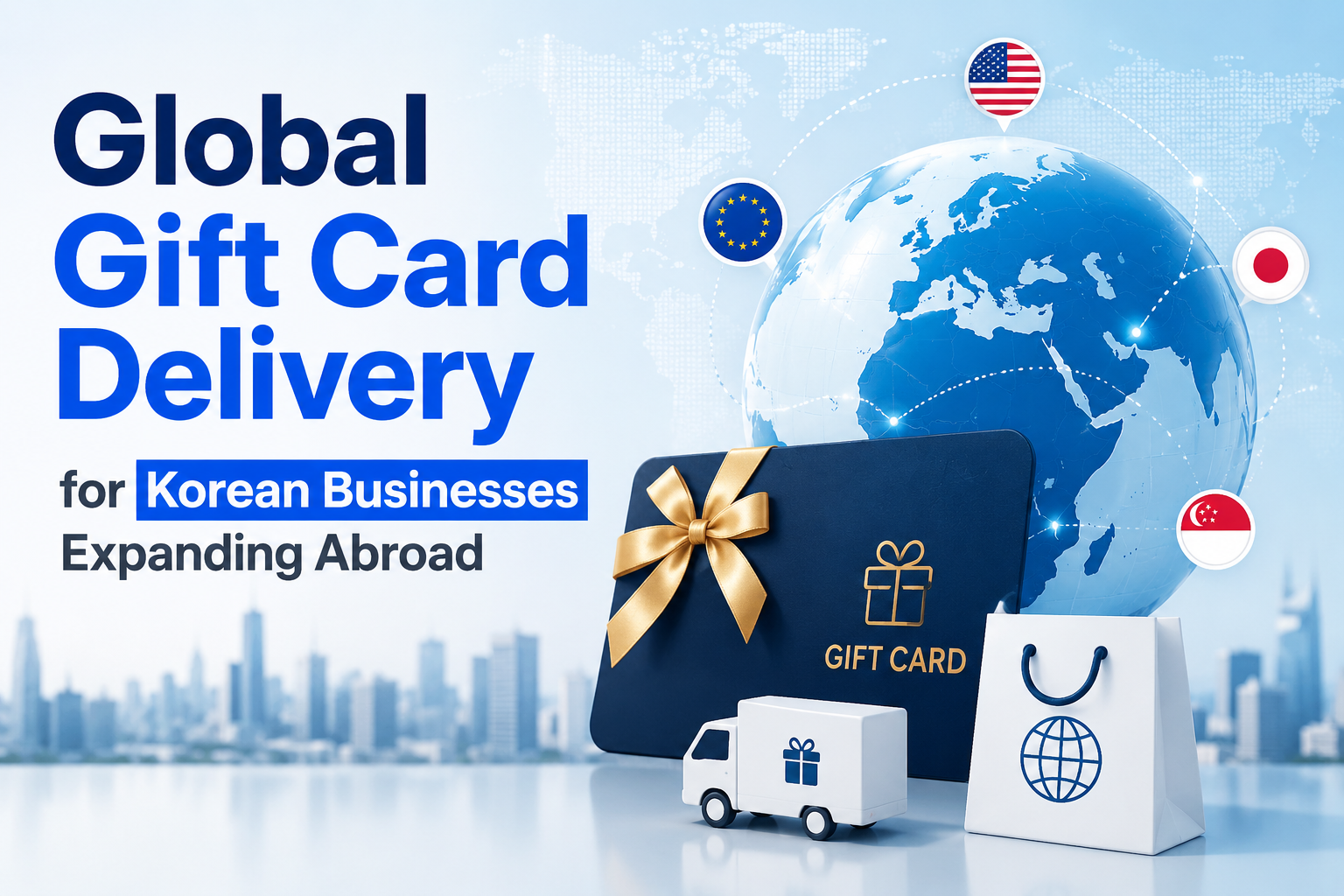

Korean businesses are expanding abroad faster than ever — into the US, Southeast Asia, Europe, and beyond. But here's the problem: when you need to reward an employee in New York, incentivize a research respondent in Singapore, or recognize a partner in Germany, you quickly discover that most gift card infrastructure is built for a single region. That forces Korean companies to juggle three or four separate vendor contracts just to cover their key markets.
The good news? A single global gift card partner with deep catalog access in both Korea and your target markets eliminates that complexity — and gives every recipient a reward they actually want.
📌 TL;DR
The global B2B gift card market is valued at $455B in 2026 and growing at 10.1% CAGR — the infrastructure category is maturing fast.
Multi-country reward programs require local catalog depth in each target market, not just a country coverage headline.
API integration delivers gift codes in real time; bulk fulfillment handles volume campaigns without integration overhead — you need both options from a single partner.
Wincube processes 220M+ GMV annually across 90+ countries, with 30,000+ gift card options spanning deep Korean and global catalogs under one partner relationship.
A global gift card program is a reward delivery system that lets your business send digital gift cards to recipients in multiple countries — all through a single platform or API connection. Instead of sourcing local gift cards market by market, you connect once and distribute rewards to employees, customers, or survey respondents wherever they are.
For Korean businesses, this distinction is critical. Korea's digital economy is deeply tied to specific local brands: Naver Pay, Coupang, Baemin (배달의민족), Olive Young, Emart, and Culture Land are daily-use platforms for Korean consumers. A reward program that only offers Amazon or Starbucks misses the mark entirely for Korean recipients. But Korean businesses expanding into the US, Europe, or Southeast Asia face the opposite challenge — their overseas employees and customers want locally relevant brands too, not Korean-only options.
The scale of this opportunity is significant. The global B2B gift card market is valued at $455 billion in 2026 and is projected to reach $892 billion by 2033 at a 10.1% CAGR (Persistence Market Research). Corporate buyers drive the largest share of this growth — they accounted for 64.85% of US gift card market volume in 2023 (SkyQuestTT). The shift is structural: enterprises are replacing legacy reward mechanisms with scalable, API-driven digital gift card platforms because manual procurement breaks down as programs grow across borders.
The reason this matters for Korean companies specifically: the Korea-to-global expansion trajectory is accelerating. Korean conglomerates, fintech platforms, e-commerce companies, and research panel operators are all building overseas presences that require reward infrastructure in multiple currencies and brand catalogs simultaneously. A global gift card program is not a nice-to-have for these companies — it is the operational backbone of employee engagement, customer loyalty, and research incentive delivery at scale.
The most important practical outcome: every recipient gets a reward for a brand they recognise and use. An employee in Seoul who receives a Coupang gift card, and a colleague in Chicago who receives an Amazon gift card, both feel genuinely rewarded — because the program adapted to their market. That localization is what separates a global gift card program from a US-centric rewards tool with a country dropdown.
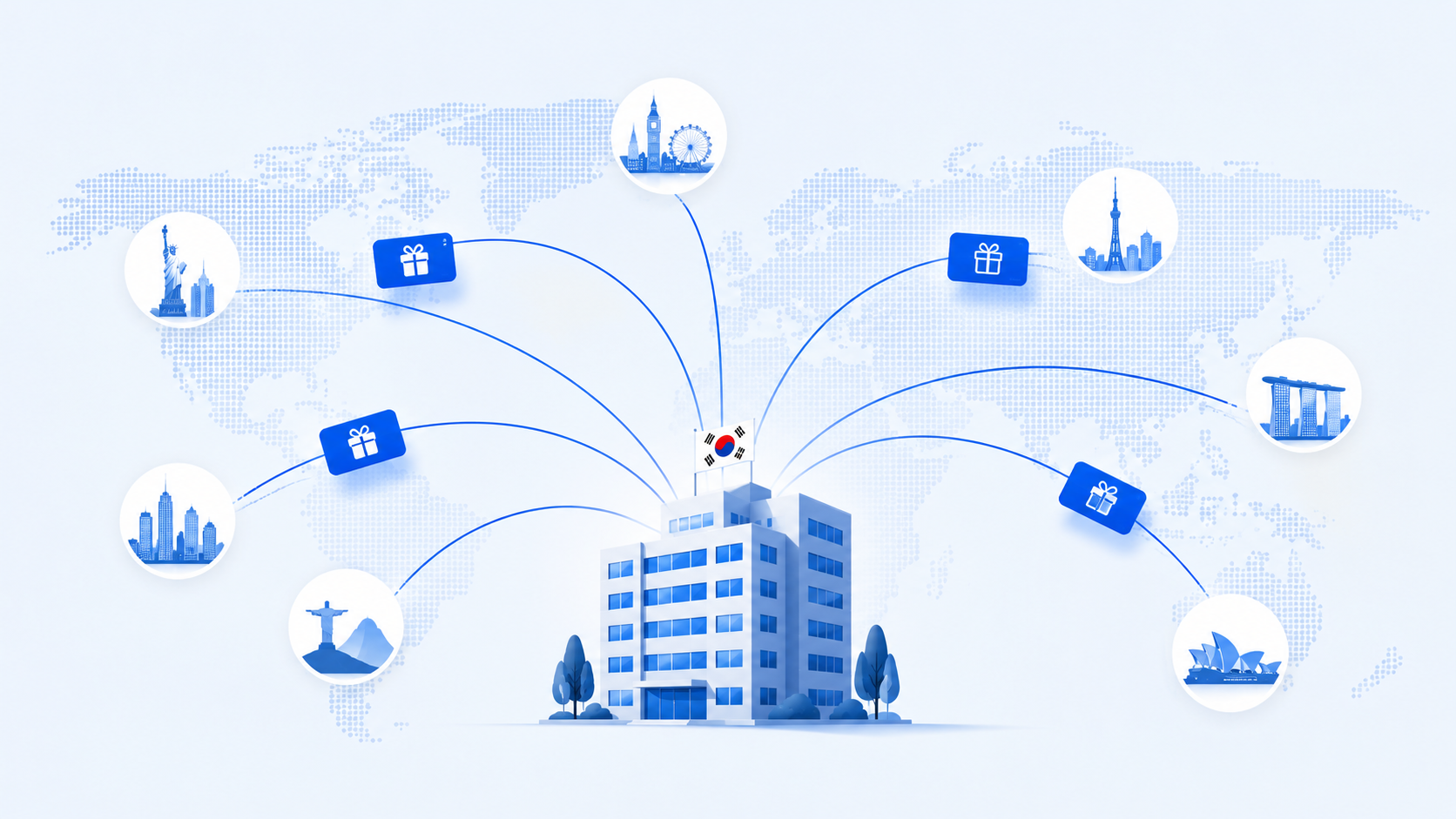
The challenge is real — and the pain compounds as you enter more markets.
Catalog fragmentation. A gift card that works in Seoul does not work in San Francisco. A US Amazon card is not redeemable in Korea. Most B2B gift card suppliers specialize in one region. That means Korean companies entering US, European, or Southeast Asian markets often end up managing separate vendor relationships for each geography — one for the US, one for Europe, one for Korea. Each contract, each API integration, and each billing relationship adds operational overhead that grows linearly with each new market.
Currency and compliance complexity. Multi-country reward programs involve fluctuating exchange rates, regional tax treatment of employee gifts, and local prepaid instrument regulations. Getting even one of these wrong leads to delayed deliveries, incorrect denominations, or regulatory exposure. Korea, the US, and EU countries each have distinct frameworks governing how digital prepaid cards are issued and distributed.
Local relevance gaps. Research from the Incentive Research Foundation confirms that gift cards are the most utilized tool in corporate incentive programs — but their impact depends entirely on whether the recipient actually wants the brand being offered. An employee in New York does not want a Baemin coupon. A survey respondent in Seoul does not want a DoorDash gift card. Generic global catalogs that list 90 countries but carry only 15 to 20 global brands per market do not solve this problem — they just create the appearance of coverage.
Delivery speed expectations. Global enterprises increasingly expect real-time delivery. A survey respondent completing a panel in Tokyo at 11pm expects their incentive instantly — not three business days later. Legacy bulk delivery systems built for physical cards cannot meet this expectation.
Operational overhead at scale. The global rewards and incentives service market is valued at USD 6.52 billion in 2026 and growing at 8.9% CAGR (BusinessResearchInsights). That growth reflects real enterprise demand — but most Korean companies trying to operate globally are still navigating fragmented infrastructure manually, spending time managing vendor relationships instead of running their core business.
The result: companies assemble three to five supplier relationships, manage disconnected billing, and still fail to deliver locally relevant rewards in key markets. The solution is not more vendors — it is one partner with genuine depth in every market you need.
Brand relevance is where global gift card programs win or lose. The right brand in the right market drives genuine engagement. The wrong brand lands unspent — or worse, signals that your company did not think about the recipient at all.
Here is how brand relevance breaks down by region:
United States: Amazon, Starbucks, Walmart, DoorDash, Uber, Target, Apple, Google Play, and open-loop Visa and Mastercard cards are the anchor brands. Visa and Mastercard open-loop gift cards are especially valuable because recipients can spend them anywhere — no brand restriction, no redemption friction.
Korea: Naver Pay, Coupang, Baemin (배달의민족), Olive Young, Emart, Shinsegae, Culture Land, and GS25 digital gift cards dominate. These are not niche local options — Coupang processes tens of millions of transactions per month, and Naver Pay is embedded into Korea's most-used super-app. Any reward program that omits these brands is not a Korean program — it is a Western program with a Korean address.
Southeast Asia: Grab, Lazada, Shopee, and regional telco cards are the highest-performing options, with strong country-level variation across Thailand, Indonesia, Philippines, and Vietnam. A single "Southeast Asia" catalog bucket does not capture this variation accurately.
Europe: Amazon (UK, DE, FR versions), Zalando, local supermarket chains, and open-loop Visa/Mastercard cards are the standard choice for cross-border European programs.
Fiserv's Q4 2024 Gift Card Gauge (1,000+ respondents) found that 86% of employees call gift cards appropriate incentives — but that percentage assumes the card is for a brand the recipient actually uses. The same study found that 89% of recipients say receiving a reward makes them feel valued as a team member. Separate research shows 54% of employees prefer gift cards over physical gifts. The emotional impact is real. The prerequisite is brand relevance.
For Korean businesses operating globally, this means your gift card catalog needs to cover two distinct audiences simultaneously: Korean recipients who expect Korean brands, and overseas recipients who expect locally relevant global brands. A partner that only covers one side forces you into a second supplier relationship — or into delivering rewards your recipients do not want.
The delivery model you choose determines your speed, scalability, and operational overhead. Two models dominate B2B gift card delivery — and the best global partners offer both.
API Integration connects your platform, application, or reward system directly to a gift card supplier's inventory. When a trigger fires — a survey completion, a purchase milestone, an employee anniversary — the API call executes in milliseconds and delivers the gift code to the recipient instantly. No human intervention, no batch processing delay, no manual review queue.
API integration is the right choice for:
Research panels and survey platforms that need instant respondent incentives
Loyalty programs with automated reward triggers at defined thresholds
E-commerce platforms issuing purchase credits in real time
Any program where recipient experience depends on immediate delivery
Bulk Fulfillment handles large-volume orders without requiring a technical integration. You submit a recipient list and denomination structure; the supplier processes and delivers the gift codes in batch. This model suits one-time campaigns, seasonal employee programs, and enterprise use cases where you need volume at scale without committing engineering resources to an integration project.
Bulk fulfillment is the right choice for:
Annual employee recognition programs distributed across multiple office locations
Marketing campaigns with a fixed recipient list and a defined send date
Partner appreciation programs run once or twice per year
Sales incentive distributions tied to quarterly performance results
The B2B market's shift toward API-first platforms is clear: corporate buyers are replacing manual procurement with scalable, API-driven infrastructure (Persistence Market Research, 2026). But not every program needs real-time delivery — bulk fulfillment remains the most cost-efficient model for non-automated, high-volume campaigns.
Here's the thing: the best global gift card companies offer both models. If your partner only offers API integration, you are over-engineering a quarterly employee recognition campaign. If they only offer bulk fulfillment, you cannot power a real-time survey incentive platform. Korean businesses expanding globally need a partner that handles both delivery models under one contract — so your technical teams and your HR and marketing teams can both execute from the same supplier relationship, without separate procurement processes.
Korea's gift card ecosystem is built differently — and understanding that difference is essential for any business that rewards Korean recipients, whether from Korea or from abroad.
The South Korean gift card and incentive card market is valued at USD 7.56 billion in 2025 and is projected to reach USD 10.07 billion by 2029 at a 7.4% CAGR (Research and Markets, 2025). The market is dominated by platform-native digital gift cards, not generic open-loop cards. Korean consumers are far more likely to use a Coupang gift card, a Naver Pay balance, or a Baemin coupon than a Visa prepaid card — because those platform wallets are woven into daily purchasing behavior in a way that Western markets do not have a direct equivalent for.
Platform integration over open-loop. Unlike the US, where Visa and Mastercard open-loop cards dominate corporate gifting, Korean recipients prefer closed-loop platform cards tied to specific marketplaces and services they already use daily. A Shinsegae department store voucher, a Culture Land entertainment card, or a GS25 convenience store coupon all carry high perceived value because they connect directly to habitual spending patterns.
Mobile-first delivery expectations. Korea leads in mobile commerce penetration. Digital gift codes delivered via KakaoTalk or SMS are the standard expectation — not email-only delivery. Programs delivering to Korean recipients via US-style email-only workflows create unnecessary redemption friction that reduces the program's actual impact.
Culturally significant gifting occasions. Korea has distinct gift-giving seasons — Chuseok, Lunar New Year, and milestone celebrations — where specific brand combinations carry cultural weight. Corporate programs that ignore this calendar and these brand preferences deliver generic rewards when contextual relevance is highest.
Regulatory framework. Korean gift cards operate under KFTC (Korea Fair Trade Commission) guidelines for prepaid instruments, which differ significantly from US or EU rules. A gift card partner with on-the-ground Korea experience has already navigated these requirements — you benefit from that institutional knowledge rather than rebuilding it.
For Korean businesses, the practical implication is straightforward: your global gift card partner needs authentic depth in the Korean catalog — not a token "Korea" section with one or two brands. Deep local access to Naver Pay, Coupang, Baemin, Emart, Culture Land, and Olive Young is the baseline for rewarding Korean recipients effectively, whether you are a Korean company rewarding your domestic team or an international platform trying to incentivize Korean survey respondents and customers.
Choosing a global gift card partner is a procurement decision with long-term operational implications. Six criteria separate infrastructure-grade partners from those that work at small scale but break as you grow.
1. Catalog depth in your specific target markets. Generic coverage numbers like "90+ countries" tell you very little. Ask your shortlisted vendors directly: "What are the top 10 brands you carry in Korea, the US, and [your third market]?" A partner with real depth answers immediately. A partner with thin coverage deflects with regional generalities.
2. Dual delivery model. As covered above, both API integration and bulk fulfillment should be available under one contract. A partner that offers only one delivery model limits your program design before you begin.
3. Transaction scale and infrastructure reliability. Enterprise reward programs cannot tolerate fulfillment delays or API downtime. Ask for uptime SLAs and reference annual transaction volumes. A partner processing hundreds of millions of transactions per year operates infrastructure at a different reliability tier than a startup-scale supplier.
4. Multi-currency and denomination management. Your partner handles currency conversion and denomination management across markets. Issuing a $50 equivalent reward in the US, a ¥6,000 equivalent in Japan, and a ₩65,000 equivalent in Korea through one billing relationship requires a partner with genuine multi-currency operational capability — not one that charges you to figure out the conversion manually.
5. Compliance and regional expertise. Local regulations on prepaid instruments vary by country. A partner with on-the-ground experience in Korea and the US has already navigated KFTC, IRS, and local financial regulations — you benefit from that knowledge base without rebuilding it from scratch for every new market you enter.
6. Relationship-driven support model. Enterprise-scale global reward programs require responsive account support, not a self-serve portal and a ticket queue. The best partners for Korean businesses expanding globally operate a direct relationship model — dedicated contacts who understand your program requirements and can escalate issues quickly.
The global digital gift card market is projected to reach USD 774.3 billion by 2032 at 11.6% CAGR (Research and Markets). That growth creates options — but also noise from undifferentiated suppliers. Apply these six criteria and your shortlist narrows quickly to the partners that can genuinely support your global expansion at scale.
Wincube is a B2B digital gift card aggregator and rewards infrastructure provider, headquartered in Seoul with a U.S. branch in Delaware. Operating since 2011, Wincube processes 220M+ GMV per year across 90+ countries — with 30,000+ gift card options spanning both its Korean catalog and its global catalog.
For Korean businesses expanding abroad, Wincube's core advantage is its dual catalog structure. Most global gift card companies treat Korea as one of 90 markets. Wincube is built from Korea. That means the Korean catalog includes genuine depth — Naver Pay, Coupang, Baemin (배달의민족), Emart, Olive Young, Shinsegae, Culture Land, GS25, and more. These are the brands Korean recipients actually use, not a single token option labeled "Korea" to satisfy a country checklist.
At the same time, Wincube's global catalog covers the international brands your overseas employees and customers expect: Amazon, Starbucks, Walmart, DoorDash, Uber, Google Play, Visa, Mastercard, and hundreds more across North America, Europe, and Asia Pacific. Korean companies running incentive programs in the US, rewarding employees across Southeast Asia, or managing global research panels access all of this through one partner relationship.
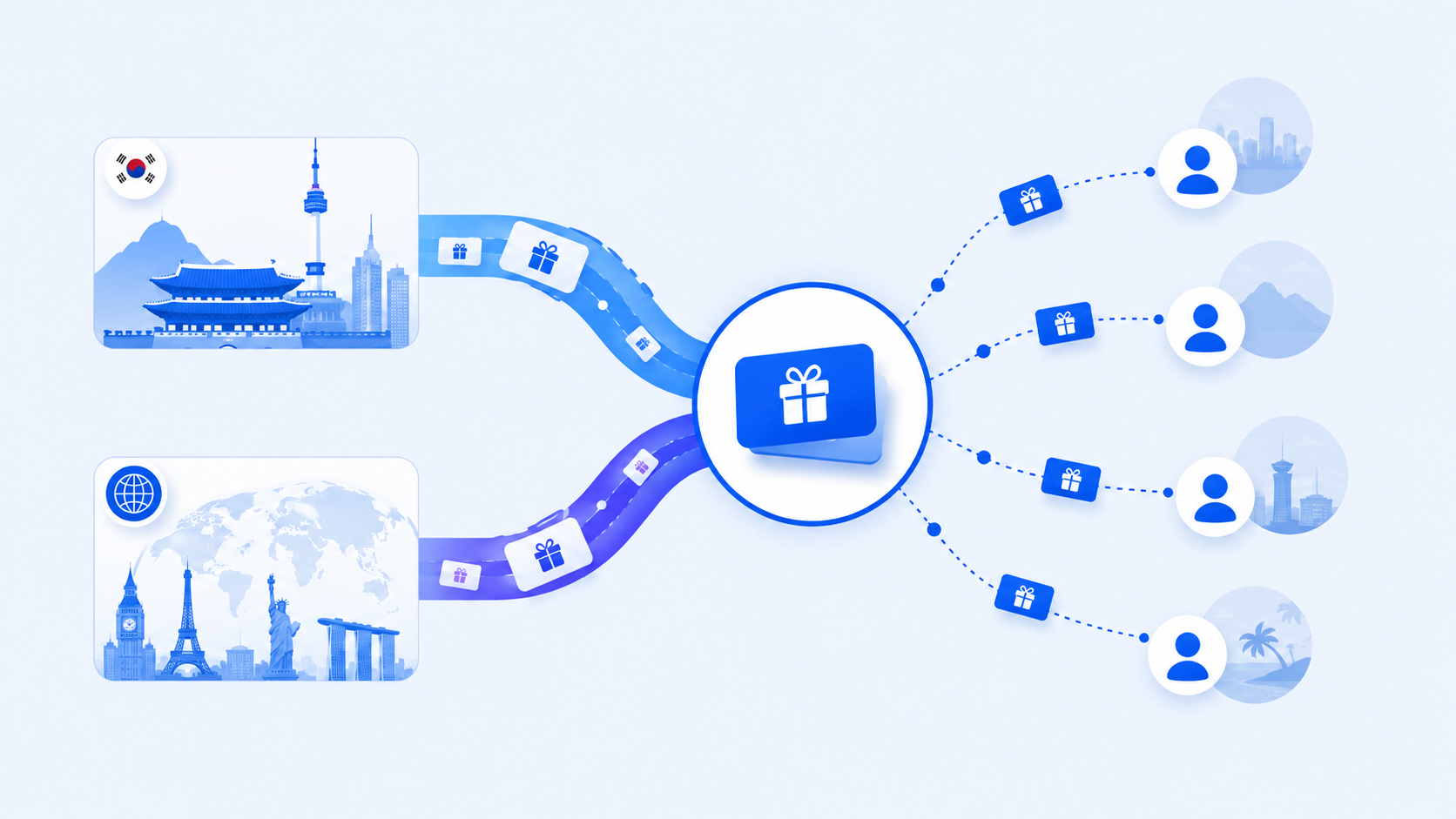
Wincube delivers rewards through two primary channels: real-time API integration for platforms that need instant code delivery, and enterprise bulk fulfillment for high-volume campaigns without engineering overhead. Korean businesses running research panels, loyalty programs, or employee incentive campaigns across multiple markets access both through one partner relationship — eliminating the need to manage separate integrations and billing contracts for each delivery method.
The scale signal matters for enterprise programs. Processing 220M+ GMV in 2025, operating 100+ gift shops, and serving clients across 90+ countries means Wincube's infrastructure handles real enterprise load — not startup-grade volume with startup-grade reliability risks. For Korean companies building global programs that will grow, this operational foundation is the right starting point.
The practical outcome for your business: instead of managing a Korean gift card supplier, a US gift card supplier, and separate contracts for each additional market, you work with Wincube as a single point of integration — one API, one bulk fulfillment relationship, and one account team that understands both sides of the Korea-global equation. Learn more about Wincube or reach out to discuss your program requirements.
If this is relevant to your team, Contact Us and we can walk through what it would look like.
Not with a dual-catalog partner like Wincube. Wincube's catalog structure covers both Korean brands (Naver Pay, Coupang, Baemin, Emart, Culture Land, Olive Young, and more) and international brands (Amazon, Starbucks, Walmart, Visa, Mastercard, and more) under one partner relationship. API integration and bulk fulfillment are both available from the same account.
API integration delivers gift codes in real time the moment a trigger fires — survey completion, purchase event, loyalty threshold. Bulk fulfillment processes large batches of recipient lists and delivers gift codes at scale without real-time integration. Most enterprise programs use both, depending on the campaign type: automated programs use API, while volume campaigns and seasonal programs use bulk.
A partner that lists 90 countries but only carries one or two brands per market leaves recipients without meaningful choice. Catalog depth means the specific brands recipients use daily in each market — for Korea, that is Naver Pay, Coupang, and Baemin; for the US, that is Amazon, Starbucks, and Walmart. Country count is a headline; brand depth is what recipients actually experience when they redeem.
The South Korean gift card and incentive card market is valued at USD 7.56 billion in 2025 and is projected to reach USD 10.07 billion by 2029 at a 7.4% CAGR (Research and Markets, 2025). Growth is driven by digital and e-gift card adoption, with platform-native cards like Coupang and Naver Pay leading the category.
Yes. Fiserv's Q4 2024 Gift Card Gauge (1,000+ respondents) found that 86% of employees call gift cards appropriate incentives and 89% say receiving a reward makes them feel valued as a team member. Separate research shows 54% of employees prefer gift cards over physical gifts. Effectiveness depends on brand relevance — the card must be for a brand the recipient actually uses in their market.
Wincube operates a relationship-driven B2B model. Contact the team to discuss your program requirements — target markets, delivery model (API or bulk), catalog preferences, and volume. The team will scope the right approach for your specific use case.
Korean businesses expanding globally face a specific rewards challenge that most gift card companies are not built to solve: you need deep Korean catalog access and genuine global brand coverage, delivered through a single partner that handles both API integration and bulk fulfillment at enterprise scale.
The B2B gift card market is growing at 10.1% CAGR and is on track to reach $892 billion by 2033. The companies that build scalable, locally relevant reward programs now retain top talent, drive customer loyalty, and earn genuine respondent engagement across every market they operate in.
Wincube has processed 220M+ GMV across 90+ countries since 2011 — with a dual catalog that covers the Korean brands your Korean recipients use daily and the global brands your overseas teams expect. One partner. Two delivery models. Real depth on both sides.
Related reading: How Global Buyers Add Korean Gift Cards to Their Rewards Catalog: A Practical Guide
Contact Email : win-obdteam@wincubemkt.com