Digital Gift Cards
WINK
WINCUBE

A global gift card program cannot run on one calendar, one set of customs or one currency. Japan, Taiwan and the United States each have their own gifting moments, and a reward budget set in dollars has to be translated before it reaches a recipient in yen or New Taiwan dollars. Here is what program owners at reward platforms and global enterprises should check in each market before they schedule a send.
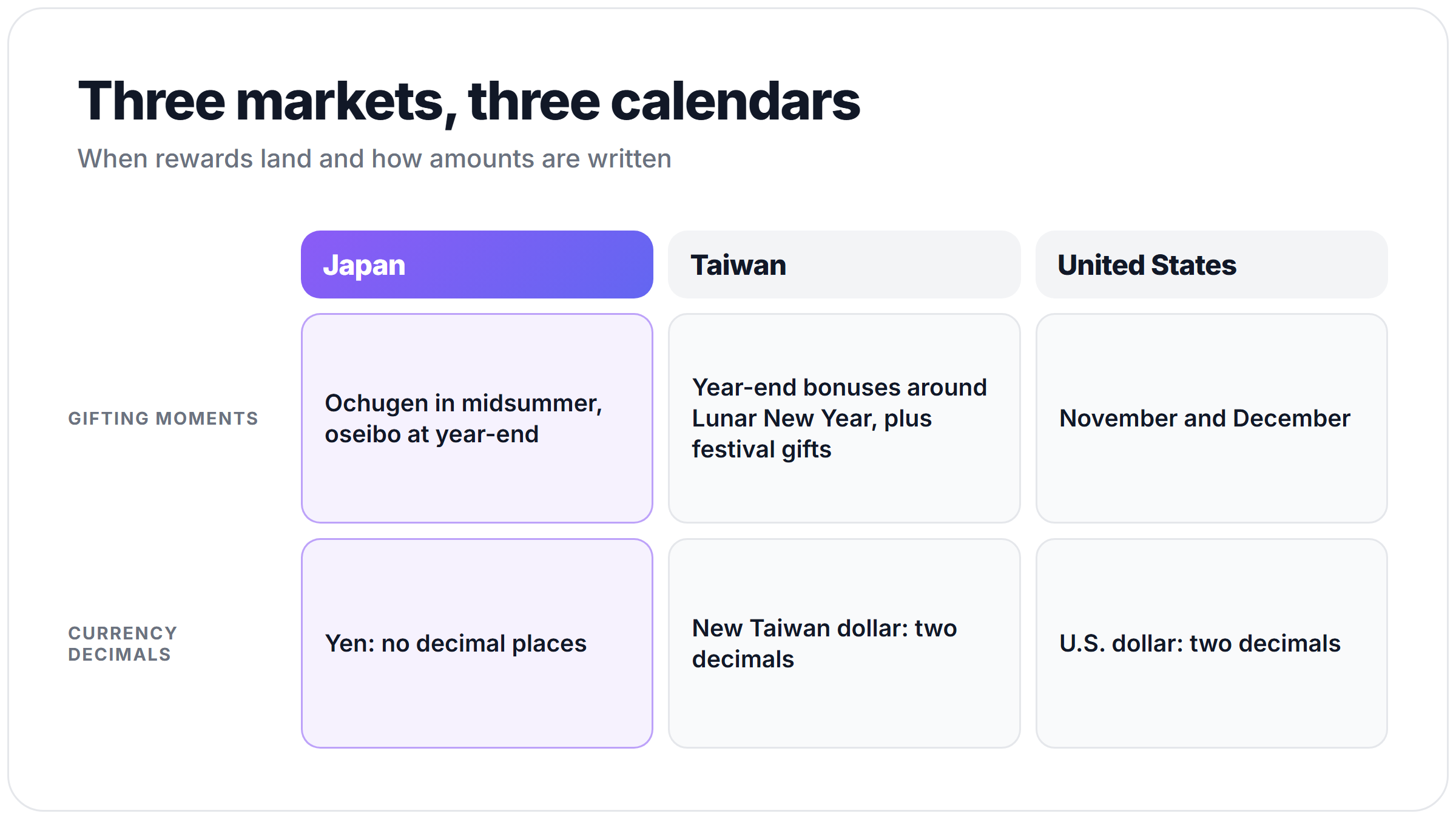
In short: Japan gives at two seasons, midsummer (ochugen) and year-end (oseibo), and gifts sent by link or email are growing fast. In Taiwan, employers plan year-end bonuses around Lunar New Year, and festival gifts such as Mid-Autumn add another moment. The United States concentrates gift card demand in November and December. The yen has no decimal places, while the New Taiwan dollar and the U.S. dollar have two, so set reward values market by market.
Japan's traditional gifting seasons are ochugen in midsummer and oseibo at year-end. A Nippon.com explainer (Nippon.com, The Social Custom of Gift Giving, 2015) places ochugen from early July to mid-August, with some regional variation, and oseibo in mid- to late December. Gifts go to people in higher social positions, such as business clients or teachers. Department stores and supermarkets set up dedicated sales areas, and gift coupons are among the usual choices. The explainer is dated, so treat it as background on the custom, not current data.
The newer shift is digital. Jiji Press reported that Japan's social gift market, where a gift is sent by link or email and the recipient redeems a digital voucher in a store or enters an address for delivery, is estimated at 600 billion yen, about 3.8 times its size six years earlier (Adnkronos, republishing Jiji Press, Social Gifting Booms in Japan; Market Nearly Quadruples, January 2026). The estimate comes from a private research firm; Yano Research Institute put the market at about 158 billion yen in 2019. Link-based e-gifts are therefore likely a familiar format for Japanese recipients.
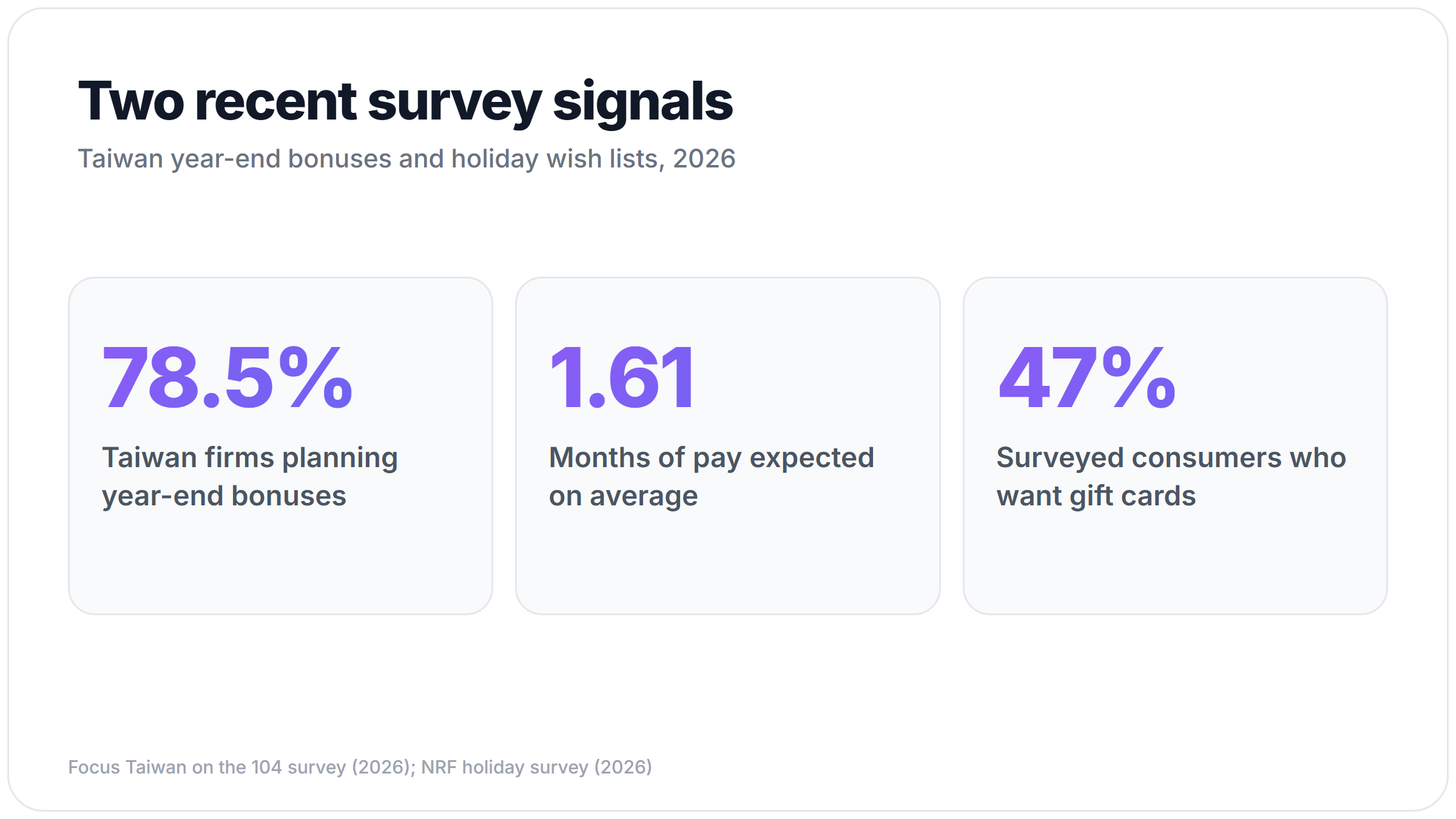
In Taiwan, year-end bonuses are a standard employer reward, and Focus Taiwan tied them in January 2025 to the upcoming Lunar New Year holiday (Focus Taiwan, Taiwan's employers to give 1.39 months of wage as year-end bonuses: Poll, 2025). The latest survey by the job bank 104, announced on November 17, 2026, found that 78.5% of 1,055 responding companies plan year-end bonuses, up from about 68% a year earlier, at an expected average of 1.61 months of pay (Focus Taiwan, Average year-end bonuses expected to equal 1.61 months' pay: Survey, 2026).
Festival gifts add a second moment. In a 2015 survey of office workers by the job bank yes123, cash or gift certificates were the most wanted Mid-Autumn Festival gift (41.5%), while traditional mooncakes, given by 54% of companies, were the gift workers wanted least (34.9%) (Taipei Times, Cash Mid-Autumn Festival gifts are most desired by office workers: survey, 2015). The survey is dated, but it suggests a flexible, redeemable reward can land better than a fixed festival item.
NRF's October 2026 holiday survey of 8,094 adult consumers (Prosper Insights & Analytics, October 1-7) put gift cards at the top of wish lists: 47% want to receive them, ahead of clothing at 44%. NRF expects November and December holiday spending to grow 4.2% over 2025, to $1.013 trillion (NRF, Affordability Shapes Winter Holiday Shopping, October 20, 2026). For the 2025 season, NRF reported that 43% of shoppers planned to buy at least one gift card and that gift card spending was expected to reach $29 billion (NRF, Gift cards gain popularity as top choice for holiday shoppers in 2025, December 11, 2025).
The window is concentrated in November and December, so settle send calendars and budgets well before it starts.
Three habits keep a multi-market program manageable. Keep one send calendar per market, not one global calendar. Set reward values in each local currency: a dollar amount converted at today's rate rarely lands on a round yen or New Taiwan dollar value, and ISO 4217, the international currency-code standard, lists the yen with no decimal places and the New Taiwan dollar and the U.S. dollar with two (SIX Group, ISO 4217 List One, published September 17, 2026). And confirm brands and delivery terms for each country with your provider before you commit volume, because they vary by country.
Wincube Global is a B2B digital gift card aggregator and rewards infrastructure provider headquartered in Seoul, with a U.S. branch in Delaware and operations since 2011. It has processed over USD 220 million in gift card GMV in 2025 across a catalog of more than 30,000 gift cards spanning over 90 countries, and it delivers through real-time API integration and bulk fulfillment. Wincube is strong in six markets: Taiwan, Japan, the United States, Canada, South Korea and Europe. Brands and delivery terms vary by country, and the Wincube team confirms the details for your markets when you start.
If this is relevant to your team, Contact Us and we can walk through what it would look like.
No. Japan centers on ochugen and oseibo, Taiwan on year-end bonuses around Lunar New Year plus festival gifts, and the United States on November and December.
Set the budget per market in the local currency where you can. ISO 4217 lists the yen with no decimal places and the New Taiwan dollar and the U.S. dollar with two, so equal dollar values rarely convert into equally round local values.
Wincube is strong in six markets, including Taiwan, Japan and the United States. Brands and delivery terms vary by country, so the Wincube team confirms the details for your markets when you start.
Sources