Digital Gift Cards
WINK
WINCUBE

Verification of Payee (VoP) now checks the payee's name against the IBAN on euro credit transfers. That makes paying 40,000 survey respondents or referral users by bank transfer a different job than it was two years ago. Payout and treasury leads at EU platforms, fintechs and research panels now face a practical question. Is the bank rail still the right default for small bulk incentives, or does part of that volume fit better on digital gift cards, which need no IBAN and run no name check?
In short: Bank transfers still suit larger payouts, recurring payments and recipients who expect cash. Under VoP, though, bulk runs add name-match exceptions, decisions about whether to opt out of the check, and the work of collecting and storing IBANs. Digital gift cards avoid the IBAN and the name check but limit how recipients can spend the reward. Many teams end up using both, with the payout method chosen by reward size, recipient preference and risk profile.
Under the Instant Payments Regulation, payment providers in the euro area must check whether the name a payer enters matches the name on the payee's IBAN before the payer authorizes a transfer. The check returns a result of match, close match, no match or other. For one consumer sending money to a landlord, that is a helpful safety prompt. For a platform sending thousands of small incentive payments from a file, each result other than a full match is an exception someone has to handle.
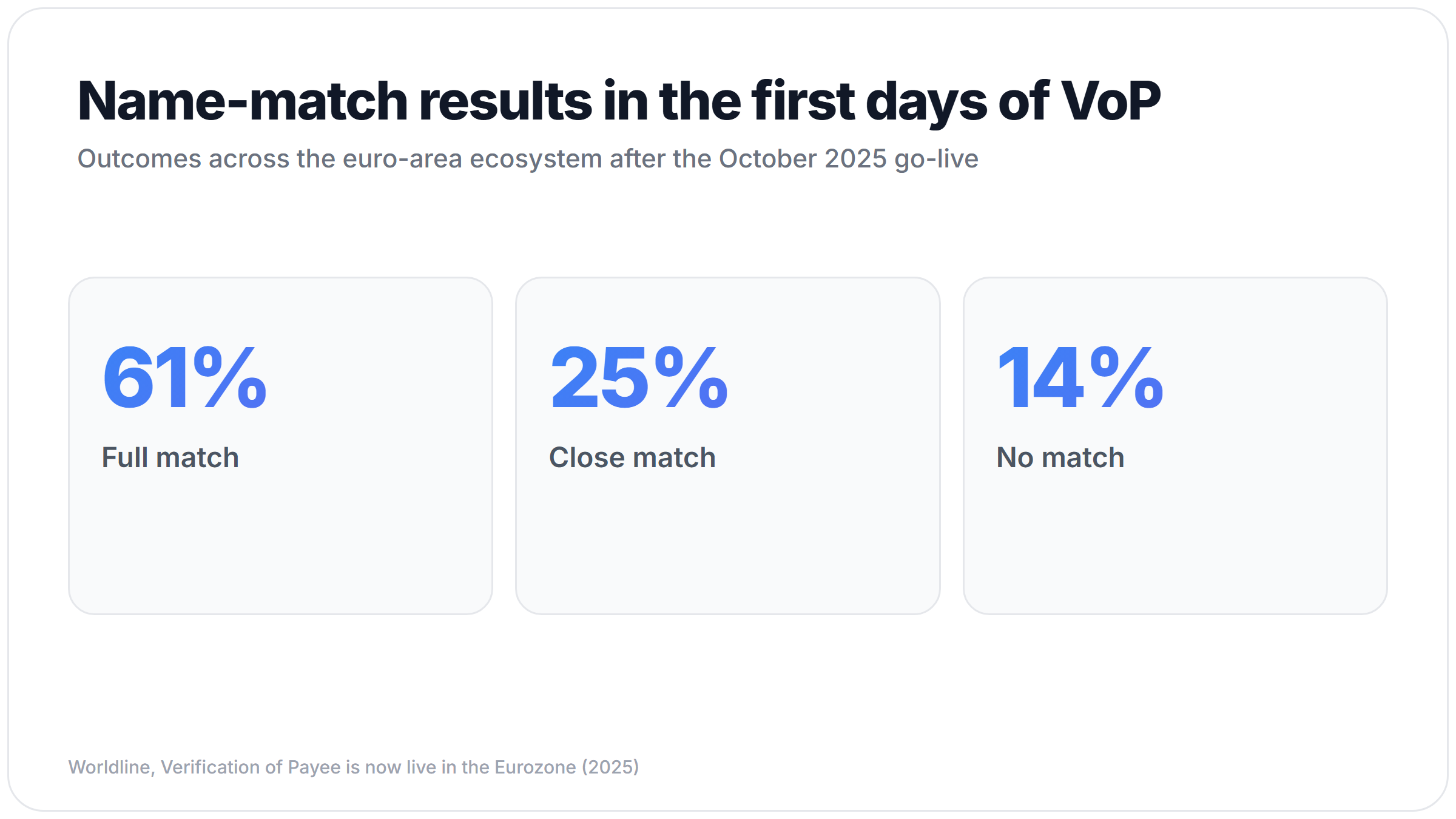
Early results show why this matters at scale. When VoP went live in October 2025, one payment processor measured outcomes across the ecosystem at 61% full match, 25% close match and 14% no match (Worldline, Verification of Payee is now live in the Eurozone, 2025). These were figures from the first days of the rollout, and matching logic differs between providers. Even so, a payout file of 10,000 recipients would have produced several thousand results needing a decision.
Regulators see the rollout as working overall. At the Payments Tomorrow conference in Paris in October 2026, François-Louis Michaud, Chair of the European Banking Authority, said the VoP rollout "has largely been a success" and that "remaining teething problems are being sorted out" (European Banking Authority, Payments Tomorrow Conference speech, 2026). For payout teams, those teething problems show up in their exception queues.
The rules let non-consumer payers opt out of VoP when they submit several payment orders as one package. Many corporates take that option. Among one large bank's EBICS corporate clients, 80% of SEPA credit transfer files and 67% of SEPA Instant files were submitted with the opt-out in January 2026 (Deutsche Bank, flow briefing: Verification of Payee, 2026). That covers one bank's channel, not the whole market, but the direction is clear.
Opting out keeps batches moving, but the payer loses the protection the check provides. If a recipient supplied a wrong or manipulated IBAN, the money can go to the wrong account with less recourse. For incentive programs that collect IBANs through self-service forms, that matters. A short prevention note: limit how often account details can be changed, and send a confirmation to the recipient's verified contact channel whenever they change. How liability is split in each case depends on your contracts and local rules, so confirm it with your legal counsel and banking provider.
VoP applies today to euro credit transfers. Under the current timeline, payment providers in EU member states outside the euro area are expected to follow from 9 July 2027, and the coming PSD3 and Payment Services Regulation package is expected to extend name checks to credit transfers in all EU currencies. Teams paying recipients in Poland, Sweden, Czechia or Hungary should plan for the same exception handling there. Exact scope and dates can change, so confirm them with your banks and compliance advisors.
Instant payments are also becoming more common. One forecast says SEPA Instant will make up 18% of all euro payments by 2035, with instant volumes expected to overtake traditional SEPA credit transfers by 2030 (GlobalData, SEPA Instant will account for 18% of all euro payments by 2035, forecasts Celent, 2026). As instant becomes the default, irrevocable payments make any mistake made before release harder to fix. That puts more weight on getting the payee data right first time.
Here is how the two rails compare on the parts of the job that take effort.
Bulk bank transfers (SEPA credit transfer or SEPA Instant)
Digital gift cards
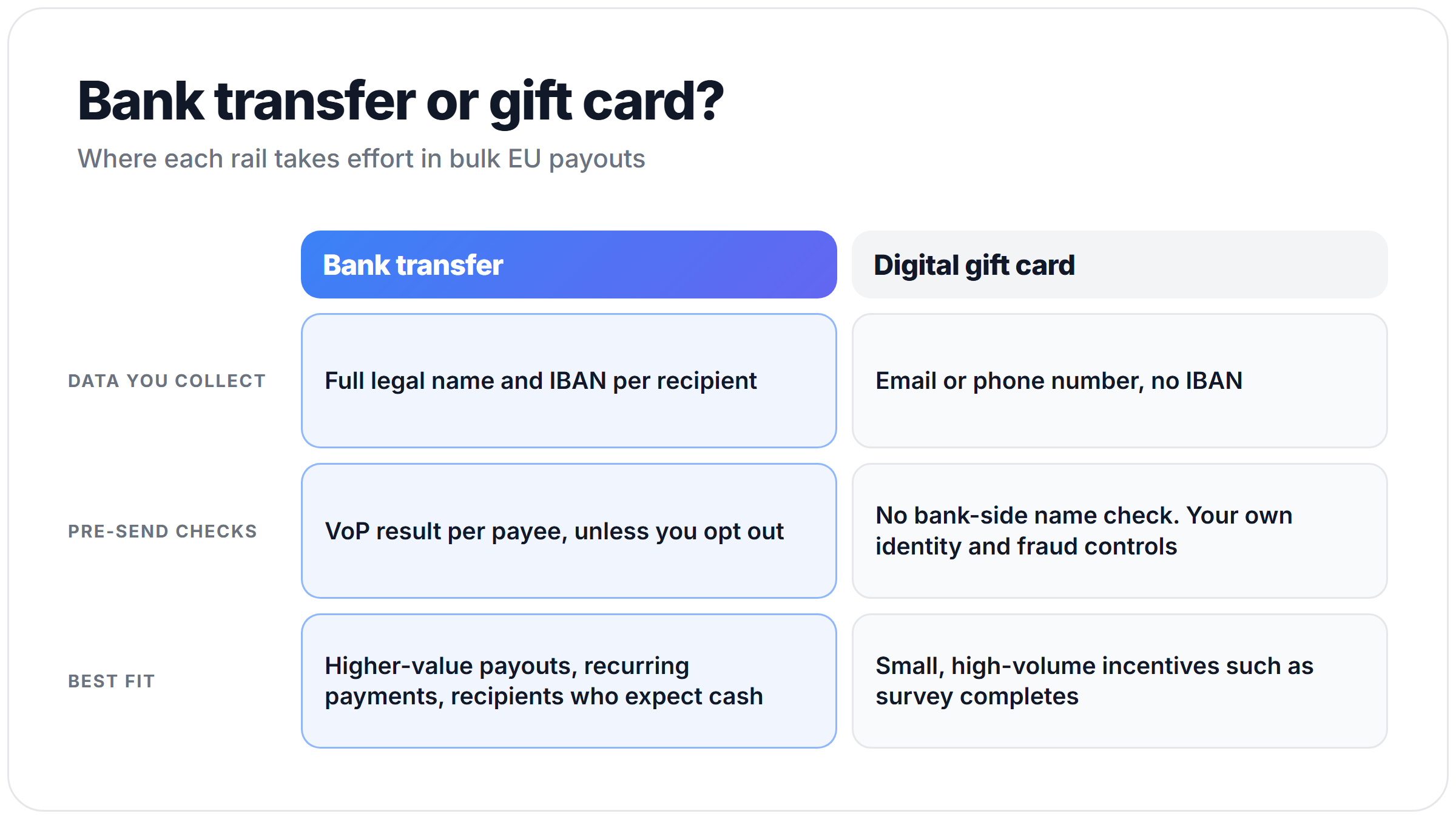
Neither column is free of work. Gift cards take away the IBAN and the name check, but they bring their own tasks: catalog coverage by country, local brand relevance and recipient follow-up. Bank transfers give recipients the most freedom but bring the VoP exceptions described above.
Most payout teams don't need to move everything to one method. A hybrid setup lets the reward decide the rail. Some patterns to consider:
For the gift card side, delivery is usually automated through an API rather than handled by hand. Our overview of what a bulk gift card API is and why platforms are adopting one covers how that integration usually works.
Wincube Global provides digital gift card infrastructure for platforms that send rewards at scale. It has processed over USD 220 million in gift card GMV in 2025 across a catalog of more than 30,000 gift cards spanning over 90 countries. For EU payout teams, that means a gift card option that can run alongside existing bank-rail payouts through real-time API integration or bulk fulfillment, without collecting IBANs. Brands and delivery terms vary by country, and the Wincube team confirms the details for your markets.
Whether gift cards should take a large share of your incentive volume or a small one depends on your reward sizes, recipient mix and how your VoP exception rates look in practice. If this is relevant to your team, Contact Us and we can walk through what it would look like.
Yes, for euro credit transfers the check applies by default, including payments submitted in files. Non-consumer payers can opt out when they submit several payment orders as one package, but they lose the protection the check gives. Confirm how your bank applies the opt-out to your submission channels.
Under the Instant Payments Regulation, business payers can generally opt out for multi-payment packages, and many corporates do so to keep batches moving. The trade-off is less protection against payments sent to the wrong account. Review the risk with your banking provider and legal counsel before choosing.
Usually not a full replacement. Gift cards suit small, high-volume incentives because they need only an email address or phone number and run no bank name check. Bank transfers remain a better fit for larger payouts and for recipients who want cash, so many programs offer both.
Sources