Digital Gift Cards
WINK
WINCUBE

Sending a reward to a recipient in Korea is only half the job. The harder question is what your program does when the send fails, stalls or is never opened. Without clear rules, one failed voucher turns into a support ticket, a duplicate send, or a recipient who quietly decides your program is unreliable.
In short: Treat every Korean mobile voucher as moving through defined status states (queued, sent, delivered, opened, redeemed, failed, expired). Resend only when the status tells you the first attempt did not reach the recipient, never as a default reaction to silence. Pair that with a clear expiry policy and a support path that can see the same status your operations team sees.
Most reward programs document the happy path in detail: choose a voucher, send it, recipient redeems. Failure handling is often left to individual support agents. In a cross-border setup this gets worse, because the team that configures the program may be in a different time zone, language and channel culture from the recipient.
Korea is a useful example because mobile delivery is the norm. According to a Korea Herald report, one leading messaging app's gifting service was used nearly 200 million times in 2025, with about 189 million gifts sent through December 17 (The Korea Herald, KakaoTalk gifting service used nearly 200 mln times this year, 2025). Recipients are used to receiving gifts on their phones, so a reward that fails to arrive is noticed quickly.
Messaging habits matter too. The practical takeaway is that many Korean recipients expect to be reached through a messaging app, and your failure rules should account for that channel rather than assume email.
For background on how Korean delivery works in the first place, see Korean Gift Card API for Rewards Platforms: 2026 Guide.
A resend policy is only as good as the statuses behind it. If your system can only say "sent" or "failed", you cannot tell a wrong phone number from a message the recipient simply has not looked at yet.
A workable model separates these states:
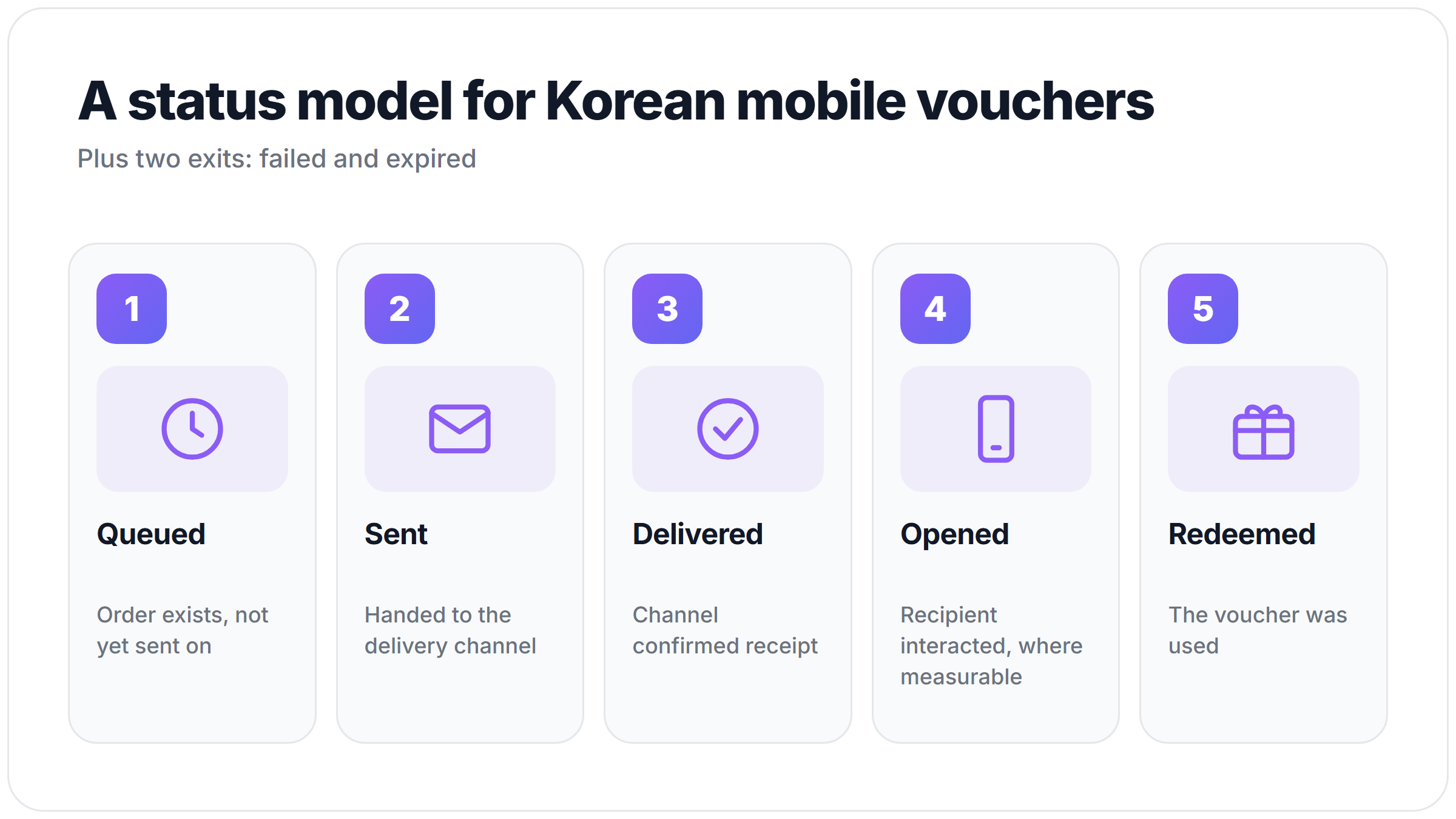
Not every channel reports every state. Some will confirm sending but never confirm delivery. Document which states are real signals and which are inferred, so nobody treats a missing confirmation as proof of failure.
A hard failure means retrying the same way will not help, for example an invalid or unreachable contact detail. A soft failure is temporary, such as a full inbox or a short channel outage. Hard failures should route to a contact-correction step. Soft failures can safely follow an automatic retry with a limited number of attempts.
Delivery signals drive outcomes, because a reward that is not received, opened and acted on cannot be redeemed. If you do not measure each step, you cannot tell where recipients are dropping out.
Resend decisions are where programs lose money and trust. Sending a second voucher when the first one is merely unopened can create a duplicate liability. Refusing to resend when the first one genuinely failed leaves a recipient without a reward.
Good resend rules answer four questions in advance:
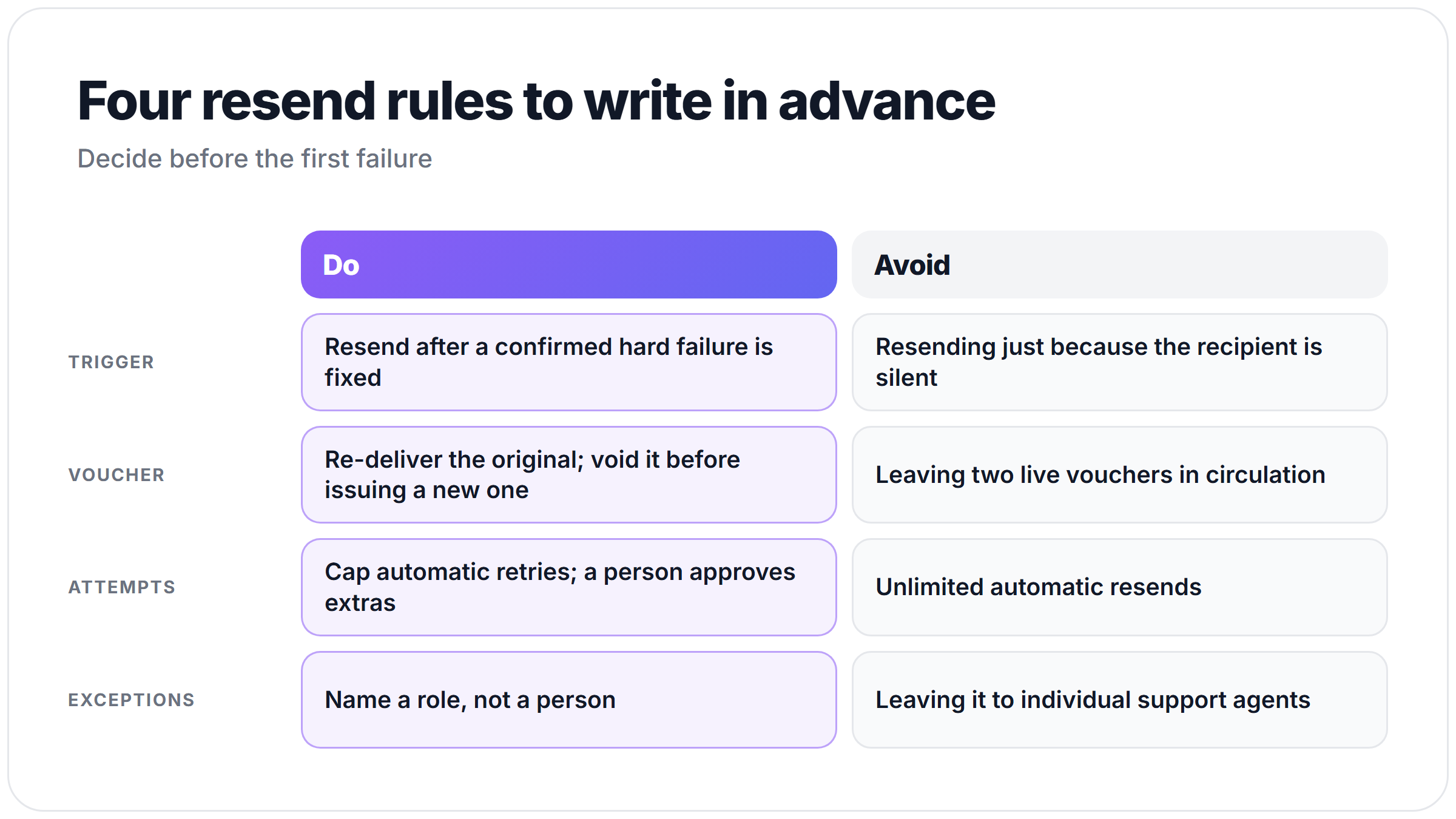
Keep an audit trail for every resend: original order, reason, who approved, and what happened to the first voucher. This protects the program from double redemption and gives finance a clean record.
Expiry is where failure handling and policy meet. If a voucher failed on day one but the recipient is only reached on day twenty, a fixed expiry date may leave them almost no time to use it. Decide ahead of time whether a resend restarts the validity window, extends it, or keeps the original date.
Expiry and refund rules differ between countries and between voucher types, so treat any guidance here as general. Confirm how expiry, refunds and unused balances should be handled with local legal and tax counsel before you publish the policy to recipients.
Many tickets are really status questions. A common practice for "where is my order" inquiries in e-commerce is to send proactive updates at key moments, including when something goes wrong, rather than waiting for the customer to ask. Reward programs can borrow the same idea. A short, plain-language message when a send fails and when it is corrected gives the recipient something to act on.
For a Korea-bound program, a few habits help:
Finally, review failures as a set, not one by one. If a particular channel, carrier-related pattern or contact source produces repeated hard failures, fix the cause upstream. For how reward delivery works across borders more broadly, see How Employee Rewards Are Delivered Seamlessly Across Borders.
Wincube Global has processed over USD 220 million in gift card GMV in 2025 across a catalog of more than 30,000 gift cards spanning over 90 countries. It delivers through real-time API integration and bulk fulfillment, with a Korean catalog alongside its global catalog. For reward operations teams, the relevant point is that the status model, resend rules and expiry policy described above can be built into your own platform around those deliveries.
There is no single right resend policy. The right one depends on your channels, your recipients and your finance controls, and it is worth writing down before the first failure rather than after. If this is relevant to your team, Contact Us and we can walk through what it would look like.
Resend when your status data shows the first attempt did not reach the recipient, such as a confirmed hard failure that has been corrected with a valid contact detail. Do not resend only because a recipient has not responded, since an unopened voucher may still be redeemable.
Where possible, re-deliver the original voucher so only one redeemable item exists. If a new voucher is required, void the original first and log the reason and approver for your audit trail.
Decide in advance whether a successful resend restarts, extends or keeps the original validity window. Expiry and refund rules vary by country, so use general guidance and confirm your policy with local legal and tax counsel.
Sources