Digital Gift Cards
WINK
WINCUBE
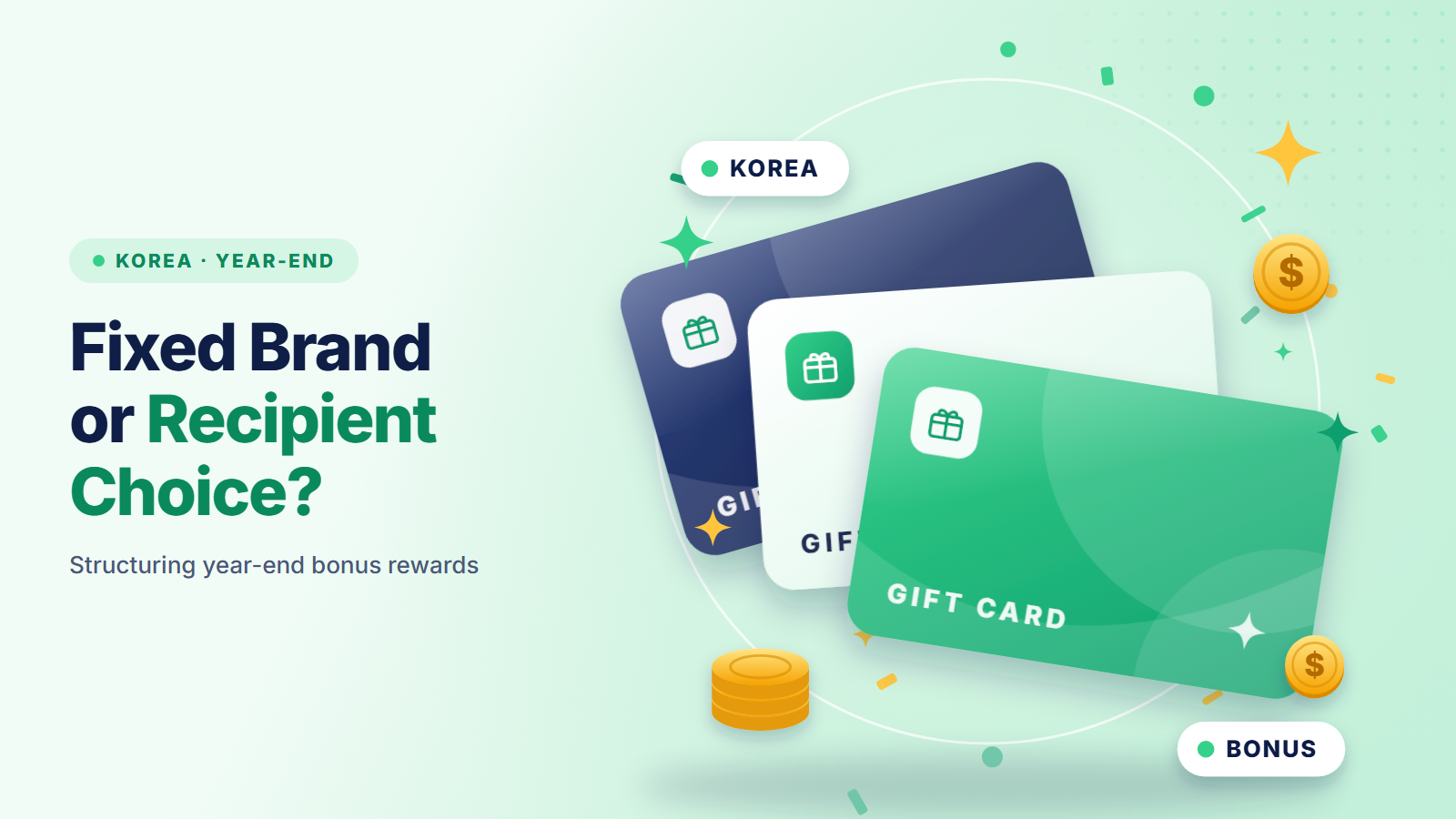

Korea's year-end bonus season typically begins in December. If you run total rewards for a global company or an employee-rewards platform with people in Korea, you probably need to settle the reward format in the next few weeks. You can send everyone a gift card for one brand, such as a coffee chain or a department store. Or you can send a recipient-choice link, where each employee picks from several Korean brands. Both are common in Korea, and they behave differently once the codes go out.
In short: Fixed-brand gift cards are simpler to approve, budget and explain, and they work well when the brand is used by almost everyone on the team. Recipient-choice, or multi-brand, reward links usually suit mixed teams better, because people can redeem for something they actually want. That tends to help satisfaction and redemption, but you need a well-curated catalog and a bit more setup. For most year-end bonus programs in Korea, a sound default is a recipient-choice link built on a short, curated list of locally relevant brands, with fixed-brand cards kept for small, uniform groups.
Korea has a large gift card market, and digital delivery is the norm. A March 2025 market databook projects the South Korea gift card market to reach USD 7.56 billion (roughly KRW 10 trillion at recent exchange rates) in 2025, growing about 8.4% a year to USD 10.07 billion by 2029. It names corporate incentive programs as one of the main growth drivers (ResearchAndMarkets via Business Wire, South Korea Gift Card Market Future Growth Dynamics Databook 2025, 2025).
That size matters for reward design. Korean employees have already received plenty of mobile gift cards from friends, retailers and earlier employer programs, so they quickly tell a useful reward from a forgettable one. A code for a brand they rarely use can sit unredeemed in a messaging app until it expires. A brand that fits their routine gets spent within days. Both cost the employer the same, but they are not worth the same to the employee.
The preference data points the same way. In a survey of 1,500 organizations, employees and consumers, Miconex found that 73% of employees would rather receive a multi-store gift card from work than a single-retailer card (Miconex, Gift Cards Are Top of Employee Wish List for Christmas 2022, 2022). The survey was run by a UK-based provider rather than in Korea, so read it as a directional signal about choice rather than a Korean benchmark.
These are the trade-offs from an infrastructure and program-design view. Neither format is better in every case.
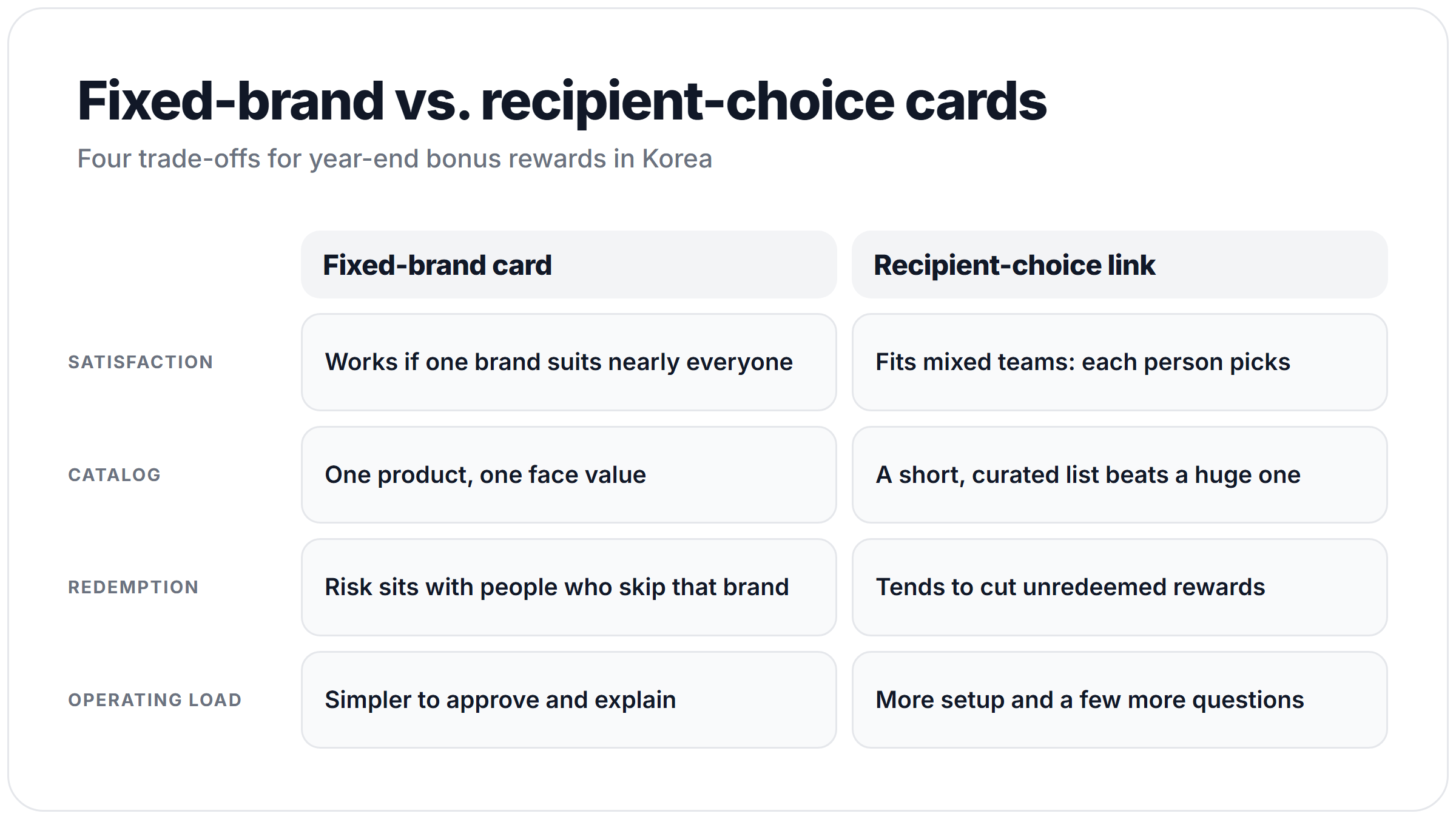
A fixed-brand card works when the brand is close to universal for the group. A team that is all in one Seoul office, where everyone uses the same café chain or convenience store, may be happy with a single brand. It gets harder with mixed teams: different ages, regions, remote and on-site staff, people with dietary or lifestyle preferences. One brand will suit some people and leave others with something they don't want.
Recipient-choice links handle that variety by design. Each person picks a brand that fits them, so the reward feels more personal even though the employer did not personalize anything.
People often assume more choice is always better. In practice, a choice link with hundreds of options can feel like homework, and some recipients put off deciding. For year-end bonus rewards in Korea, a curated list usually works better than an exhaustive one. Cover the main categories: coffee and bakery, convenience stores, food delivery, department stores or general retail, and possibly books or entertainment. Within each category, pick brands with broad national coverage.
Brands that are well known globally are not always the ones Korean employees use every day. Our article on why the future of global gift cards is local covers this in more detail. For a Korea-based team, a locally relevant catalog usually matters more than a large one.
Unredeemed rewards are a quiet problem in any gift card program. For an employer, an unused bonus reward is a bonus that didn't reach the employee as intended. Choice formats tend to reduce this because recipients pick something they plan to use, though actual rates depend on the catalog, reward value, message timing and reminders. A fixed-brand card for a brand the recipient already uses can redeem just as well. The risk is concentrated in recipients who don't use that brand.
Expiry and validity rules for mobile gift cards in Korea, and the tax treatment of employer-provided rewards, can affect how you design the program. Treat anything here as general guidance. Before you set validity periods or decide how rewards are reported, confirm the details with local legal and tax counsel.
Fixed-brand programs are easier to run at first. You have one product, one face value, one approval and one line on the invoice. Recipient-choice programs add a few steps. You need to approve a brand list, confirm how the link works on mobile, decide what happens to links that are never opened, and possibly answer more recipient questions in the first week.
Much of that extra load disappears when delivery goes through an API or bulk-issuance workflow rather than manual code handling. Our explainer on what a bulk gift card API is and why platforms are adopting one walks through how issuance, delivery and status tracking can be automated so that a choice format does not mean more spreadsheet work.
To make the decision before December, these questions usually sort it out:
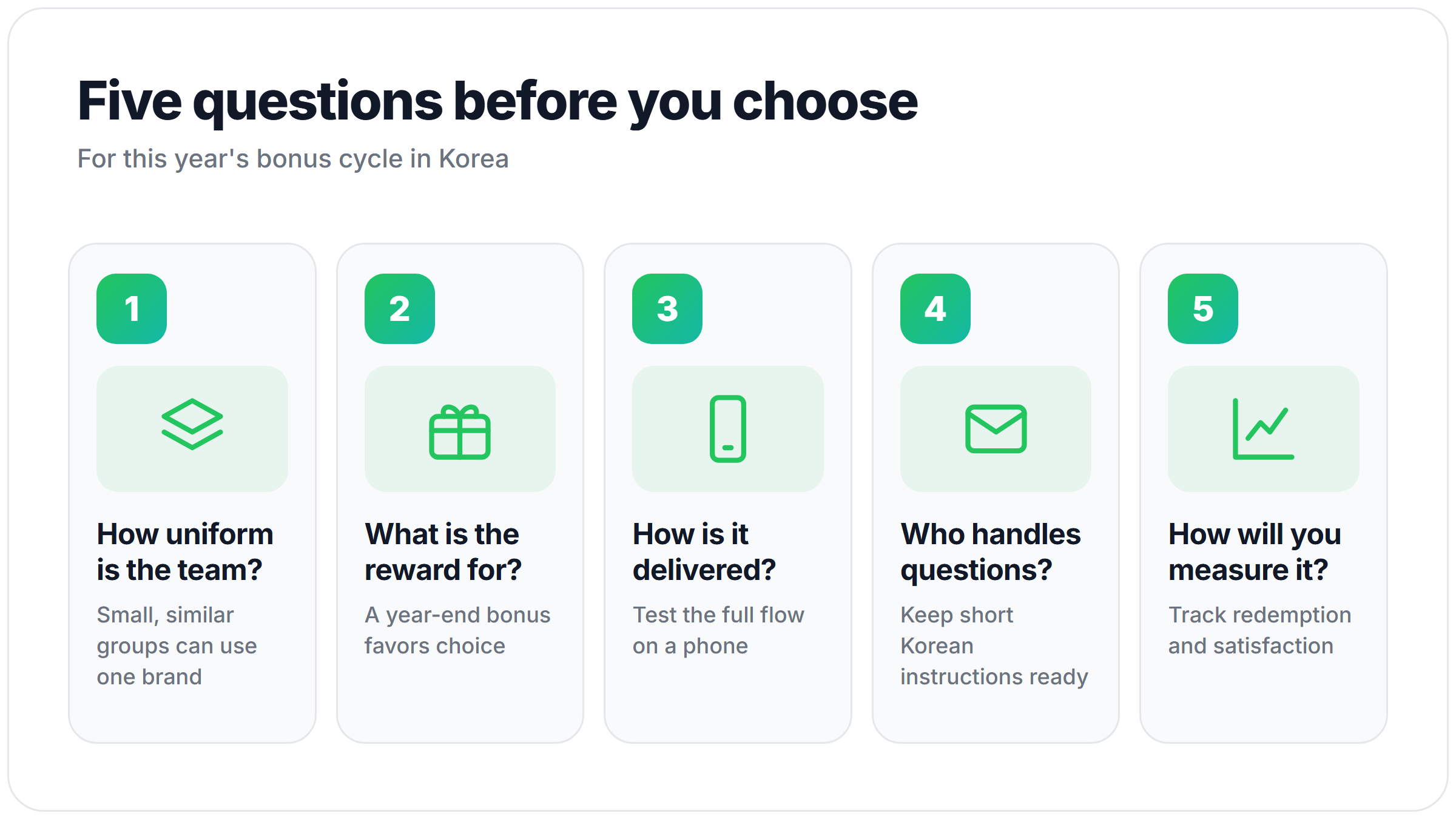
A hybrid is also reasonable. For example, a company might send a recipient-choice link to its main Korean team and a fixed-brand card to a small satellite office where one brand is clearly dominant. That example is hypothetical, but the pattern is common in practice: match the format to each group instead of forcing one answer on everyone.
Wincube Global provides gift card infrastructure through real-time API integration and bulk fulfillment. It has processed over USD 220 million in gift card GMV in 2025 across a catalog of more than 30,000 gift cards spanning over 90 countries, including a deep set of locally relevant Korean brands. For teams weighing a single brand against a wider selection, that catalog depth gives more locally relevant options to choose from, whichever format they pick.
If your team is still deciding between a single brand and a choice link for this year's bonus cycle, it can help to map your recipient groups first and then shortlist a small catalog that fits each one. If this is relevant to your team, Contact Us and we can walk through what it would look like.
For most mixed teams, a recipient-choice link tends to be the better fit, because each employee can redeem with a brand they actually use. Fixed-brand cards still work well for small, uniform groups where one brand is used almost universally. The right answer depends on how varied your team is and how much setup you can take on.
A curated list that covers the main everyday categories usually works better than a very large catalog. Aim for widely used brands in coffee, convenience stores, food delivery and general retail so that most recipients find something useful quickly. Too many options can slow decisions and leave links unopened.
They can. Validity periods for mobile gift cards and the tax treatment of employer-provided rewards are both worth reviewing before launch. Treat this as general guidance and confirm the specifics with local legal and tax counsel for your situation.
Sources