Digital Gift Cards
WINK
WINCUBE

If your platform offers rewards to dozens of enterprise clients under their own brands, your gift card integration has a harder job than a single company's. It has to keep each client's catalog, budget, approval rules, reports, and invoices fully separate, while running everything on one shared supply connection. So the main design question is not "how do we call a gift card API?" It is "where does the tenant boundary sit, and what enforces it at each layer?"
In short: A multi-tenant gift card API for a white-label reward platform should treat the tenant (your client) as a first-class object that every request, ledger entry, and report is scoped to. Per-tenant catalogs, budgets, spend limits, approval rules, and settlement should be enforced in your platform layer, on top of one upstream gift card supply integration. Get the tenant model right first. Catalog curation, budgeting, and invoicing then become configuration instead of custom code for each client.
Most guidance on gift card APIs assumes one operator: one company buys codes and sends them to its own employees, customers, or survey respondents. A white-label loyalty, HR-tech, or fintech platform is in the middle of a three-party chain. The platform integrates supply once and then resells or embeds reward features for many enterprise clients, each with its own end users. If you are still early in that integration, our overview of what a bulk gift card API is and why platforms are adopting one covers the single-operator basics this article builds on.
The market behind this model is substantial. One industry estimate puts the global B2B gift card market at USD 16.4 billion in 2025, with a projection of USD 32.87 billion by 2035 and a CAGR of 7.2% over 2026 to 2035 (Market Research Intellect, B2B Gift Card Market Report 2026-2035, 2025). Estimates like this vary between research publishers, so treat the figures as a rough indication rather than a precise number. For a platform that serves enterprise clients, multi-tenant design affects revenue, not just engineering quality.
There is also a demand-side gap that white-label platforms are well placed to fill. In a 2021 Blackhawk Network survey of 2,000 U.S. employees, 41% said they prefer prepaid or gift cards as incentives, but only 20% said they are awarded them (PR Newswire, Employers Take Note: Employee Incentives Don't Align with Their Preferences, 2021). Each enterprise client that closes that gap through your platform becomes another tenant with its own policies, so the architecture needs to absorb new tenants without new code paths.
Isolation is the non-negotiable part. In a 2022 AWS Partner Network blog post, AWS solutions architects wrote that "tenant isolation is one of the foundational topics that every SaaS provider must address. It's how your architecture ensures one tenant is prevented from accessing the resources of another tenant" (AWS Partner Network Blog, Partitioning and Isolating Multi-Tenant SaaS Data with Amazon S3, 2022). In a rewards context, those "resources" include stored-value codes, which work much like cash. A leak between tenants is a financial incident, not just a privacy one.
Start by listing what belongs to a tenant. For reward platforms, five domains matter most.
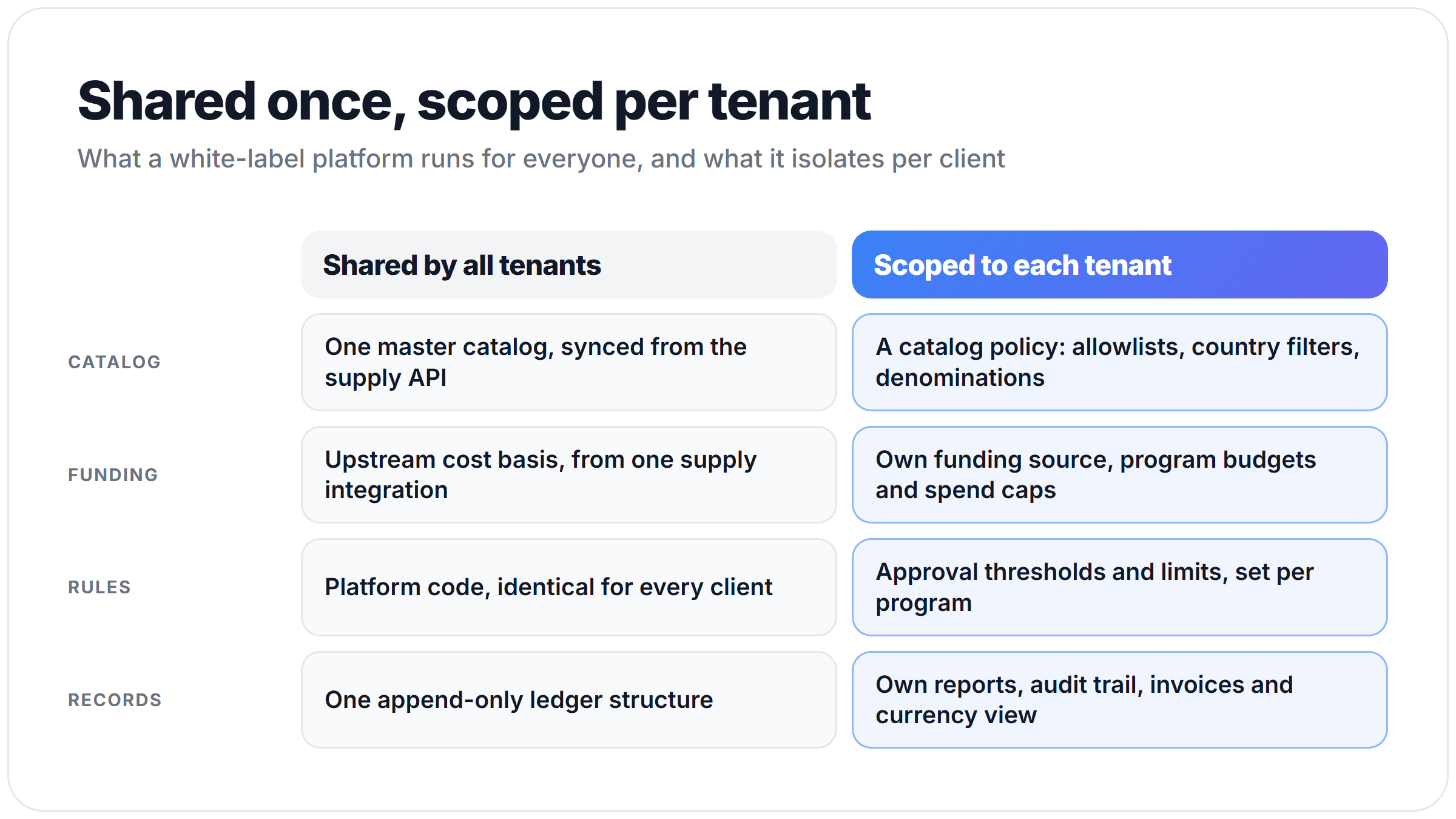
Each client usually wants a curated subset of the upstream catalog. A client may limit rewards to certain countries, exclude some categories, or show only brands its compliance team has approved. Model this as a tenant-level catalog policy (allowlists, denylists, country filters, denomination ranges) applied over a shared master catalog. Do not copy the catalog per tenant. Copies drift out of date when upstream products change price, go out of stock, or are retired.
A practical pattern:
Budgets are where isolation failures cost the most. Each tenant needs its own funding source, whether that is a prepaid balance, a credit line you extend, or a pass-through arrangement. Every order must check and debit that tenant's funds atomically. Common layers include:
Debit before you call upstream, then reconcile with the upstream result. If the upstream order fails, release the hold. If the upstream call times out, keep the hold until you can confirm the order's status. Idempotency keys should also include tenant scope, so one tenant's retry can never collide with another tenant's order.
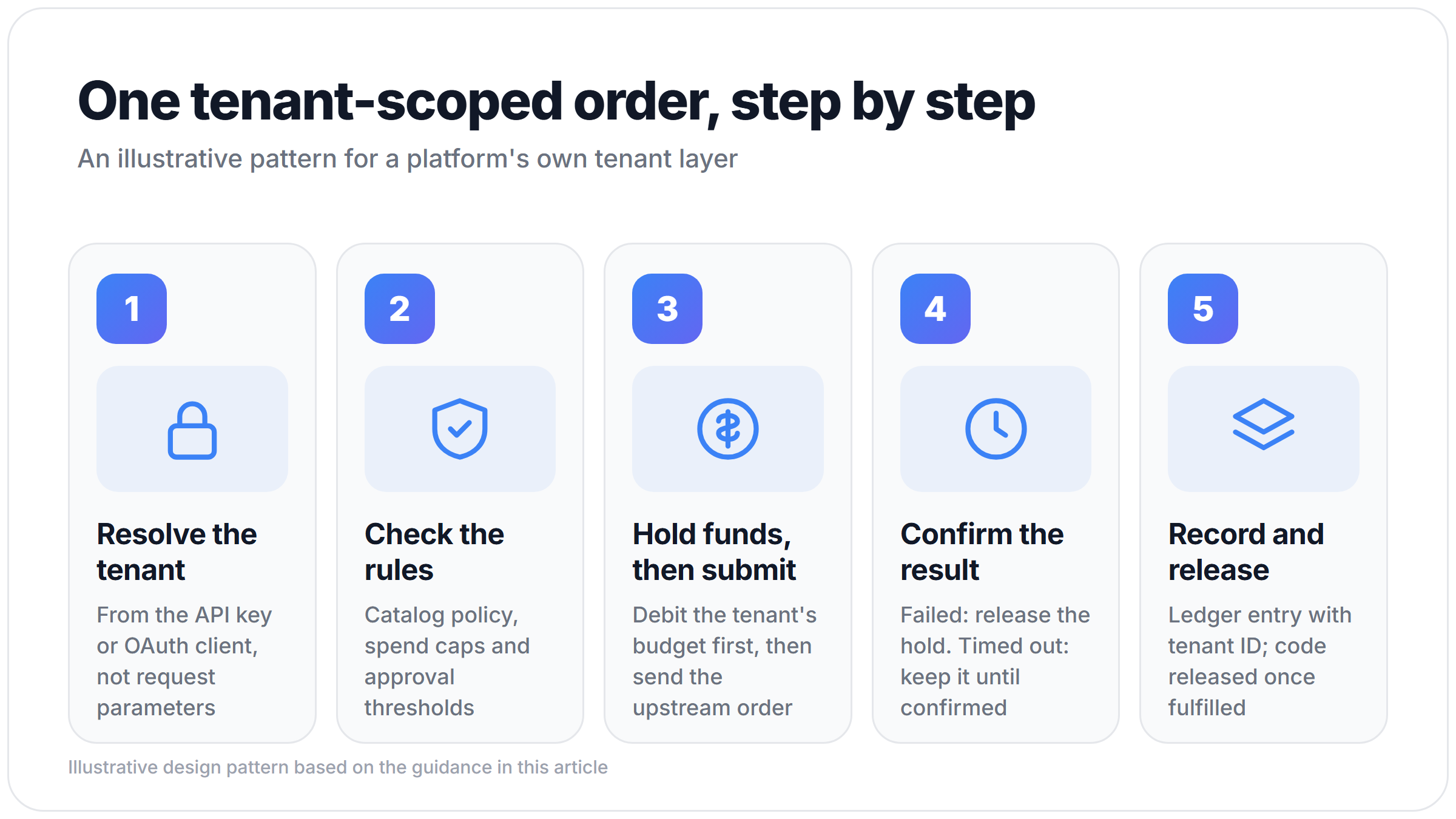
Enterprise clients often require human approval above certain thresholds, or for certain programs. Make approval workflows declarative, using rules like "orders above X in program Y need one approver from role Z," and store them per tenant. The order then moves through clear states (pending approval, approved, submitted, fulfilled, failed), and the code is not released to the recipient until it reaches the fulfilled state.
Each tenant should see only its own orders, recipients, and spend, ideally broken down by program and cost center. Internally you need a cross-tenant view for operations and finance. Build reporting on an append-only ledger in which every entry carries tenant ID, program ID, product ID, amount, currency, and upstream reference. Audit logs should record who approved or cancelled what, and when.
Settlement is usually per tenant: each client receives its own invoice or statement, often in its own currency. Your ledger should therefore support per-tenant currency views and keep the upstream cost basis separate from the amount billed to the tenant. If you operate across borders, rules on invoicing, tax treatment of reward spend, and stored-value regulation differ by jurisdiction. Treat this as general guidance, and confirm the specifics with local legal and tax counsel before you finalize your billing model.
Defining what belongs to a tenant is half the work. The other half is making sure no code path can cross the boundary.
Authentication and context. Resolve tenant identity from credentials (API keys or OAuth clients issued per tenant) rather than from request parameters a caller could change. Once resolved, carry tenant context through every service call, queue message, and background job.
Data access. Whether you use separate databases, separate schemas, or a shared schema with row-level security, the database should enforce tenant scoping on its own. A shared schema with tenant ID columns plus row-level security policies is a common middle ground for platforms with many small and mid-sized clients. Very large or highly regulated clients may justify a dedicated silo.
Code storage and delivery. Encrypt gift card codes at rest, ideally with tenant-scoped keys, and restrict decryption to the delivery path. Avoid putting codes in logs, analytics events, or tenant-visible exports. A brief warning: codes in transit and at rest are an attractive target for fraud, so treat code-handling services as high-sensitivity systems with strict access reviews.
Rate limits and fairness. One tenant's bulk send, such as a year-end campaign to thousands of employees, should not starve another tenant's real-time redemptions. Apply per-tenant rate limits and queue partitioning, and pace upstream calls so a single tenant cannot exhaust your shared supply-side quota.
Webhooks. Fan out upstream fulfillment events to per-tenant webhook endpoints, signed with per-tenant secrets. Never send one tenant's event payload to another tenant's endpoint, even during retries or replays.
Consider a hypothetical HR-tech platform with two clients. Client A, a manufacturer, allows only domestic grocery and fuel gift cards up to a fixed amount per employee, with manager approval above a threshold. Client B, a distributed software company, allows a broad international catalog with no approval step but a monthly cap per recipient. In a well-designed system, both clients run on the same code and the same supply integration. The only differences are their tenant records: catalog policy, budget, approval rules, and billing currency. Onboarding a third client means creating a new configuration, not starting a new engineering project.
Your multi-tenant layer is only as reliable as the supply API underneath it. When you evaluate upstream providers, look for:
Some reward platforms connect several upstream suppliers to broaden coverage. In that case, add a routing layer that maps each master catalog product to one or more suppliers, so the tenant-facing catalog stays the same when routing changes. For more on what enterprise buyers expect from the platforms they choose, see our guide to how to evaluate a digital rewards platform for a global workforce.
Wincube Global is a B2B digital gift card aggregator and rewards infrastructure provider, with real-time API integration and bulk fulfillment as its two delivery models. Wincube has processed over USD 220 million in gift card GMV in 2025, across a catalog of more than 30,000 gift cards spanning over 90 countries. For white-label reward platforms, that means one upstream integration can supply the master catalog behind many tenant-specific catalogs, while your platform keeps control of tenant isolation, budgets, approvals, and client-facing settlement.
Every platform's tenant model is different, and the right split between what your platform owns and what the supply layer handles depends on your clients, regions, and compliance requirements. If this is relevant to your team, Contact Us and we can walk through what it would look like.
A multi-tenant gift card API serves many separate clients (tenants) from one shared system, while keeping each client's catalog, budget, orders, and reports isolated. For white-label reward platforms, the tenant is usually the enterprise client, and every request and ledger entry is scoped to that tenant.
Usually not. A single master catalog synced from the upstream supply API, filtered at read time by per-tenant policies, is easier to keep accurate. Per-tenant copies tend to drift when upstream products change price, availability, or status.
Most platforms invoice each tenant separately, from a ledger that records tenant, program, currency, and upstream cost for every order. Because invoicing, tax, and stored-value rules vary by jurisdiction, platforms should confirm their billing approach with local legal and tax counsel.
Sources