Digital Gift Cards
WINK
WINCUBE


Say a year-end bulk order for a few thousand recipients is already in flight when one requested brand becomes unavailable. The issuer might be pausing code issuance, a denomination might have sold out, or a regional catalog might drop the brand for maintenance. Somebody then has to decide whether the order waits, ships partly, or switches to another brand, and that person usually has hours to decide, not days. The real question for procurement and rewards operations teams is not how to avoid every stock-out. It is how to decide ahead of time what happens when one occurs.
In short: Agree on substitution rules before peak season, not while an order is stuck. A workable setup has three parts. Tiered substitutes ranked by how close each one is to the original brand. Approval thresholds that state which swaps run automatically and which go to a human. Recipient messaging that explains a change and leaves people a choice where possible. With those written down, a single brand being unavailable becomes a routine exception instead of a holiday escalation.
The stakes are seasonal. In the US, the National Retail Federation reported that 43% of holiday shoppers planned to buy at least one gift card in 2025, with gift card spending expected to reach USD 29 billion (National Retail Federation, Gift cards gain popularity as top choice for holiday shoppers in 2025, 2025). Corporate reward programs, platform promotions and consumer gifting all draw on the same brands in the same weeks. That overlap is why gaps in availability tend to appear exactly when order volume is highest.
Peak-season shortages are not just a theory. In the 2021 holiday season, which had heavy supply chain disruption, Adobe estimated that online shoppers saw more than 6 billion out-of-stock messages, a 253% increase over the 2019 holiday season (Adobe, Adobe: U.S. consumers spent a record $204 billion online this holiday season, 2022). Digital gift cards have no shipping containers, but availability still depends on issuer systems, denomination inventory and regional catalog status. The lesson carries over: when demand peaks, flexibility has to be planned.
For bulk gift card buyers, flexibility works best when it is decided in a policy document beforehand rather than worked out on a call at 11 p.m.
A consumer facing a sold-out brand picks another one and moves on. A bulk order behaves differently. It may cover thousands of recipients in several countries, each promised a particular brand in an announcement, an incentive campaign or a survey invitation. When one brand cannot be fulfilled, the gap usually shows up in a few predictable ways:
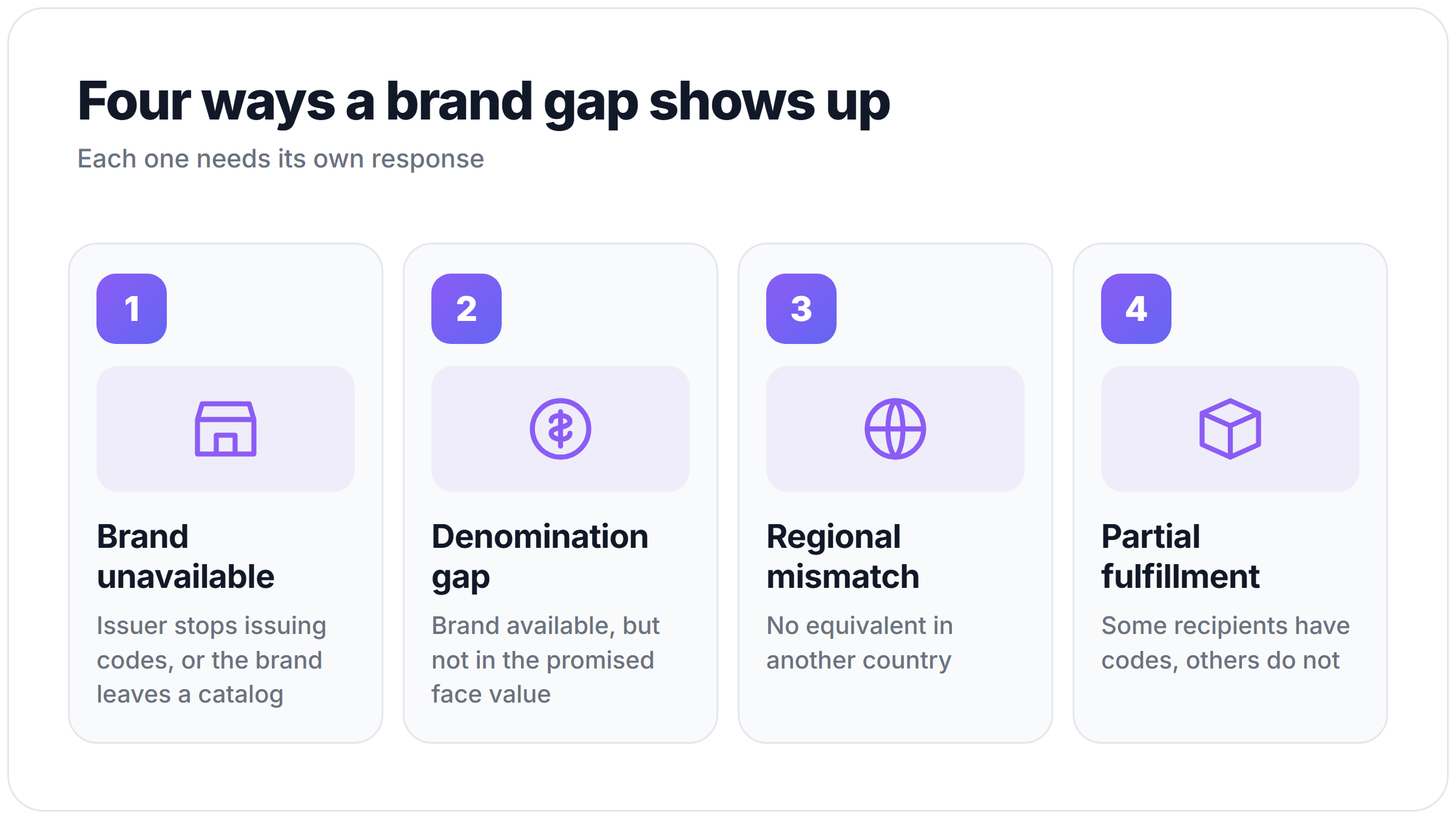
Each case needs its own response. A denomination gap can often be fixed by combining two smaller face values of the same brand. A regional mismatch needs a local alternative. Partial fulfillment raises a fairness issue, because recipients in the same program end up with different outcomes. Rules that treat all four as one generic "out of stock" event will make poor decisions in at least some of them.
With an API integration, a brand that is out of stock is shown as sold out and is not ordered, so the decision is made before the order rather than in the middle of it. That is why the rules in this guide matter most for bulk orders. If you are weighing the API model, What Is a Bulk Gift Card API and Why Platforms Are Adopting One explains how platforms automate catalog and order flows.
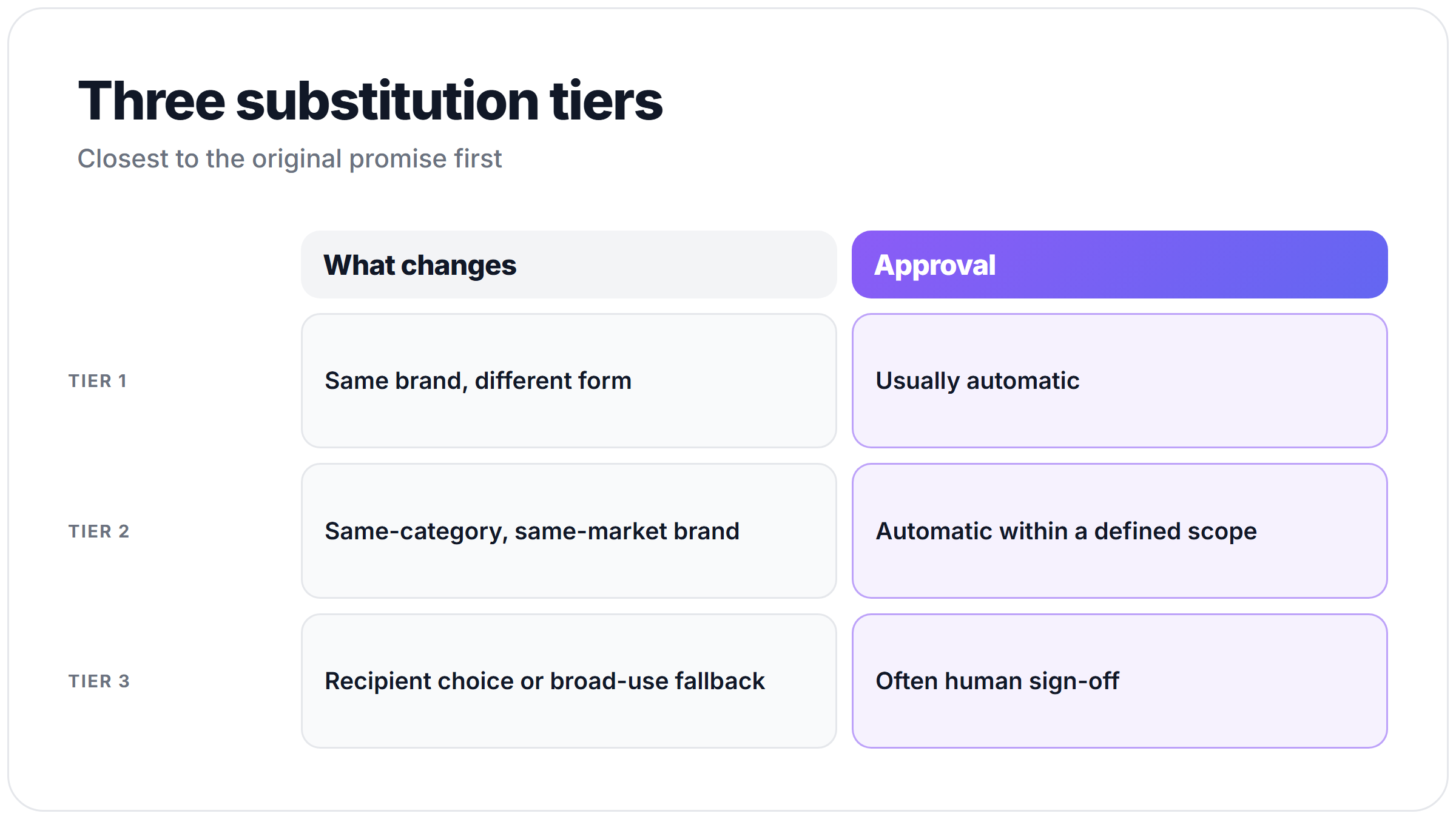
Substitution tiers rank alternatives by how closely they keep the original promise to the recipient. A simple three-tier model covers most programs.
Keep the brand and change only the delivery details, such as splitting one face value into two smaller ones or delaying issuance by a set number of hours. The recipient still gets what was promised, which makes this tier the safest option to automate.
Swap to a brand that serves the same need in the same country, such as another coffee chain, another general merchandise retailer or another food delivery service. The substitute should match the original on how it is redeemed (online, in store or both), have similar redemption reach in that market, and carry an equal face value. For example, in a hypothetical program covering recipients in Korea, a convenience store voucher could have a pre-approved Tier 2 alternative from another nationwide convenience store chain, while a café brand would map to another widely available café brand. For Korean B2B vouchers, which are sold for promotional use and cannot be cancelled or refunded, agree the substitute list before the order is placed (see our guide on refunds and cancellations for bulk Korean voucher orders). The same reasoning applies in any market. Equivalence is local, so substitute lists need to be built country by country. The Future of Global Gift Cards Is Local explains why one global list rarely works.
When no close equivalent exists, give recipients a choice among several brands, or fall back to a broad-use option suitable for that market. This tier protects the recipient experience but moves furthest from the original promise, so it usually comes with an explanatory message.
A few design principles make tiers hold up in practice:
Tiers say what may be swapped. Thresholds say who decides. Without them, teams tend to escalate everything, which stalls orders, or escalate nothing, which surprises stakeholders.
A practical threshold model considers three variables:
Also decide what happens when nobody answers. A sensible default is a time-boxed hold, for example waiting a set number of business hours for approval and then using the pre-agreed Tier 2 substitute. Choose the window to fit the program's delivery promise. A holiday bonus scheduled for a specific date can tolerate less waiting than a rolling incentive.
Finally, log every substitution with its reason, its tier and the approver. That record makes reconciliation, invoicing questions and post-season reviews much simpler.
Even a good substitution can feel like a broken promise if the recipient is not told. Good recipient messaging tends to share a few traits:
For cross-border programs, localize the message and the substitute together. How Employee Rewards Are Delivered Seamlessly Across Borders covers the wider delivery considerations. If substitutes have different expiry or refund conditions from the original brand, mention that difference in general terms, and confirm the applicable rules in each country with local legal or tax counsel before launch.
Wincube Global provides gift card infrastructure through real-time API integration and bulk fulfillment. It has processed over USD 220 million in gift card GMV in 2025 across a catalog of more than 30,000 gift cards spanning over 90 countries. A catalog of that breadth helps when building market-by-market substitute lists, because a close local equivalent is more likely to exist when the first-choice brand is unavailable.
If your team is preparing for year-end volume, it is worth writing your substitution tiers, approval thresholds and recipient messaging into a short policy before the first large order goes out. We are happy to talk through how to structure these rules for your order flow. If this is relevant to your team, Contact Us and we can walk through what it would look like.
A substitution rule is a pre-agreed instruction for what happens when a requested brand cannot be fulfilled in a bulk order. It names acceptable alternatives, ranks them by how closely they match the original, and says who must approve each type of swap. Agreeing on it in advance keeps orders moving without improvised decisions.
Low-impact changes, such as splitting a face value within the same brand, are usually safe to automate. Swaps to a different brand, or changes that affect a large share of the order, generally benefit from human approval within a fixed time window. The right balance depends on how sensitive the program is and how firm its delivery date is.
Tell recipients briefly that the original brand was temporarily unavailable, confirm the value was protected, and offer a choice of alternatives where possible. Send the message in the program owner's voice and localize it for each market. If expiry or refund terms differ, note this in general terms and confirm local rules with counsel.
Sources