Digital Gift Cards
WINK
WINCUBE

When a sales ops leader launches a two-week SPIFF to push a new product tier or close out a quarter, the hardest part is often paying the winners, not designing the contest. With reps in Singapore, São Paulo, London and Austin, a "simple" cash bonus becomes several payroll runs, several tax treatments and a payout that may land weeks after the contest ends. That delay weakens the whole point of a short-term incentive. So the real question for distributed teams is which payout method keeps a SPIFF fast, controlled and motivating across borders: cash through payroll, or digital gift cards.
In short: For short, frequent SPIFFs across several countries, digital gift cards usually win on payout speed, administrative load and spend control, because they can be sent by email or API soon after a result is confirmed, outside the payroll cycle. Cash bonuses still fit larger, less frequent awards and reps who strongly prefer flexibility. Many revenue teams run both: cash for quota-based commission and big contest prizes, gift cards for quick, recurring SPIFF wins. Either way, tax treatment varies by country, so confirm the rules with local tax counsel.
Non-cash incentives are already standard spending, not an experiment. A 2022 study by the Incentive Federation estimated that U.S. businesses were spending about USD 176 billion (approx. KRW 250 trillion) a year on non-cash incentives. The same study found that sales incentives were the largest share of that spending, at 30%, ahead of employee incentives (23%) and customer loyalty incentives (18%) (PPAI, Incentive Programs Capture $176 Billion in Business Spending Annually, 2022). With sales programs taking the largest share, payout mechanics deserve the same attention as contest rules.
Gift cards are the most widely used reward inside those budgets. In the 2026 outlook survey by the Incentive Research Foundation (IRF), covering 400 incentive professionals in North America and Europe, gift cards accounted for 30% of program allocations in North America and 34% in Europe, and nearly 70% of North American organizations expected their gift card use to increase (Incentive Research Foundation, Industry Outlook for 2026: Merchandise, Gift Cards, and Event Gifting, 2025).
A SPIFF (sales performance incentive fund) works because of a short gap between action and reward. A rep books a demo, closes a deal on the target SKU or hits a weekly activity threshold, and the reward follows while the effort is still fresh. Commission plans reward the quarter. SPIFFs reward the week.
That timing is exactly what many payroll systems weren't built for. Payroll runs on fixed cycles, often monthly in many markets, and each one-off bonus needs approvals, tax withholding and, for international reps, coordination with a local payroll provider or employer of record. A contest that ends on the 3rd might not pay out until the end of the following month. By then the next SPIFF has started, and reps can't easily connect the reward to the behavior it was meant to drive.
Budgets are also tight. The same IRF research points to a mix of flat budgets and growing participation, and IRF President Stephanie Harris noted that "the number of program participants is projected to increase in 2026, despite flat budgets and rising costs" (Incentive Research Foundation, 2025). For sales ops, that can mean more participants per dollar and more pressure to keep administrative overhead low.
Here is how the two options compare on the dimensions revenue and sales ops leaders actually manage.
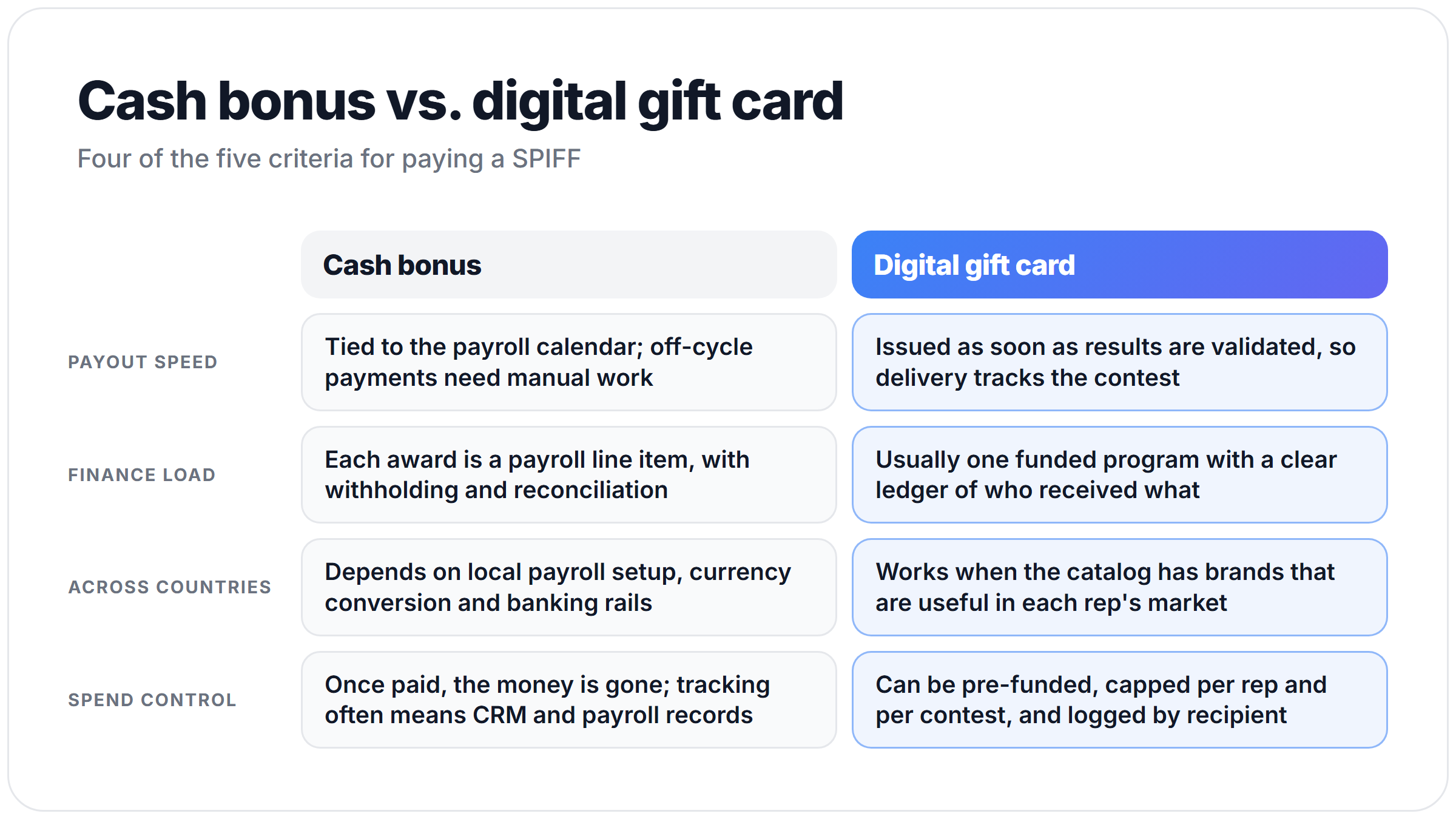
For a 10-day SPIFF, the difference between "paid this week" and "paid next month" matters a lot.
Gift cards don't remove tax obligations. In many jurisdictions, non-cash awards to employees may still be treated as taxable income. Treat this as general guidance only, and confirm reporting rules in each country with local legal or tax counsel before launch.
Local relevance is the deciding factor here. We cover this in more depth in How Employee Rewards Are Delivered Seamlessly Across Borders, including why a catalog should reflect where recipients actually live, not just where the company is headquartered.
Cash tends to blend into a paycheck. A rep who gets a small bonus may not remember it a month later, especially after taxes. A branded gift card, delivered with a message tied to a specific win, can be more visible and easier to link to the contest.
The research isn't one-sided, though. The Incentive Research Foundation reviewed a 2022 working paper that tested frequent, small rewards in lab experiments with business students. When rewards were paid after every round, performance improved steadily with cash but stayed flat with a single non-cash reward (a movie gift card in one experiment, chocolate in the other), which the authors link to people tiring of the same tangible reward. Because those experiments offered only one non-cash option, the IRF's takeaway is to offer as wide a range of non-cash choices as possible and to introduce new reward types regularly when rewards are small and frequent (Incentive Research Foundation, Academic Research in Action, 2023). In practice, that argues for gift card programs with real choice, meaning several brands and categories per market, rather than one fixed card every week.
One practical caution: gift card codes are valuable, so deliver them only to verified work identities and keep approval steps for high-value awards. Basic controls like these help limit misuse.
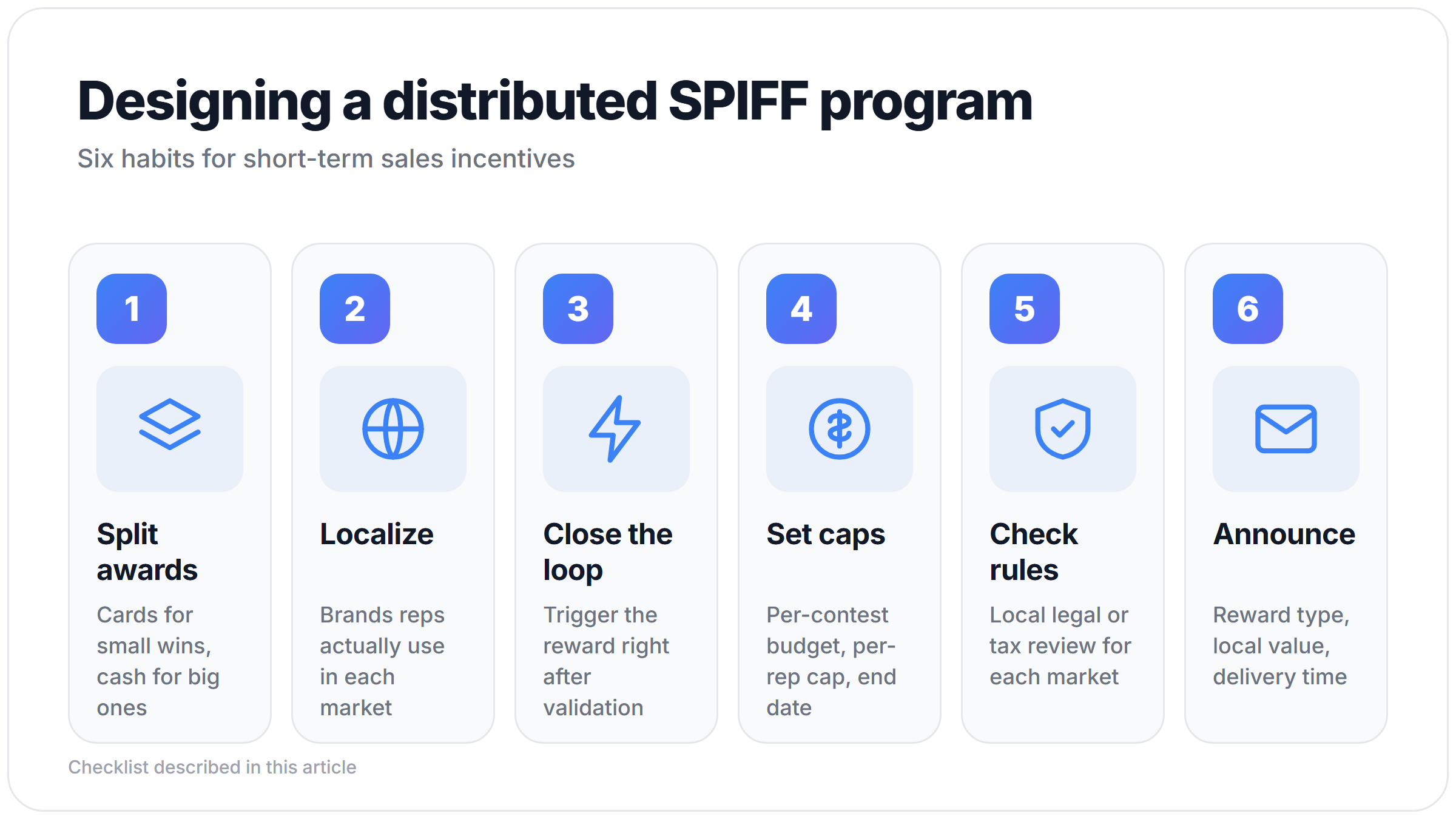
A few patterns can help sales ops teams running distributed SPIFFs.
A hypothetical example: a SaaS company runs a three-week SPIFF across five countries, paying the equivalent of USD 50 (approx. KRW 71,000) for each qualified demo of a new module. Through payroll, that would mean dozens of small off-cycle adjustments across five entities. With a gift card program, the team funds one budget, rewards each validated demo within days, and finance reviews one budget and one ledger at the end.
Wincube Global is a B2B digital gift card aggregator and rewards infrastructure provider, and sales incentives are one of the use cases it serves. Wincube Global has processed over USD 220 million in gift card GMV in 2025 across a catalog of more than 30,000 gift cards spanning over 90 countries. Companies can order through real-time API integration or bulk fulfillment, from a Global Catalog that includes brands such as Starbucks, DoorDash and Uber and a Korean Catalog that includes Coupang and Olive Young. For revenue ops teams with reps in several markets, that means one provider relationship can cover the reward side of a SPIFF. Availability of a given brand varies by country, so check each market's list before you set the contest rewards.
Whether your next SPIFF runs in two countries or twenty, the right payout mix depends on your award sizes, contest frequency and how your reps prefer to be recognized. We're happy to talk through the options with you, with no commitment. If this is relevant to your team, Contact Us and we can walk through what it would look like.
For short, frequent SPIFFs across several countries, digital gift cards are usually faster to deliver, easier to budget and simpler to audit than cash bonuses paid through payroll. Cash still makes sense for large or infrequent awards and for reps who strongly prefer flexibility. Many teams use both, depending on award size.
In many countries, non-cash awards given to employees may be treated as taxable income, and reporting rules differ by jurisdiction. This article offers general guidance only. Confirm the treatment in each market with local legal or tax counsel before launching a program.
Digital gift cards can usually be sent by email, SMS or API soon after a result is validated, rather than waiting for the next payroll cycle. Actual timing depends on your approval workflow and the delivery setup in each market. Keeping validation steps simple helps keep the reward close to the win.
Sources