Digital Gift Cards
WINK
WINCUBE

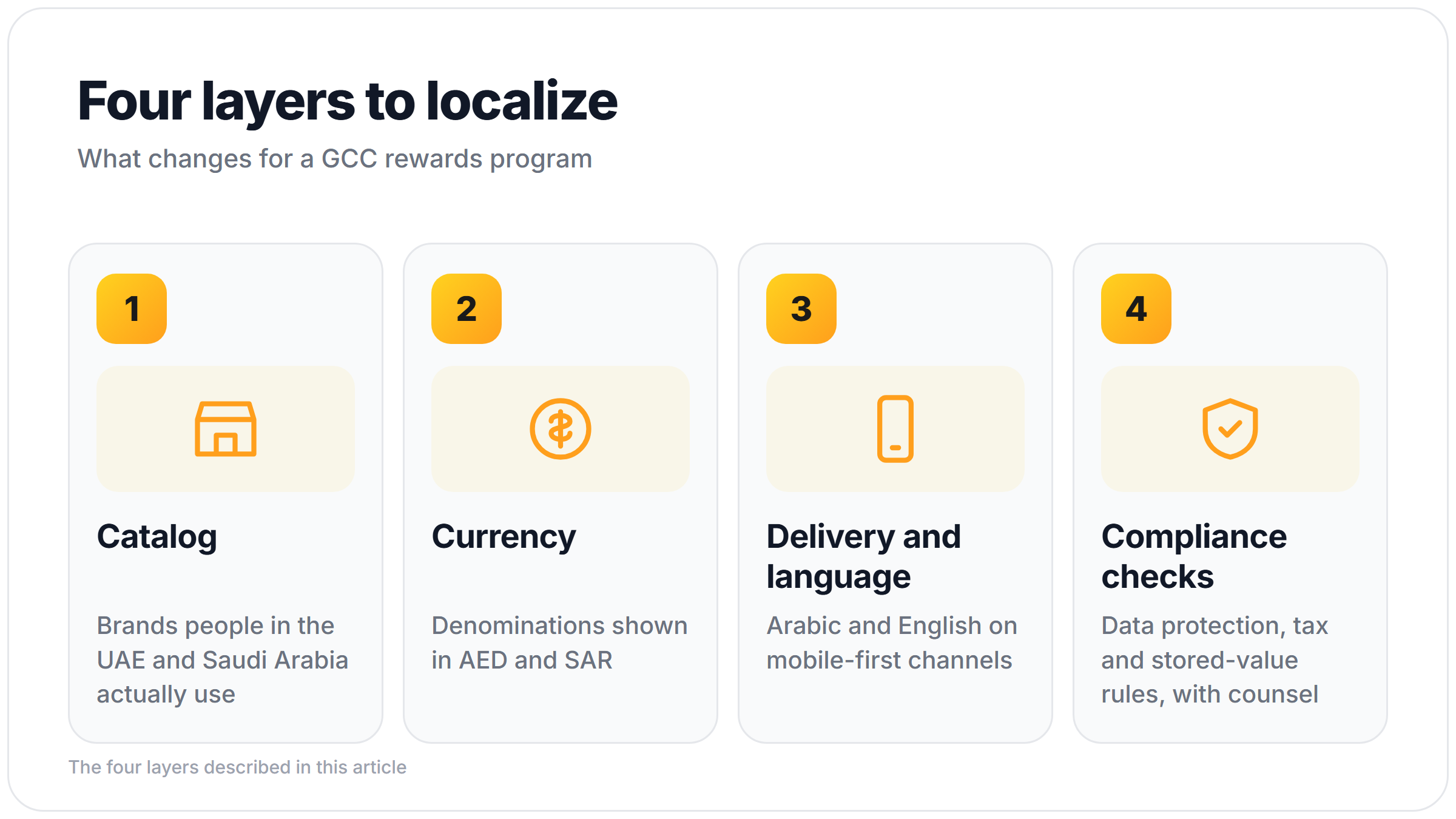
Your rewards platform works well in North America and Europe, and now a client wants the same employee or customer program in Dubai and Riyadh. The question is what has to change for a reward to feel local in the Gulf, and what you can keep from your existing setup. In many cases the API and the program logic can carry over with little change. The parts that need rework are the catalog, how currency and denominations are shown, the delivery channels, the calendar and a short list of compliance checks.
In short: A GCC digital rewards program needs four things localized: a catalog of brands people in the UAE and Saudi Arabia actually use, denominations shown in AED and SAR, delivery and messaging in both Arabic and English on mobile-first channels, and a compliance review covering data protection, tax treatment and stored-value rules in each country. Your reward logic, approval workflows and reporting can usually stay the same. Platforms that treat the GCC as one uniform market tend to run into problems, because the UAE and Saudi Arabia differ in language mix, workweek, regulation and how recipients prefer to redeem.
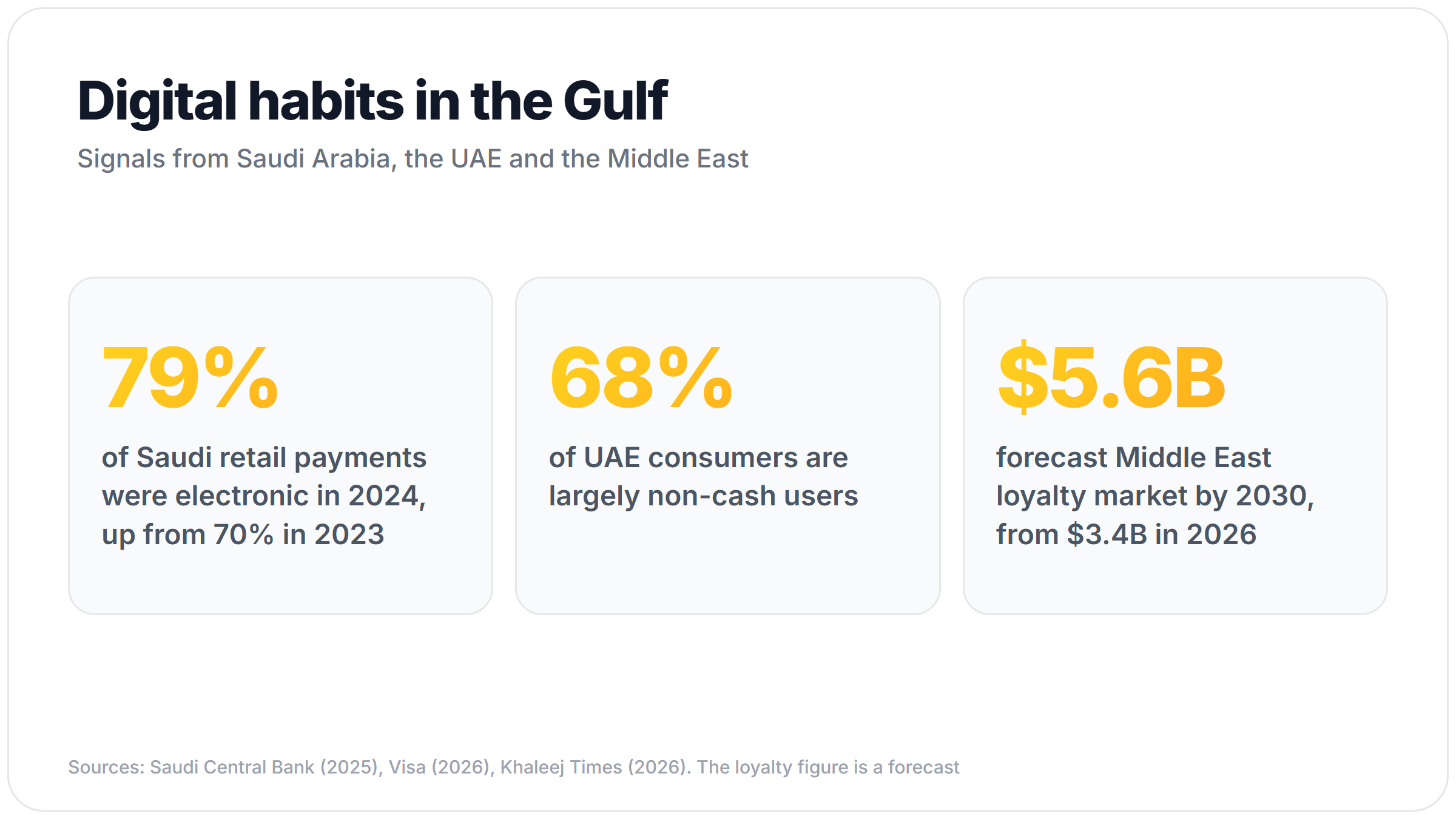
Both demand and payment habits are pushing in the same direction. On demand, the Middle East loyalty market is forecast to grow from USD 3.4 billion in 2026 to USD 5.6 billion by 2030, an annual growth rate of 12.8 percent, with the UAE forecast at USD 592.4 million and Saudi Arabia at USD 1.27 billion by 2030 (Khaleej Times, Middle East loyalty market set to hit $5.6 billion as firms chase retention, 2026). The article does not say who produced the forecast and it is not measured spend, so use it as a signal of direction and do not build a business case on it alone.
Payment habits back up the forecast. In Saudi Arabia, electronic payments made up 79 percent of total retail payments in 2024, up from 70 percent in 2023, according to the Saudi Central Bank (SAMA, E-Payments Account for 79% of Total Retail Payments in 2024, 2025). When most everyday spending in a market is already digital, a code-based reward is no longer a novelty and simply fits how people pay.
The UAE shows the same pattern. Visa's third "Where Cash Hides" study found that 68 percent of UAE consumers are largely non-cash users. Salima Gutieva, Visa's VP and Country Manager for the UAE, said that "this year's findings highlight a clear shift in consumer spending habits, with digital payments continuing to gain ground across everyday transactions" (Visa, Mobile Payments on the Rise, Cash Continues to Decrease, 2026). For a rewards product lead, this means recipients in both markets expect to receive a reward on their phone and spend it right away.
A catalog filled with global brands looks impressive on a sales slide, but redemption depends on whether recipients use those brands in their daily lives. In the GCC, the brands that drive redemption usually include regional supermarket and hypermarket chains, food delivery apps, coffee and quick-service restaurants, fashion and electronics retailers, and entertainment. Several categories have a strong regional or country-specific player that a global-only catalog will not include.
When you build the GCC catalog, check the following:
We explore this "global reach, local relevance" problem in more depth in The Future of Global Gift Cards Is Local.
The UAE dirham and the Saudi riyal are both pegged to the US dollar, so FX volatility is less of a worry than in many emerging markets. The display layer still matters. Recipients should see AED or SAR denominations that match how local brands sell their cards. Odd converted amounts make a reward look foreign. For example, a hypothetical USD 50 reward works out to roughly AED 184 or SAR 188, while local brands often sell round denominations, so you have to decide whether to round up, round down or let the program set local amounts directly.
Practical decisions to make early:
Mobile comes first in the Gulf. Email delivery still works for many corporate programs, but recipients increasingly expect to get a reward on their phone, through SMS, a messaging app or inside the client's own app. Check which channels your client is permitted to use for business messages in each country, and whether recipients have opted in.
Language deserves more attention than it usually gets. Arabic and English are both widely used, and an Arabic reward message needs proper right-to-left layout, not a machine-translated string dropped into a left-to-right template. Test the following in both languages:
Timing matters too. Workweeks and public holidays differ between GCC countries, and a reward sent at midnight local time, or on the first day of Eid when support desks are closed, creates avoidable friction. For more on cross-border delivery mechanics, see How Employee Rewards Are Delivered Seamlessly Across Borders.
The compliance list below is general guidance for planning, not legal advice. Rules change, and their details depend on your structure and your client's, so confirm each item with local legal and tax counsel in the UAE and Saudi Arabia before launch.
Wincube Global provides B2B gift card and rewards infrastructure. Wincube has processed over USD 220 million in gift card GMV in 2025 across a catalog of more than 30,000 gift cards spanning over 90 countries, and it is strong in six markets: Taiwan, Japan, the United States, Canada, South Korea and Europe. Brands and delivery terms vary by country, and the Wincube team confirms the details for your markets. For platforms expanding into the Gulf, the useful first conversation is which countries, brands and currencies a given client program needs.
A sensible first step is often small. Pick one country, one client program and a short list of high-utility brands, run it through a Ramadan or year-end cycle, and review the results to decide what to expand next. If this is relevant to your team, Contact Us and we can walk through what it would look like.
Partly. Some regional brands redeem in both countries, but many do not, and recipients' preferences differ. Map availability by country and present each recipient only with brands they can actually use.
For customer-facing programs and many employee programs, offering both Arabic and English is the safer default. Arabic content should use proper right-to-left layouts and be checked by a native speaker, especially on the mobile redemption page.
Confirm data protection handling, VAT and any employee-reward reporting implications, how expiry terms are disclosed, and whether your model falls under local stored-value rules. Treat this as a checklist to review with local legal and tax counsel, not a substitute for their advice.
Sources