Digital Gift Cards
Global Gift Cards
CROSS BORDER GIFTCARD
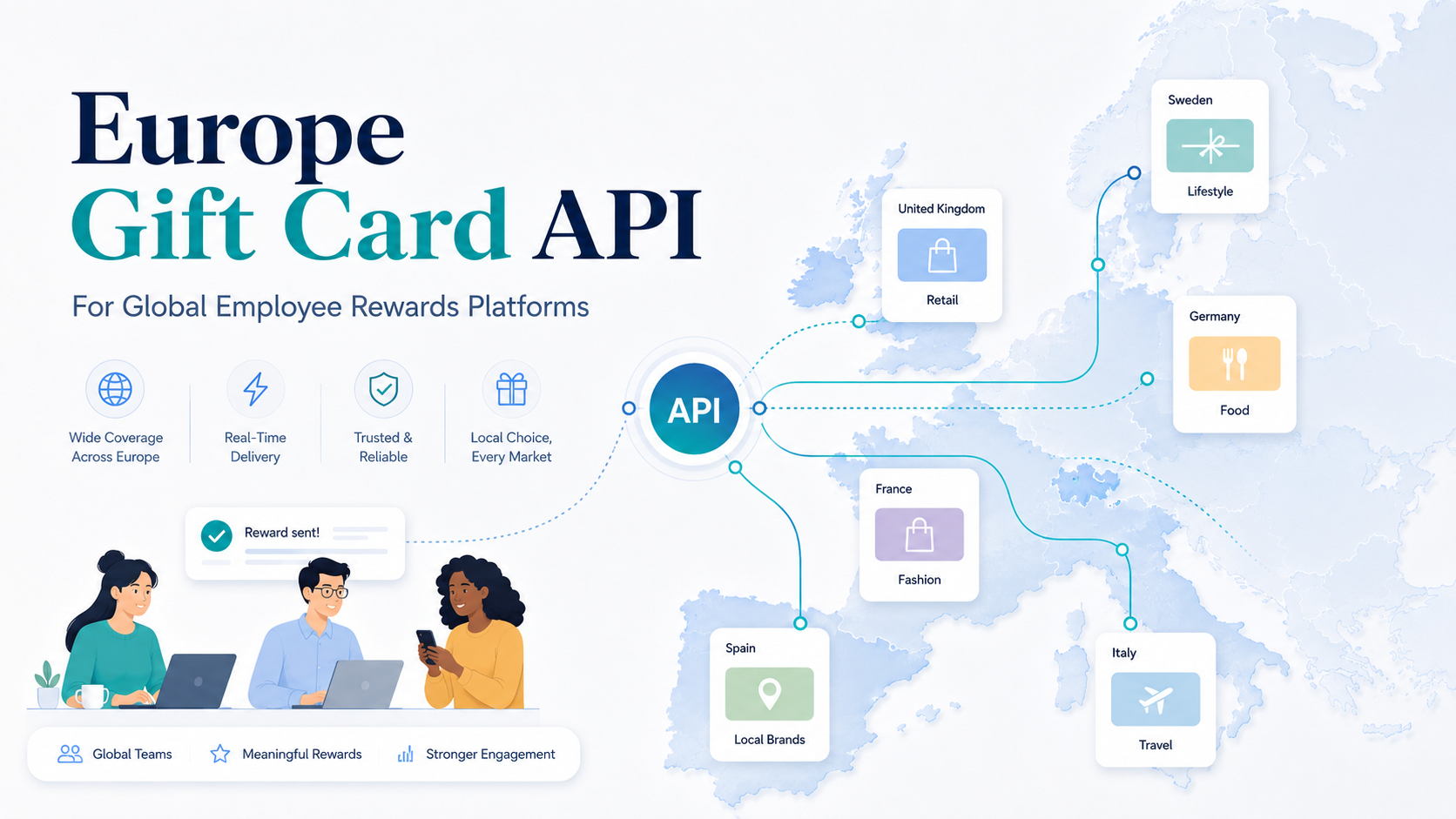

If your employee rewards platform serves recipients in Germany, France, the UK, or anywhere else in Europe, you know the core problem: sourcing locally relevant gift cards at scale — through a single, reliable integration — is harder than it looks. Europe is not one market. It is 30+ distinct retail landscapes, multiple currencies, and a mosaic of regional brands that employees actually want to receive.
The answer is a Europe gift card API: a single programmatic connection that gives your platform access to a curated catalog of European gift card brands, delivered in real time or via bulk fulfillment, without managing a dozen separate supplier relationships. Here is exactly how it works, what to look for in a provider, and how global rewards platforms build European coverage at scale.
📌 TL;DR
Europe's gift card and incentive market reached $79.5 billion in 2025, tracking toward $114.3 billion by 2030 — the B2B segment drives more than two-thirds of all transactions
A gift card API triggers local European gift cards automatically from any reward event; HR platforms and employee benefit programs account for 68% of B2B gift card sales in Europe
54% of employees prefer gift cards over physical gifts, and 80% of European gift cards are redeemed within one month of issuance
Wincube enables API integration and bulk fulfillment across 30,000+ global gift cards in 90+ countries — including deep European and Korean catalog coverage — through one relationship
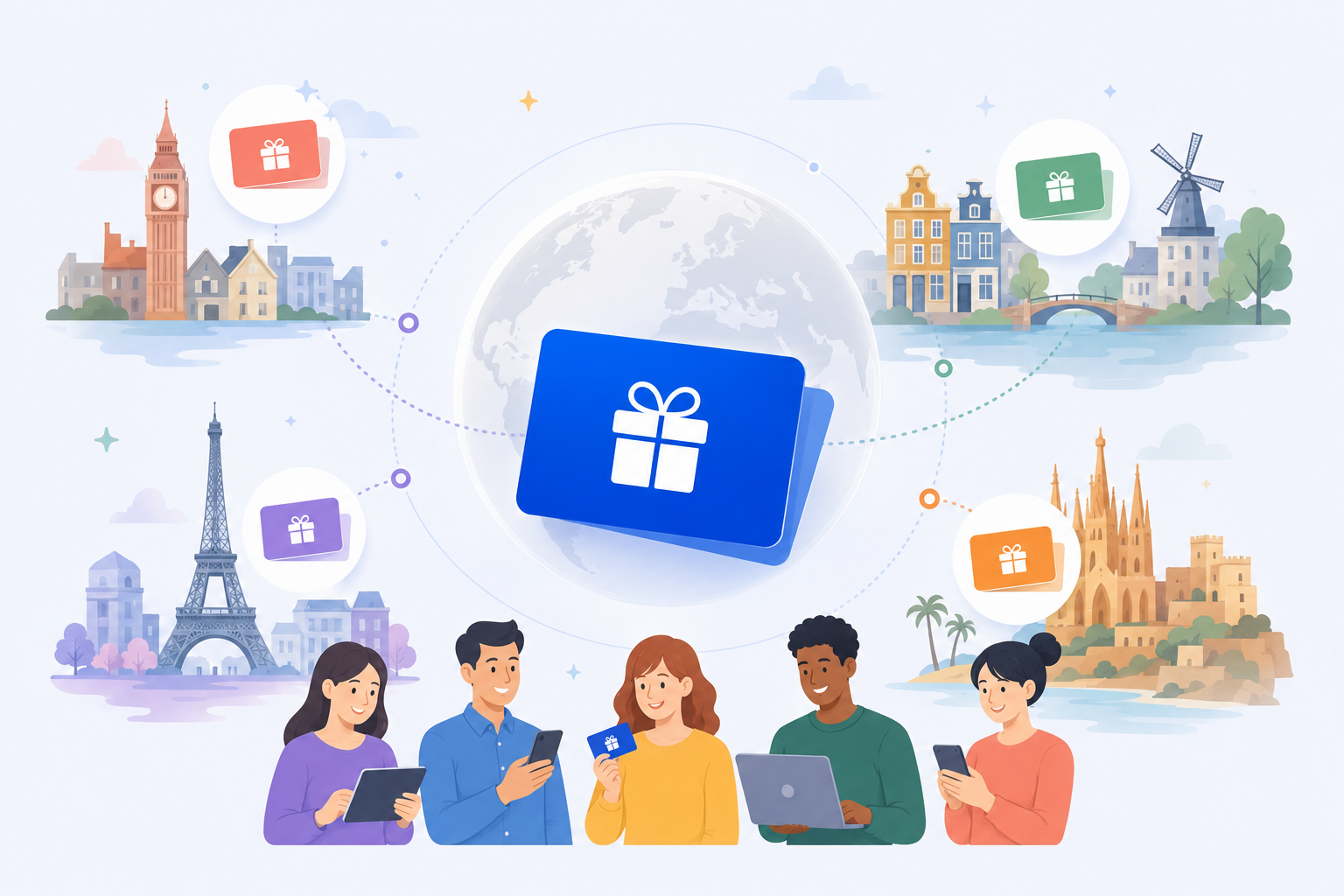
A gift card API is a programmatic interface that connects your rewards platform — HR system, incentive software, loyalty engine — to a fulfillment provider's catalog. When an employee earns a reward, your system sends an API call; the provider delivers a digital gift card to the recipient's inbox or app, typically within minutes.
The Europe-specific version matters because European employees don't want generic reward options. A German employee presented with US-only brands has a poor reward experience — and poor redemption rates make program ROI impossible to defend to HR leadership or finance. The Incentive Research Foundation identifies choice and personalization as the top drivers of reward satisfaction. In a European context, choice means local brands, local language, and denominations matched to local purchasing power.
The scale makes the case clearly. Europe's gift card and incentive market reached $79.5 billion in 2025 and is projected to reach $114.3 billion by 2030, growing at a CAGR of 7.4% (GlobeNewswire, February 2026). The corporate rewards and incentives segment is the fastest-growing slice of that market, with a projected CAGR of 15.8% through 2034. HR platforms and employee benefit programs drive 68% of B2B gift card sales in Europe (ResearchAndMarkets, 2026) — the demand is institutional, not experimental.
Digital cards accelerate the shift further. Within Europe, digital gift cards expand at a 10.78% CAGR — faster than the overall market — driven by mobile-wallet integration, instant delivery, and ESG considerations around physical card waste (ResearchAndMarkets, 2026). European employees don't wait two days for a card in the mail. They expect a reward in their inbox the moment it is earned.
Two delivery models cover every program type. Real-time API integration fires individual gift cards automatically when a milestone event triggers — a performance review, a peer recognition, a sales close. Bulk fulfillment handles campaign launches and large-volume distributions: submit a recipient list, receive a batch of codes at enterprise scale. Most programs use both, depending on the campaign structure.
A Europe gift card API is the infrastructure layer that makes multi-country reward programs operationally sustainable. Not a feature — a prerequisite for any platform running European programs at scale.
The value of any gift card API is its catalog. Here is how European coverage breaks down by country and category — and what genuine catalog depth looks like in practice.
United Kingdom: Amazon UK, ASOS, Marks & Spencer, John Lewis, Currys, Deliveroo, Uber Eats UK, Google Play UK, Spotify UK, iTunes UK. The UK is Europe's largest individual gift card market and requires UK-specific brand versions — an Amazon.de voucher is not a valid UK reward and will be rejected at checkout.
Germany, Austria, Switzerland (DACH): Amazon.de, Zalando, REWE, dm-drogerie markt, MediaMarkt, eBay Germany, Spotify Germany, Steam. DACH is the second-largest European gift card market by value and has distinct brand preferences from the UK and France — Zalando in Germany is a stronger preference than ASOS.
France: Amazon FR, Carrefour, Fnac, Decathlon, Netflix France, H&M. France's retail landscape centers on national chains not found elsewhere in Europe. Fnac is a particularly strong reward preference for French knowledge workers across tech and professional services.
Netherlands and Belgium: bol.com, Albert Heijn, IKEA Netherlands, Coolblue. Dutch and Belgian recipients have strong preferences for local platforms — bol.com is the dominant e-commerce brand in the Benelux region and outperforms Amazon in recipient preference surveys.
Spain and Italy: Amazon ES/IT, El Corte Inglés, Zara, MediaMarkt Spain, Esselunga. Southern Europe is an underserved market for many global rewards platforms. Providers that carry Spanish and Italian brands expand your program's addressable European employee population.
Pan-European brands fill the gaps: Spotify (multi-region), Google Play (multi-region), Netflix, Airbnb, Booking.com, Adidas, Nike, IKEA, and Uber are available across multiple European countries and serve as reliable fallback options when country-specific brands are not available for a particular recipient location.
Open-loop prepaid cards — Visa and Mastercard gift cards — are the universal fallback for recipients who want spending flexibility across any retailer. These work throughout Europe without restriction and are particularly useful for multi-country programs where predicting recipient preferences per country is impractical.
The evaluation question to ask any API provider: is the catalog deep in the specific countries your employees are in? A provider listing "European coverage" while offering only Amazon and Netflix per market will underperform. Always request a country-by-country catalog export before committing to an integration.
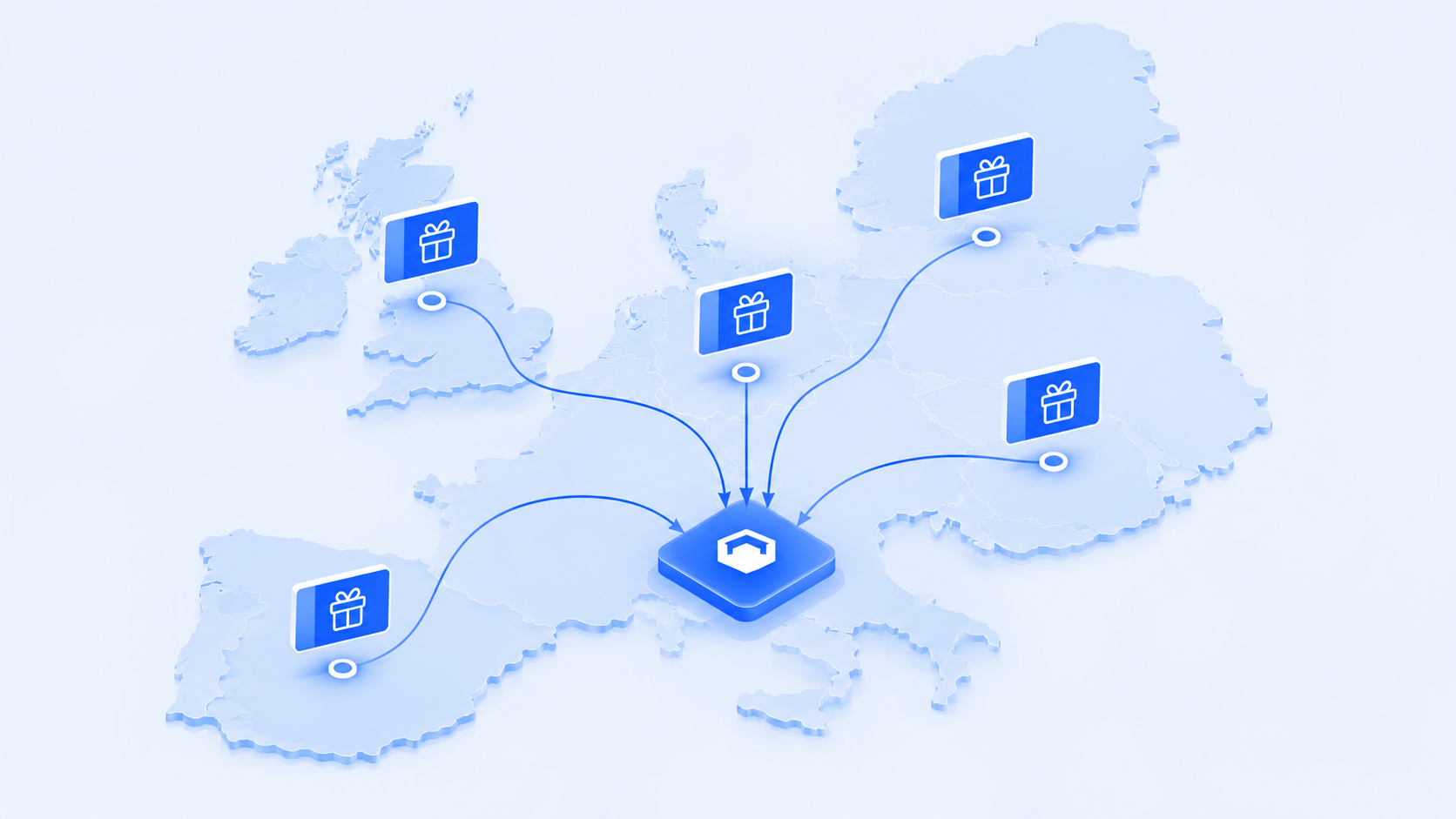
Gift card API integration follows a consistent pattern across providers. Understanding each step helps your engineering team scope the work correctly before committing to a provider contract.
Step 1: Credentials and sandbox access. You receive an API key and access to a test environment. In sandbox, you simulate orders, test denomination options, and validate delivery flows — without issuing real gift cards. A well-documented sandbox with realistic test data is the clearest signal of a provider's overall API quality and long-term developer experience.
Step 2: Catalog query. Your system calls a catalog endpoint to retrieve available brands, countries, denominations, and delivery methods. This list updates dynamically as the provider adds new brands. Filter by recipient_country to return only brands valid in the recipient's location — this prevents the most common UX failure in multi-country programs: presenting a recipient with brands they can't actually redeem.
Step 3: Order placement. When a reward event fires, your system places an order: brand ID, denomination, recipient email, delivery language, and country code. The API returns an order ID and delivery confirmation. The response structure should include a fulfillment status field and an estimated delivery timestamp.
Step 4: Real-time fulfillment. For real-time integrations, delivery is typically instant or within minutes. The recipient receives a digital gift card — a redemption code plus localized instructions — via email or app notification. Localization matters: a German-language delivery email for a German recipient produces higher redemption rates than an English-only template sent globally.
Step 5: Webhook notifications. Modern gift card APIs support webhooks that notify your system when a card is delivered, opened, or flagged for a delivery failure. This closes the reporting loop without polling and removes manual follow-up from your ops team. Webhook support is non-negotiable for production-grade reward programs — confirm it before proceeding with any provider evaluation.
Bulk fulfillment as a parallel track. For campaign launches or large-volume incentive programs, bulk fulfillment is more efficient than per-event API calls. Submit a recipient file; the provider processes and delivers at enterprise scale. The average B2B gift card order in Europe reached €16,000 in 2025 (ResearchAndMarkets, 2026). Bulk fulfillment handles that volume without per-call overhead.
Platforms that integrate both delivery modes — real-time API for individual milestone events, bulk fulfillment for campaign launches — cover every reward program type without additional infrastructure or supplier relationships.
Five structural challenges consistently surface when global rewards platforms build out European gift card sourcing — and each one compounds as your European employee base grows.
Supplier fragmentation. Most European gift card catalogs are regional. A platform covering UK, DACH, and Southern Europe typically manages multiple supplier contracts — each with separate procurement terms, invoicing cycles, and technical integrations. Every additional supplier multiplies reconciliation burden and vendor management overhead. A single-API approach collapses this into one relationship: one contract, one technical spec, one monthly invoice.
Currency complexity. The UK operates in GBP. Switzerland in CHF. Norway and Sweden in NOK and SEK. Most EU members use EUR, but denomination structures still vary by brand and country. An API that handles currency conversion at the transaction level — so your platform invoices in one base currency while recipients receive local-currency cards — removes a significant burden from your engineering and finance teams and eliminates FX reconciliation from your monthly close process.
Redemption relevance at the country level. 54% of employees prefer gift cards over physical gifts (Rewordin, 2026) — but preference converts to satisfaction only when the brands are relevant to the recipient's location. A UK employee receiving an Amazon.de voucher — the German-market product — cannot use it at a UK checkout. Catalog routing by country is not optional infrastructure; it is the difference between a rewards program that drives engagement and one that generates HR support tickets.
Delivery reliability under fast spend cycles. 80% of European gift cards are redeemed within one month of issuance (ResearchAndMarkets, 2026). That rapid cycle means delivery failures surface within days, not quarters. Any delay, expired code, or wrong denomination becomes an HR incident almost immediately. Providers with documented uptime SLAs and idempotency key support — which prevents duplicate orders from retry logic — reduce this failure surface meaningfully.
GDPR and data residency. Sending recipient personal data to a gift card fulfillment provider triggers GDPR obligations under a data processor relationship. Verify that your API provider processes European recipient data within GDPR-compliant infrastructure and provides a current Data Processing Agreement (DPA). This is a procurement requirement for most enterprise HR teams in Europe, not an optional extra to negotiate post-launch.
These five challenges explain why global platforms consistently consolidate on a single multi-country API provider rather than maintaining fragmented regional relationships — the operational savings compound as European headcount scales.
Running a reward program across multiple European countries through a single API integration requires the provider to handle three layers of operational complexity on your behalf — not your engineering team's.
Catalog routing by recipient country. The API accepts a recipient country parameter and returns only brands available and valid in that location. A German recipient sees German brands; a UK recipient sees UK brands; a French recipient sees French brands. This routing eliminates the most common UX failure in multi-country programs — presenting recipients with brands they cannot redeem where they live. Without country-level routing built into the API, your engineering team builds and maintains that logic manually, which creates a permanent maintenance burden as your European employee population grows.
Denomination alignment per country and brand. Denomination structures vary by market. Amazon.de gift cards run in EUR increments; Amazon UK cards run in GBP increments; Spotify cards vary by country. Your API provider should expose denomination ranges via catalog metadata, so your platform surfaces correct options at the point of reward selection — without your team maintaining a manual denomination lookup table per country and brand.
Single billing with multi-currency delivery. Even when rewards go to recipients in GBP, EUR, CHF, and SEK, your platform pays one invoice — typically in USD or your base operating currency — with the provider handling foreign exchange at the transaction level. This removes multi-currency treasury management from your accounts payable process and simplifies monthly reconciliation significantly. A fragmented supplier model requires separate invoices per region, each in local currency, which creates FX exposure and AP overhead that scales poorly.
Localized recipient delivery. Email delivery templates should localize by recipient country. German recipients receive German-language delivery instructions; French recipients receive French; UK recipients receive English. This affects redemption rates directly. Recipients who receive English-only instructions for local-language brands redeem at lower rates, which degrades program ROI and increases reward-related support volume from your HR team.
Consolidated cross-country reporting. Program managers need visibility across all European markets in one view: total spend by country, redemption rate by brand, unfulfilled orders flagged for follow-up. A provider that requires separate logins or separate reports per region creates administrative burden that scales poorly as your European employee headcount grows.
Corporate gift cards account for approximately 78.3% of European gift card market volume (ResearchAndMarkets, 2025). At that scale, operational simplicity — one integration, one billing relationship, one reporting view — is a prerequisite for sustainable program management.
Evaluate European gift card API providers against these eight criteria before committing to an integration. Most providers excel at two or three of these — and fall short on the rest.
1. Country-level catalog depth, not headline coverage. "90 countries" means nothing without verifiable depth in your specific target markets. Request a catalog export for your top five European countries. Count the brands. Verify that listed brands are the correct country-specific versions — Amazon UK and Amazon.de are separate products with separate redemption flows.
2. Both real-time API and bulk fulfillment. Programs need both delivery models. Real-time API for individual milestone events; bulk fulfillment for campaign launches and large-volume distributions. A provider that supports only one model creates operational gaps for the other use case.
3. Documented uptime SLA. Require a written SLA at 99.9% uptime minimum for production API endpoints. Gift card delivery is time-sensitive — a two-hour outage during an active reward cycle is an immediate HR incident that reflects on your platform's reliability.
4. Idempotency key support. Retry logic in distributed systems creates duplicate order risk. An API that accepts idempotency keys ensures retried requests don't result in double-issued cards. This is table stakes for enterprise-grade infrastructure and should be documented in the API reference before you integrate.
5. Webhook delivery notifications. Webhooks that fire on delivery confirmation, open events, and failure states close the reporting loop without polling. Confirm that webhooks are available and fully documented before proceeding with any provider evaluation.
6. GDPR-compliant data handling. The provider processes recipient PII on your behalf. Confirm they offer a current Data Processing Agreement, process EU recipient data in GDPR-compliant infrastructure, and have a documented data retention policy that satisfies your legal team's requirements.
7. Multi-language recipient delivery. Verify the provider localizes delivery emails by country — not a single English-language template sent to all recipients globally. Localization directly affects redemption rates in non-English-speaking markets across the continent.
8. Dedicated account support. With average B2B orders at €16,000 per transaction in Europe (ResearchAndMarkets, 2026), your program warrants a named account contact — not a general support ticket queue. Confirm the support model before signing any contract.
Use this list as a structured scorecard. Gaps in any of these criteria translate directly to operational friction, recipient dissatisfaction, or compliance exposure post-launch.
Global rewards platforms face a structural choice: assemble a patchwork of regional suppliers to cover Europe, North America, and Asia separately — or find one provider with verified multi-region depth and reduce the relationship count to one.
Wincube is a B2B digital gift card infrastructure provider operating since 2011, headquartered in Seoul, South Korea, with a U.S. branch in Delaware. In 2025, Wincube processed 220M+ GMV in 2025 across a catalog of 30,000+ global gift cards in 90+ countries, operating 100+ gift shops globally.
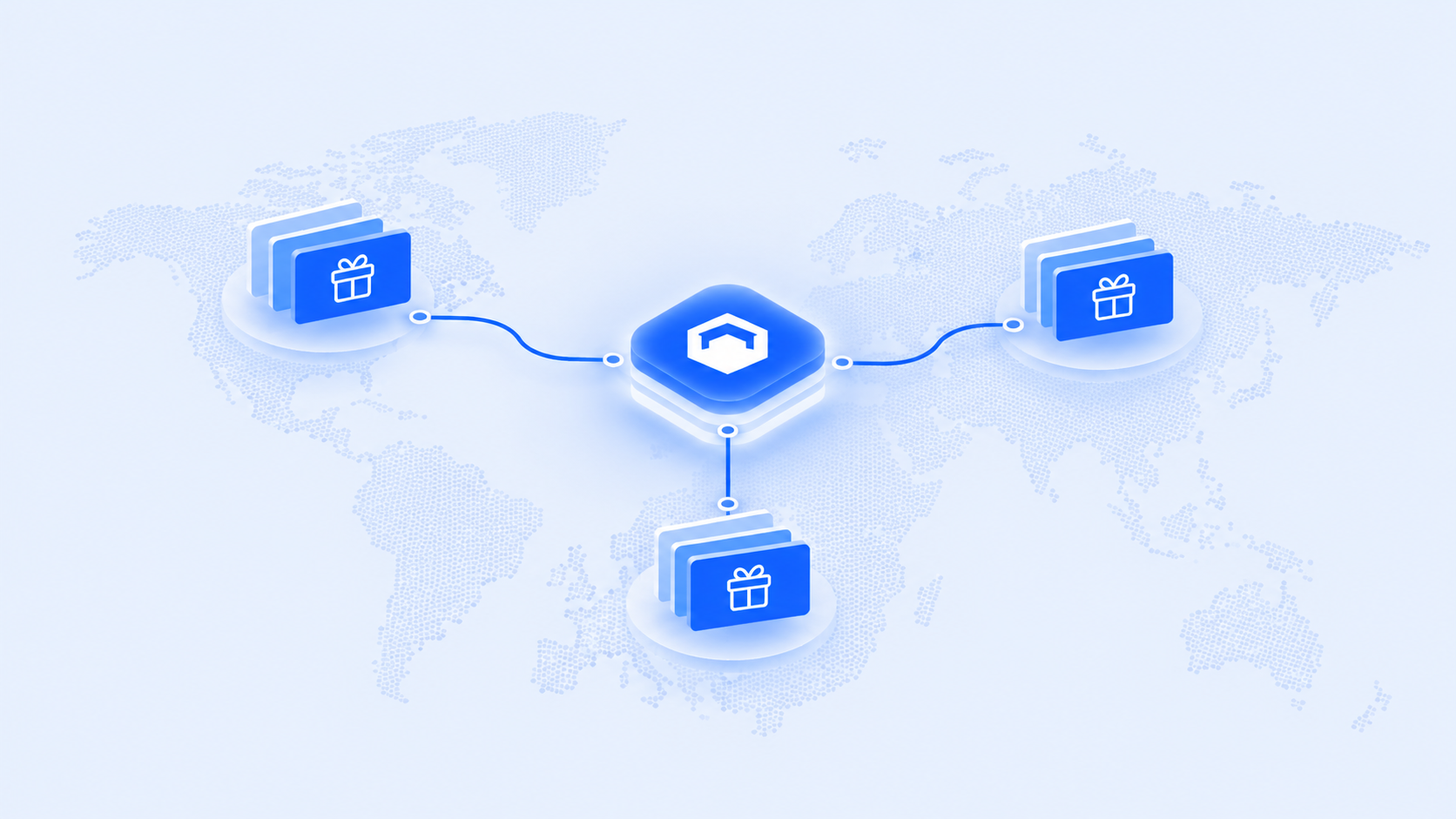
For platforms serving both European and non-European employees, Wincube's dual-catalog structure is the operational differentiator. The Global Catalog covers international brands — Amazon (by country), Starbucks, Uber, Visa, Mastercard, Google Play, Airbnb — available country-by-country across Europe and North America. The Korean Catalog covers Naver Pay, Coupang, Baemin (배달의민족), Shinsegae, Culture Land, Emart, and Olive Young — brands that no Western generalist API provider carries at operational depth.
That combination matters for global enterprises. A rewards platform serving teams in London, Frankfurt, New York, and Seoul runs one Wincube integration and covers all four markets — without separate supplier contracts per region. Most international competitors list Korea as "one of 90 countries." Wincube's Korean catalog reflects genuine operational depth, built over 15 years serving Korean enterprises and global clients with Korean recipient bases.
Two delivery models cover every program type. API integration delivers individual gift cards in real time, triggered directly from your platform when a reward event fires. Bulk fulfillment handles large-volume distributions and campaign launches at enterprise scale. Both are available through a single integration relationship.
For global rewards platforms that need European catalog depth, US coverage, and access to Korean and APAC recipients — through one operational relationship — Wincube eliminates the fragmented supplier model entirely. To explore what API integration or bulk fulfillment looks like for your European reward program, get in touch with the Wincube team directly.
If this is relevant to your team, Contact Us and we can walk through what it would look like.
A Europe gift card API is a programmatic connection between a rewards platform and a fulfillment provider's catalog of European gift card brands. When a reward event fires in your system, the API delivers a localized digital gift card to the recipient's inbox within minutes — without manual fulfillment or regional supplier management.
Integration timelines depend on your platform's existing architecture, but most gift card API integrations follow a standard REST API pattern and complete in days to weeks, not months. A provider with a well-documented sandbox environment and clear API references reduces integration time significantly. Bulk fulfillment setups — which require no API integration at all — are operational from day one.
A single API integration covers multiple European countries when the provider's catalog includes country-specific brands across your target markets. The critical variable is catalog depth per country — not headline coverage claims. Verify country-level brand lists before committing to any provider. Request a catalog export for your top five European markets and count the brands per country.
Denominations vary by brand and country. In Europe, most retail gift cards are available in increments from €5 to €250 (or the local currency equivalent — GBP, CHF, SEK, NOK). Open-loop Visa and Mastercard prepaid options typically offer wider denomination ranges for recipients who prefer spending flexibility rather than a specific retailer.
Gift card API providers process recipient personal data (name, email, country) on your platform's behalf, which triggers a GDPR data processor relationship. Require your provider to supply a current Data Processing Agreement, confirm GDPR-compliant data residency for EU recipient data, and review their data retention policy before going live. This requirement applies regardless of where your company is headquartered.
These are two distinct delivery models. A real-time gift card API triggers individual cards automatically when a reward event fires — a milestone, a recognition, a performance review. Bulk fulfillment is a batch process: submit a recipient list and the provider processes and delivers cards at scale, on a schedule. Enterprise rewards programs use both, depending on whether the program type requires individual event-based delivery or scheduled campaign distribution.
Europe's gift card and incentive market is a $79.5 billion infrastructure opportunity growing at 7.4% annually — and the corporate rewards segment outpaces the overall market at 15.8% CAGR through 2034. The platforms that connect to reliable, multi-country European gift card API infrastructure now build the operational capacity to serve that growth. Platforms that delay play catch-up against competitors who are already integrated.
The decision framework is straightforward. Evaluate any provider against the eight criteria in this guide: country-level catalog depth, dual delivery models, uptime SLA, idempotency support, webhooks, GDPR compliance, localized delivery, and dedicated account support. Any provider that clears all eight criteria is a strong candidate. Most fall short on catalog depth or compliance documentation.
For platforms that also need US coverage and Korean gift card access — for global employee reward programs that span multiple regions in a single workflow — a single provider covering all three markets eliminates the fragmented supplier model entirely. Wincube has delivered that for enterprises running global reward programs since 2011, processing 220M+ GMV in 2025 across 30,000+ cards in 90+ countries.
To explore what European gift card API integration looks like for your platform's specific use case, get in touch with Wincube's team directly.
Related reading: Unified Cross-Border Rewards: Scaling Employee Gift Cards Globally
Contact Email : win-obdteam@wincubemkt.com