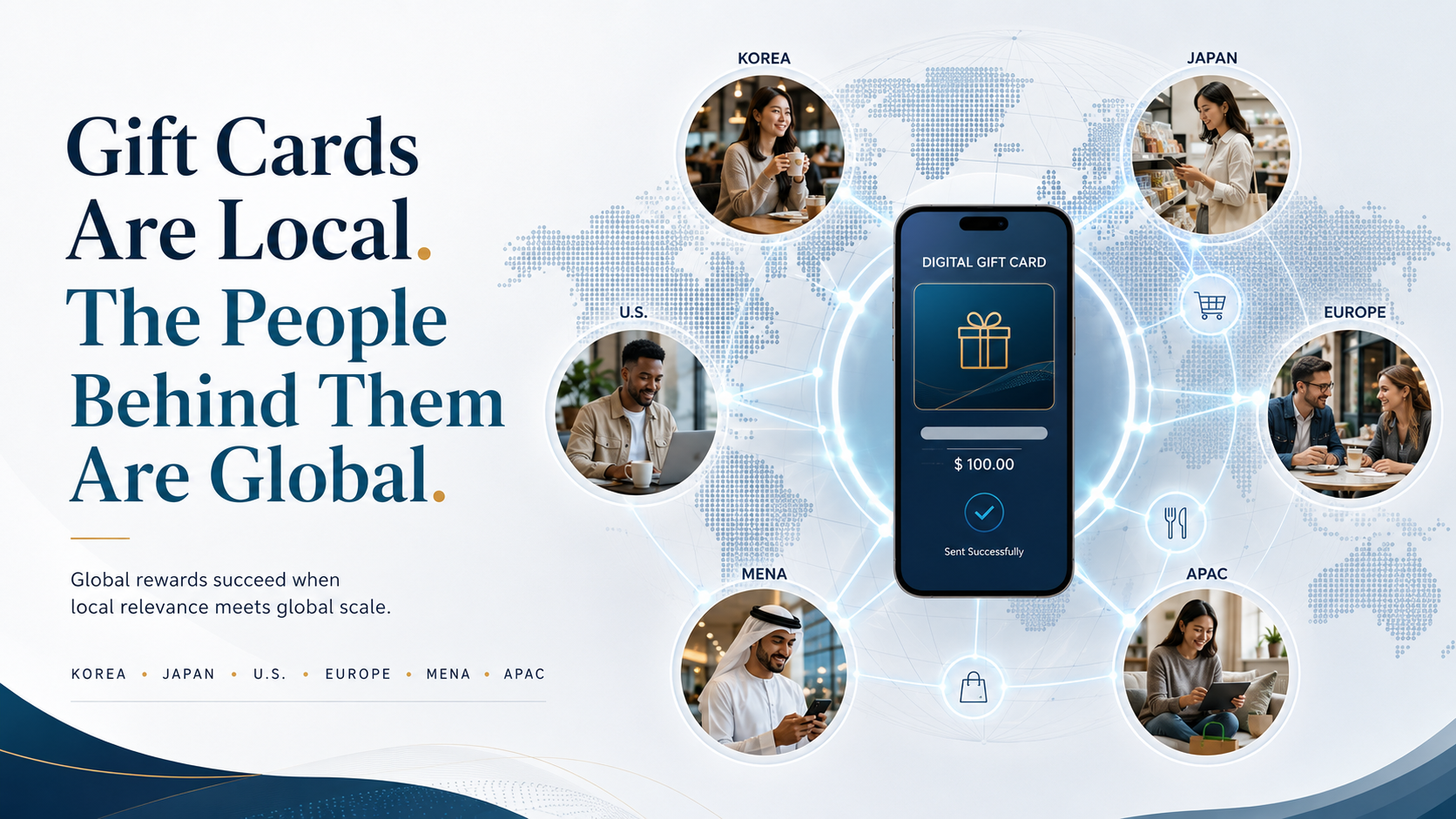

In the global gift card industry, one idea is often misunderstood.
People sometimes imagine that a “global gift card business” means one card, one balance, one product that works everywhere. But the real market does not work that way.
Gift cards are local by design.
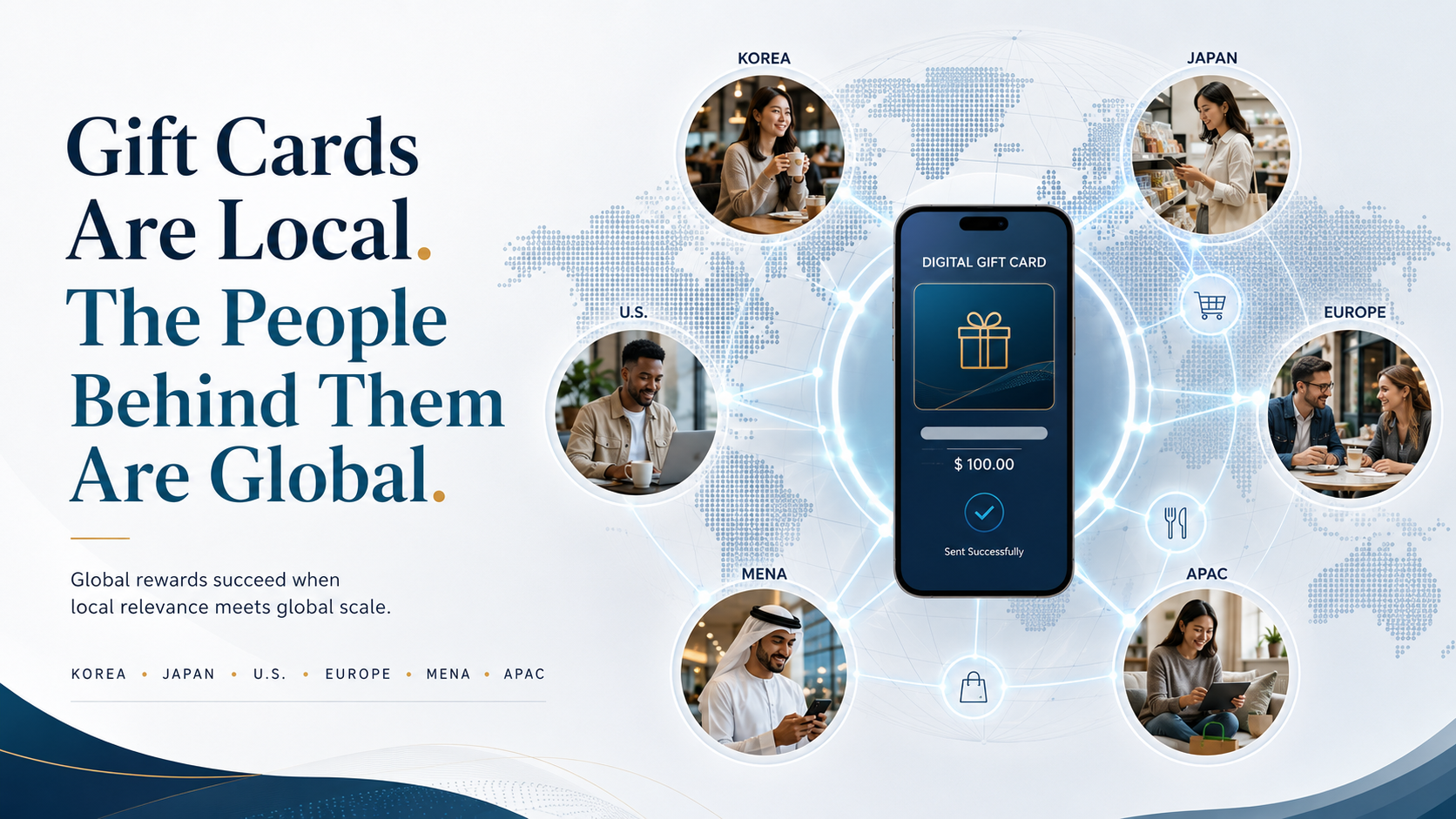
A coffee gift card works where that coffee brand operates. A supermarket gift card follows local currency, local tax rules, local redemption policies, and local customer behavior. A digital retail gift card may depend on a regional online account, a specific currency, or a country-based checkout system. Offline redemption may require POS integration. Online redemption may be shaped by the brand’s local policy.
In other words, the gift card itself is usually local.
But the people who buy, send, receive, and use gift cards are no longer living within one simple market boundary.
Global companies now hire across countries. Teams are spread across Korea, Japan, the United States, Europe, MENA, APAC, and beyond. Employees work for international companies while still living deeply local lives. They have family in one country, colleagues in another, business partners in another, and friends across several markets.
The product is local.
The relationship is global.
That is the real opportunity.
A company in the United States may want to reward an employee in Korea. A Korean company may want to send appreciation to a partner in Japan. A global platform may need to run a campaign for users across Southeast Asia, Europe, and the Middle East. An employee living abroad may want to send a familiar local brand to a family member back home.
In each case, the question is not simply, “Can we send a gift card?”
The better question is, “Can we send something that actually makes sense in the recipient’s local life?”
This is where digital gift cards become much more than a convenient delivery format. They become a bridge between global organizations and local daily life.
A physical gift can be slow, expensive, and difficult to ship across borders. Cash can feel impersonal, operationally complex, or legally sensitive depending on the market. A generic global reward may be easy to send, but not always meaningful to receive.
A local digital gift card is different.
It can be delivered instantly. It can match the recipient’s country, currency, preferred brand, and real purchasing habits. It can be used in the places where people already shop, eat, travel, order, subscribe, and spend their everyday time.
That is why the value of a gift card is not only in its monetary amount.
Its real value is in relevance.
For B2B reward programs, this matters more than ever.
Employee rewards, sales incentives, customer promotions, loyalty campaigns, partner appreciation, research incentives, and global payout programs all face the same challenge: how do you deliver value across countries without losing local meaning?
A reward that feels useful in Seoul may not feel useful in Tokyo. A brand that works well in the United States may not be the right choice in Dubai. A popular European option may not fit the lifestyle or redemption behavior of users in Southeast Asia.
More countries do not simply mean more SKUs.
They mean more context.
This is why global gift card distribution should not be seen as a catalog business alone. It is becoming a localization business, a reward infrastructure business, and increasingly, a cultural intelligence business.
The strongest global reward programs are not built by ignoring borders. They are built by understanding them.
They understand that Korea is different from Japan. That the United States is different from Europe. That MENA and APAC are not single markets, but complex regions with different payment habits, brand preferences, regulatory environments, and gifting cultures.
The goal is not to make every market look the same.
The goal is to connect each market in a way that feels natural to the people living there.
This is also why gifting remains deeply human, even when delivered through digital infrastructure.
People do not experience rewards as “global distribution.” They experience them as a coffee they can buy after work, groceries they can purchase for their family, a meal they can share, a subscription they enjoy, or a brand they already trust.
People may work globally, but they live locally.
They live in local currencies, local stores, local apps, local holidays, local habits, and local relationships. A reward becomes meaningful when it enters that world naturally.
At WinCube, we see global gift cards not as borderless products, but as locally relevant connections delivered at global scale.
We are preparing to support companies with gift card products across Korea, Japan, the United States, Europe, MENA, APAC, and other key markets. Our focus is to help global businesses deliver the right local value to the right recipient, wherever their employees, customers, partners, or communities may be.
Because the future of global rewards is not one card that claims to work everywhere.
It is the ability to deliver the right local gift, in the right market, at the right moment.
A truly global reward does not erase locality.It respects it.